
When you ask what does and mean on a car title, the short answer is that it joins two owners and usually locks them together for a sale. The word itself is plain English, not slang, and its power comes from the paperwork rule behind it.
You will see it between two names in the owner section. In most states both people must then sign before the car can be sold, gifted, or retitled, though your state may word the rule a little differently.
The Line Behind What Does and Mean on a Car Title
| Title wording | Usual effect on a transfer |
|---|---|
| AND between two names | Both owners sign before a sale moves forward |
| OR between two names | Either owner can sign alone in many states |
| AND/OR between two names | Effect varies by state, so confirm first |
| Slash between two names | Often read as AND in California records |
| No word between two names | Do not guess, since the default can differ |
| Joint tenancy wording added | Survivorship language may change the death path |
| Tenants in common wording added | Each share may pass through an estate |
| AND with a lienholder listed | The lender claim must also be released |
| Three names joined by AND | Every listed owner must sign |
Paperwork Receipts That Show and Doing Its Quiet Joining Job
“Maya Chen and Luis Chen”
Example owner line in a title guide. Two equal owners, and neither name stands alone.
“Jordan Ellis and Priya Ellis”
Example line on a dealer transfer form. A buyer should expect two signatures at handover.
“Sam Rivera and Alex Rivera”
Example line in a private sale checklist. Bring the second owner or a power of attorney.
“Taylor Brooks and Casey Brooks”
Example line in a gift transfer example. A gift still counts as a transfer here.
“Morgan Hale and Riley Hale”
Example line in a refinance worksheet. The lender wanted both owners involved.
“Jamie Ortiz and Drew Ortiz”
Example line in a renewal explainer. Renewal did not change ownership at all.
“Robin Park and Skyler Park”
Example line in an estate planning note. AND alone did not settle the death path.
“Avery Quinn and Jordan Quinn”
Example line in an out of state move guide. The new state wanted both releases first.
“Casey Lee and Morgan Lee”
Example line in a power of attorney explainer. Signing for another owner needed a valid document.
The Signature Split That Decides Your Next Sale
| Sale moment | Signatures usually needed |
|---|---|
| Private sale with AND | Both owners sign the assignment section |
| Private sale with OR | One owner can sign in many states |
| Trade in with AND | Both owners sign, or the dealer may refuse |
| Gift to family with AND | Both owners sign, since a gift transfers ownership |
| Adding a new owner | Both current owners usually sign the application |
| Removing an owner | Both owners usually sign the release |
| Retitle after a move | Both owners sign if AND still applies |
| Power of attorney signing | The appointed signer signs for the absent owner |
| Odometer disclosure alone | One transferor signature is allowed federally |
And or or When Life Changes the Plan
| Life change | How an AND title usually responds |
|---|---|
| One owner moves away | The sale waits for a signature or signing authority |
| One owner refuses to sign | The transfer stalls, and a court order may follow |
| One owner dies, no survivorship wording | The share may pass through probate or an heir process |
| One owner dies, survivorship wording present | The survivor may retitle with agency forms |
| Divorce while both names remain | The decree or signed release may control |
| One owner becomes incapacitated | A power of attorney or court representative may be needed |
| Loan payoff during joint ownership | Both owners still sign a later sale |
| Car is totaled and insured | Check the policy and title together |
| Co-owner cannot be found | Extra proof may be required before any sale |
Counter Moments Where and Slows You Down or Saves You
“Both signatures are required for this transfer.”
Example DMV counter response in a sale guide. The deal waited for the second owner.
“Your co-owner must sign before we can process this.”
Example dealer desk reply in a trade in story. The trade paused for both schedules.
“One signature is enough when the title reads OR.”
Example contrast line in a title explainer. It showed why the connector mattered.
“We cannot accept a title with only one AND signature.”
Example rejection note in a transfer checklist. It saved a buyer from a rejected title.
“Please bring a notarized power of attorney.”
Example agency instruction for an absent owner. The form had to match agency rules.
“The lienholder release is still missing.”
Example follow up message after a joint sale. Both had signed, yet the claim blocked it.
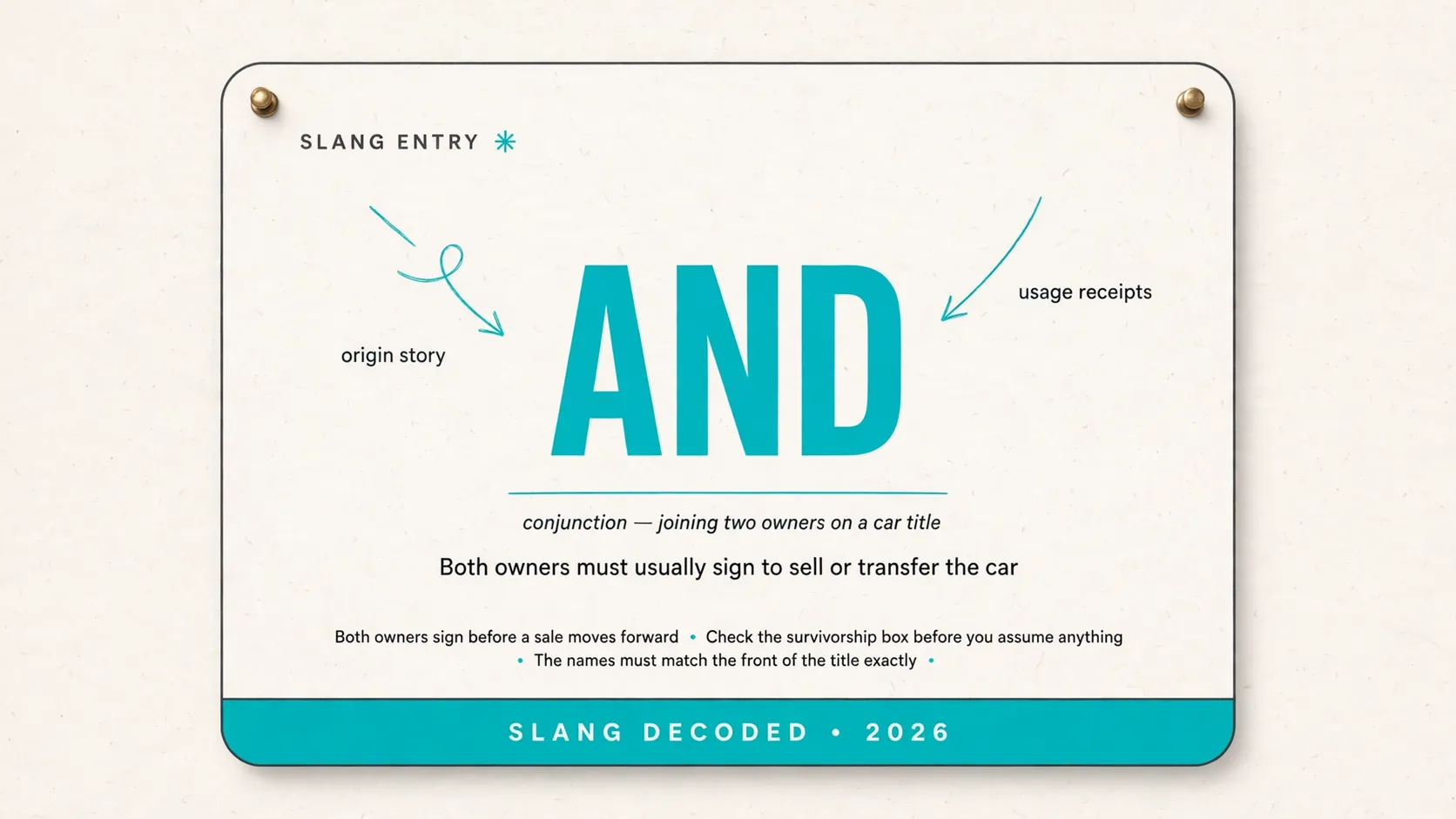
“Check the survivorship box before you assume anything.”
Example warning in a state specific title guide. It mattered where a box replaced the word.
“The names must match the front of the title exactly.”
Example signing tip in a private sale guide. A nickname could slow the transfer.
“Do not sign until the buyer and price details are ready.”
Example caution in a title signing explainer. A rushed signature could confuse joint cases.
Reading the Front of Your Title Like a Checker
| Spot to inspect | What you should notice |
|---|---|
| Owner names | Full legal names matching identification documents |
| Connector word | AND, OR, or AND/OR sets the signing rule |
| Slash mark | A slash can stand in for AND |
| Lienholder box | A lender name means a separate release is needed |
| Vehicle identification number | Number matching the car and sale papers |
| Odometer reading | Current, honest, and consistent across forms |
| Survivorship box or wording | Extra wording can change the death path |
| Spelling of each name | Correct misspellings before a sale, not during one |
| Address on record | Old addresses can delay mailed notices |
Who Else Shows up on the Same Paperwork
| Label on the form | Role in plain terms |
|---|---|
| Co-owner | Second person sharing legal ownership |
| Registered owner | Person named as owner in agency records |
| Legal owner or lienholder | Lender with a claim until payoff |
| Buyer or transferee | Person receiving ownership now |
| Seller or transferor | Person giving up ownership now |
| Lessor | Leasing company retaining an interest |
| Trustee | Person holding the vehicle for a trust |
| Estate representative | Person authorized to act for an estate |
| Authorized representative | Person signing under power of attorney |
State Habits You Cannot Assume from Your Own Title
| State pattern described | What to verify locally |
|---|---|
| California slash habit | Whether a slash counts as AND |
| California OR pattern | Whether OR counts as joint tenancy |
| Texas OR pattern | Whether OR carries survivorship here |
| New York joint tenancy limit | Whether survivorship needs separate wording |
| Florida joint tenancy pattern | Whether joint tenancy is the default |
| Oregon survivorship box | Whether a box replaces the connector word |
| Arizona AND/OR pattern | How AND/OR is read while both live |
| States without AND/OR | Whether AND/OR is offered at all |
| No connector shown | What default the agency applies |
Why a Tiny Word Carries so Much Weight at the Sale Table
You can drive a jointly owned car for years without thinking about the word between the names. The word only turns loud when money, a move, or a disagreement arrives, and by then the title has set the rules. Buyers should read the owner line before paying, and sellers should line up both signatures before promising a date.
The protection cuts both ways, and that trade off is the whole point. AND stops one owner from selling behind the other owner back, yet it also stops a willing owner from closing a fair deal alone. If you value speed above all else, that friction will feel heavy, and if you value a veto, the same friction will feel like safety.
How to Choose and or or Before You Sign the Next Form
Think about the worst ordinary week, not the best one. Ask what should happen if one owner is traveling, unwell, unreachable, or opposed to a sale, and let that answer guide the connector you request. A couple sharing every decision may prize OR, while partners with separate money may prize AND.
People chasing this paperwork question often land on related headwords too, such as pink slip, cosigner, and lienholder, and each one points to a different corner of the same title form. The pink slip is the California nickname for the title itself, a cosigner may back a loan without owning the car, and a lienholder holds a claim that must be cleared. Sorting those roles before you sign keeps a simple AND choice from turning into a tangle later.
What to Do When One Owner Cannot Sign or Will Not Sign
Start with the agency, not with a workaround. Ask which power of attorney form it accepts, whether notarization is required, and whether the absent owner can sign and mail the title. A clean, accepted document beats a rushed signature, and it protects the buyer from a transfer that gets rejected weeks later.
A refusal is a different problem from an absence, and it needs a calmer route. Talk first, keep records of the conversation, and ask the agency or a local attorney what options exist in your state. Do not alter a title, sign for another person without authority, or promise a buyer a clean transfer you cannot deliver.
The Title Is Not the Registration and the Loan Is Not Ownership
Your title proves who owns the car, while your registration proves the car is authorized for road use in your state. The two documents can list different people in some cases, and adding a name to a registration alone does not hand over an ownership share. When you want to change ownership, you change the title, and the registration follows the new record.
A loan adds a third layer, and it is easy to mix up with ownership. The lienholder does not own your car in the everyday sense, but its claim stays on the title until the loan is satisfied and a release is recorded. Both owners on an AND title still need to sign a sale, and the buyer still needs that lien release before the new title is truly clean.
Questions Drivers Keep Asking About and on a Car Title
Does and on a car title mean both owners own half the car? Not necessarily, because the word sets the signing rule and shares depend on state law and extra wording.
Can one owner sell a car when the title says and? No, because both owners usually must sign, and one signature is likely to be rejected.
Does and give the surviving owner the car automatically? Not by itself, because survivorship usually needs extra wording or a state rule that creates it.
Can you change and to or on an existing title? Often yes through a new title application, but both current owners usually must request the change together.
Does the order of names matter when and joins them? Order alone usually does not give the first person stronger rights, because the connector word carries the weight.