
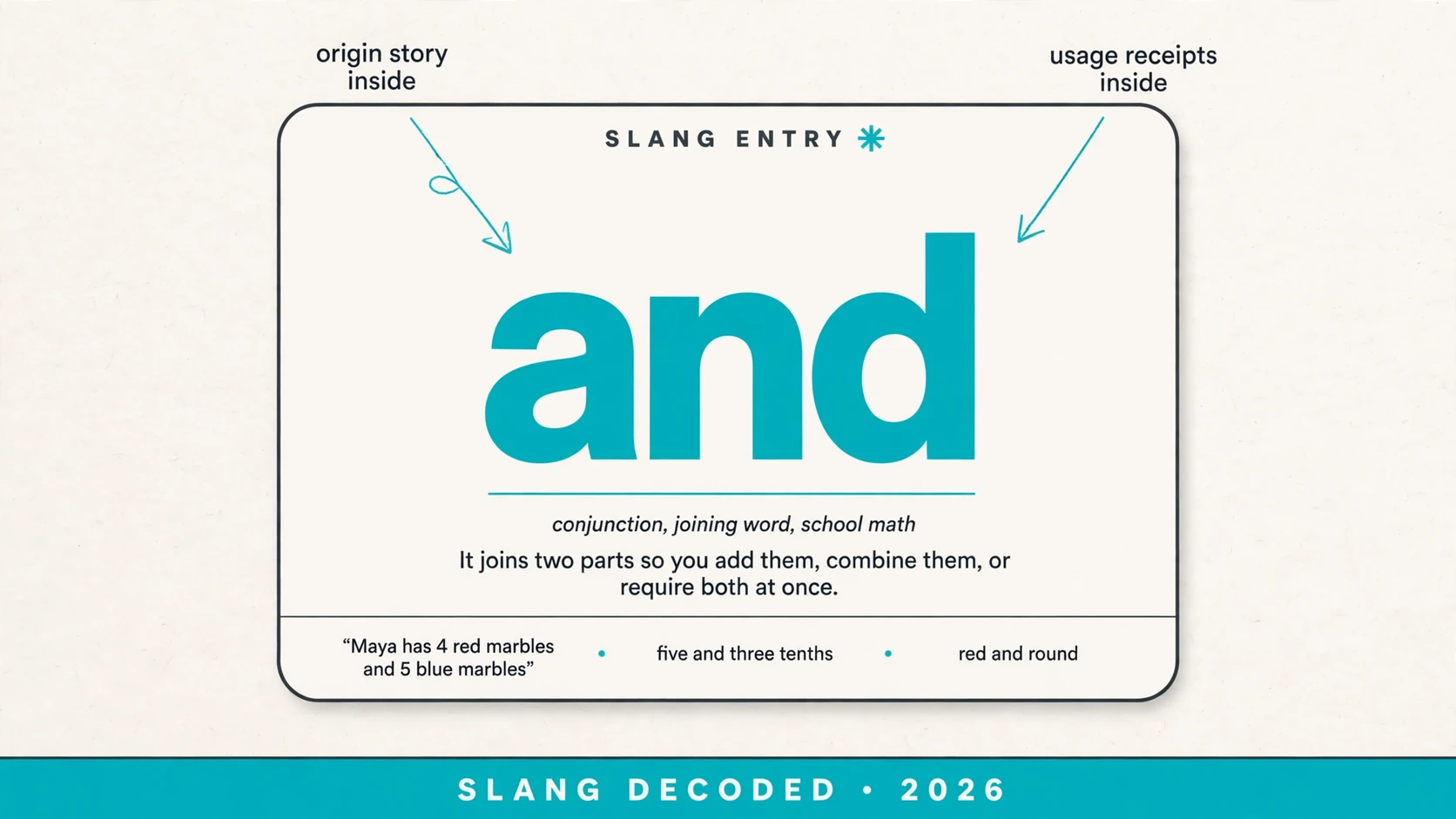
The question what does and mean in a math problem has a short answer, and it joins two parts so you add them, combine them, or require both at once. In most school problems it is a joining word, not a secret code, and the sentence around it tells you which job it is doing.
You do not need a slang dictionary for this one. You need a quick read of the whole sentence, because the same small word can point to a plus sign in one problem and to a stricter both must be true test in another.
What Does and Mean in a Math Problem When Two Amounts Sit Side by Side
| Use in a problem | What and is doing |
|---|---|
| Two groups are named | It joins the groups into one total |
| A whole and a part are named | It joins the part to the whole |
| Two amounts are listed | It joins the amounts before you add |
| Two actions happen together | It joins the actions into one result |
| Two conditions are named | It requires both conditions at once |
| Two sets overlap | It points to the shared overlap only |
| A number is read aloud | It can mark the decimal point |
| A range has two ends | It holds both ends at the same time |
| A story names two owners | It joins what each owner has |
How and Turns into a Plus Sign in Everyday Word Problems
| Wording you might see | Math you write |
|---|---|
| Find the sum of 6 and 9 | 6 plus 9 |
| Maya has 4 pens and 7 pencils | 4 plus 7 |
| Tom scored 12 points and 8 points | 12 plus 8 |
| There are 15 red cards and 10 blue cards | 15 plus 10 |
| Sam saved 20 dollars and 5 dollars | 20 plus 5 |
| A box holds 3 apples and 6 oranges | 3 plus 6 |
| Lily read 9 pages and 11 pages | 9 plus 11 |
| Ben has 2 dogs and 3 cats | 2 plus 3 |
| The class has 18 girls and 14 boys | 18 plus 14 |
Homework Receipts Where and Joins Two Groups into One Total
“Maya has 4 red marbles and 5 blue marbles. How many in all?”
From a homework sheet. One total is asked for, so 4 plus 5 is 9.
“Jake picked 7 strawberries and 6 blueberries. How many berries?”
From a fruit worksheet. The berries are counted apart, then joined for 13.
“There are 12 chairs and 8 tables. How many pieces of furniture?”
From a classroom problem. The question groups them, so 12 plus 8 is 20.
“Sara bought 3 notebooks and 2 folders. How many school supplies?”
From a shopping story. One supply total is wanted, so the answer is 5.
“A farmer has 9 cows and 4 horses. How many animals?”
From a farm exercise. Two kinds of animals are named, and the total is 13.
“Leo scored 10 points and 9 points. How many points in all?”
From a sports problem. The halves stay separate, but the total is 19.
“Emma has 15 stickers and gains 5 more. How many now?”
From an add to problem. The start and new amounts join, so the total is 20.
“A baker made 24 muffins and 18 cupcakes. How many treats?”
From a bakery problem. The batches stay separate, and the total is 42.
“Noah read 8 pages and 12 pages. How many pages in two days?”
From a reading log problem. The days stay separate, then join, so the total is 20.
When and Means Both Must Be True in Probability and Logic
| Situation you might see | What both must hold means |
|---|---|
| A coin shows heads and a die shows 6 | Both happen in the same trial |
| A card is red and a heart | It passes the color test and suit test |
| A number is even and greater than 10 | It passes both tests at once |
| A spinner lands on blue and odd | The result is blue and odd |
| A student passes math and reading | Both subjects are passed, not one |
| A shape has four sides and right angles | Both shape facts are true together |
| A day is sunny and warm | The weather meets both descriptions |
| A bag draw is blue and blue again | The first and second draws are blue |
| A code uses a letter and a number | The code has both kinds of characters |
How and Marks the Decimal Point When You Read a Number Aloud
| Spoken form you might hear | Written form it matches |
|---|---|
| Five and three tenths | 5.3 |
| Two and seven hundredths | 2.07 |
| Nine and four tenths | 9.4 |
| Twelve and sixty five hundredths | 12.65 |
| One and nine hundredths | 1.09 |
| Forty five and six tenths | 45.6 |
| Three and twenty five hundredths | 3.25 |
| Seven and one hundred eight thousandths | 7.108 |
| Zero and five tenths | 0.5 |
Test Style Receipts Where and Narrows the Answer Instead of Widening It
“A number is greater than 4 and less than 9. Which numbers fit?”
From a worksheet about limits. Only numbers above 4 and below 9 count, so 5, 6, 7, and 8 fit.
“Pick a marble that is red and round. Which marbles qualify?”
From a sorting task. A red square fails, and a blue round marble fails, so only red round marbles qualify.
“Find a multiple of 3 and a multiple of 4.”
From a number hunt. The answer must sit in both lists, so 12 is the smallest positive fit.
“A student is in art club and chess club. Who is counted?”
From a Venn diagram exercise. Only students in both clubs sit in the overlap.
“Roll an even number and a number greater than 3.”
From a probability task. Only 4 and 6 pass both tests, while 2 fails the second test.
“Choose a word that starts with S and ends with E.”
From a word puzzle. The word must pass both letter tests, so passing one test is not enough.
“A rectangle is longer than 5 and 3 wide.”
From a shape problem. Both size facts must hold for the same rectangle.
“The password has a capital letter and a digit.”
From a logic puzzle. Letters only fails, and digits only fails, so both parts must be present.
“Find x where x is greater than 1 and less than 5.”
From an inequality problem. The value must sit above 1 and below 5, so 2, 3, and 4 fit.
And Beside or in the Same Sentence and Why the Difference Matters
| When you see and | When you see or |
|---|---|
| Both parts must happen | At least one part must happen |
| The answer set gets smaller | The answer set gets larger |
| The overlap is the target | Either side can be the target |
| One failed test ends the match | One passed test can save the match |
| You multiply for both events | You add with care for overlap |
| The Venn overlap is shaded | Both circles are shaded |
| A number must pass every test | A number can pass any test |
| The story feels stricter | The story feels wider |
| Missing one part means no match | Missing one part can still match |
Lead Words That Change What and Is Allowed to Mean
| Lead phrase in the problem | What and turns into |
|---|---|
| The sum of 7 and 2 | A plus sign between 7 and 2 |
| The total of 7 and 2 | A plus sign between 7 and 2 |
| The difference between 9 and 4 | A minus sign between 9 and 4 |
| The product of 3 and 5 | A times sign between 3 and 5 |
| The quotient of 12 and 3 | A divide sign between 12 and 3 |
| The ratio of 8 and 2 | A divide sign between 8 and 2 |
| Twice the sum of 4 and 6 | A plus sign inside, then times 2 |
| Five less than the sum of 3 and 2 | A plus sign inside, then subtract 5 |
| The average of 10 and 20 | A plus sign, then divide by 2 |
Read the Whole Sentence Before You Reach for the Plus Sign
Your first instinct with and is often to add, and in many homework problems that instinct is right. You still save yourself trouble when you pause for one full read, because the sentence may ask for a total, a shared overlap, or a number read aloud. A fast plus sign feels good, and a wrong plus sign costs you the whole problem.
Look for the question at the end before you pick an operation. If it asks how many in all, you are joining groups. If it asks which numbers fit both rules, you are testing each number twice. That check keeps a simple joining word from turning into a careless mistake.
Why Your Teacher Keeps Warning You About Keyword Hunting
Keyword hunting tells you to grab one word and run, and and is the word that shows why that shortcut breaks. The same word can join amounts in one problem, demand two true facts in the next, and stand in for a decimal point in a third. You will often meet or, plus, and sum in the same lessons, and each one pulls the sentence in a different direction, so the meaning has to come from the full sentence.
Teachers push back on keyword lists because real problems mix clues on purpose. A problem can use and while it needs subtraction for a missing part, and a problem can ask for addition without using and at all. When you read for the action in the story, you spot those twists faster.
How and Narrows a Question Instead of Widening It
In everyday talk, and can feel like it adds more stuff to the pile. In logic and probability, it does the opposite, because every extra condition cuts the list of winners down. You start with every possible result, then you keep only the results that pass the first test, and then you keep only the survivors that pass the second test too.
That narrowing move is why Venn diagrams help so much here. The overlap in the middle is small on purpose, and it holds only the items that belong to both circles. If you shade the whole picture instead, you have answered an or question, not an and question, and your answer will be too big.
A Quick Check You Can Run on Any Homework Line
Try this check before you write an equation, and keep it short enough to use under time pressure. First, name the two parts that and is joining, in plain words, without numbers. Second, ask whether the question wants both parts together, both tests passed, or a decimal read aloud.
Then test your reading with one easy case you already know. If your reading says a red square should count for red and round, your reading is wrong, because the square fails the round test. If your reading says 5.3 should be read as five and three tenths, your reading is right, because the word marks the point between whole and fractional parts.
Questions You Still Ask About and in Math Problems
Does and always mean add in a math problem?
No, it often means add, but it can also mean both conditions must hold, or mark a decimal point, so read the full sentence first.
What does and mean in a math problem about probability?
It means both events happen in the same outcome, so you are looking at the overlap where the two events meet.
How is and different from or in a math problem?
And needs every condition to pass, while or needs at least one condition to pass, so and gives a smaller set of answers.
Why do teachers say and stands for a decimal point?
Because a number like 5.3 is read as five and three tenths, with and taking the place of the decimal point between whole and fractional parts.
Can and mean multiply or subtract in some problems?
Yes, a lead phrase like product of or difference between can turn and into times or minus, so the phrase before and decides the operation.