
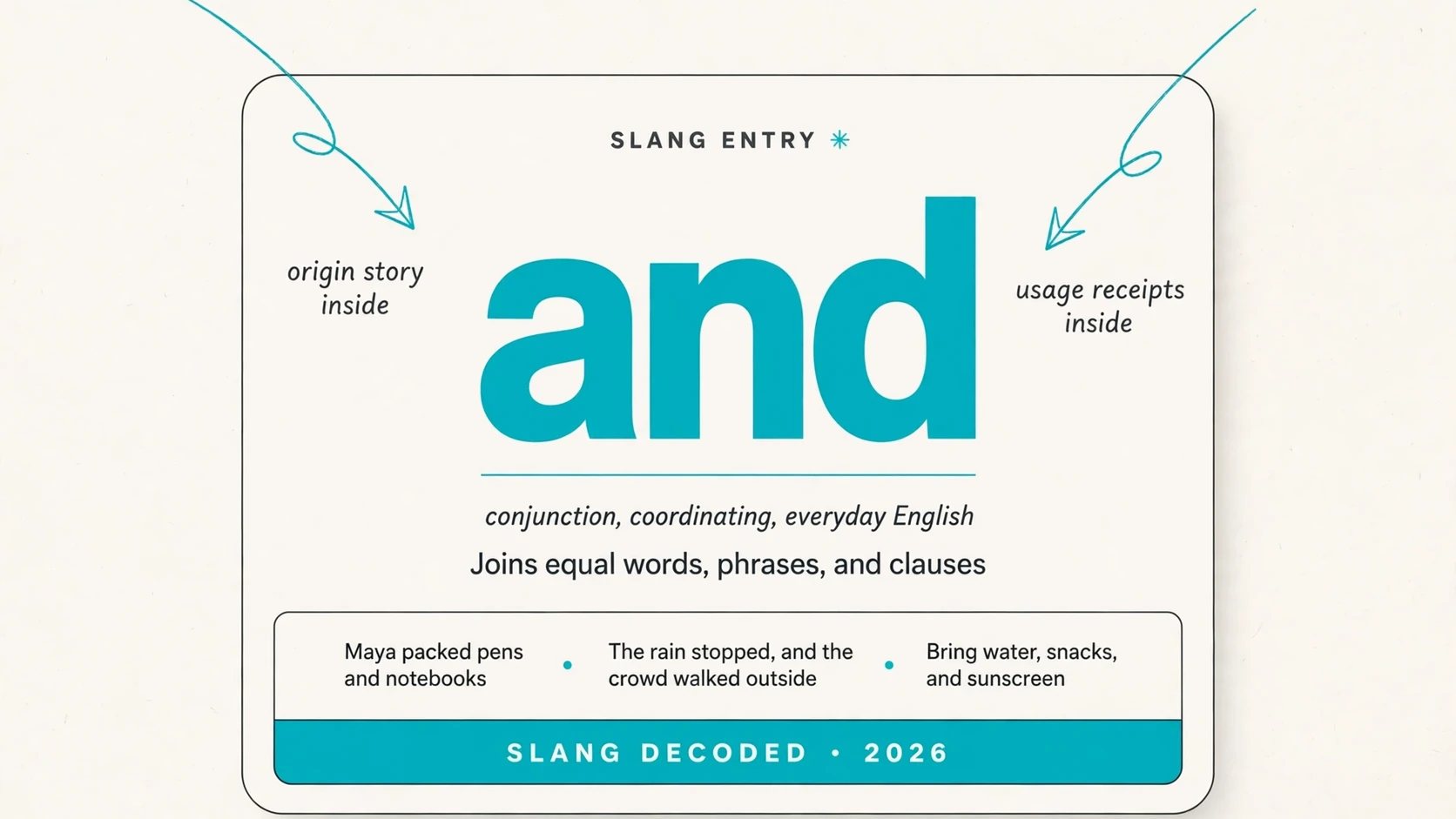
What does and mean in a sentence is a grammar question, not a slang question. The word and is a coordinating conjunction, and it joins two equal parts as one connected thought. It adds one thing to another without contrast, choice, or cause, and it keeps both sides standing on their own.
You meet and in almost every sentence you write, from a short text to a school essay. Once you see it as a small bridge between equals, the comma rules, list rules, and run on traps start to feel easier to spot and fix.
And as a Tiny Bridge Between Equal Words
| Pair joined | Example sentence |
|---|---|
| Two nouns | Maya packed pens and notebooks |
| Two adjectives | The soup was warm and filling |
| Two verbs | Jamal stretched and yawned |
| Two adverbs | She spoke softly and clearly |
| Two names | Priya and Sam shared the pizza |
| Two places | The bus stopped at the library and the center |
| Two colors | He painted the poster blue and green |
| Two foods | We ordered rice and beans |
| Two activities | On Saturday we hiked and swam |
What Does and Mean in a Sentence When It Joins Two Full Thoughts
| First thought | Joined sentence with and |
|---|---|
| The rain stopped | The rain stopped, and the crowd walked outside |
| She finished her shift | She finished her shift, and she called her brother |
| The laptop charged | The laptop charged, and the update finished |
| He practiced all week | He practiced all week, and his timing felt steadier |
| The store closed early | The store closed early, and the line moved next door |
| We saved our work | We saved our work, and we sent the draft |
| The dog barked once | The dog barked once, and then it settled down |
| The bus arrived late | The bus arrived late, and class started without two students |
| The game went long | The game went long, and fans stayed until the end |
Lists That Stay Clear from the First Item to the Last
| List shape | Example sentence |
|---|---|
| Two items, no comma | Bring water and snacks |
| Three short items | Bring water, snacks, and sunscreen |
| Three items, no final comma | Bring water, snacks and sunscreen |
| Four items in a row | She bought milk, bread, eggs, and fruit |
| Items with their own joining word | They served soup, salad and bread, and cake |
| Longer list of actions | He showered, dressed, ate, and caught the bus |
| List of places | The tour stopped in Austin, Dallas, and Houston |
| List of names | The winners were Ana, Luis, Zoe, and Max |
| List that could confuse a reader | I thanked my teachers, Rosa, and Ben |
Compound Subjects and Predicates without the Extra Comma Trap
| Sentence pattern | Example and check |
|---|---|
| Two subjects, one verb group | Maya and Luis run the announcements together |
| Two subjects, no comma needed | The cat and the dog slept through the movie |
| Two verbs, one subject | She locked the door and turned off the lights |
| Two verbs, no comma needed | He washed the dishes and dried them |
| Longer compound subject | The teacher, the aide, and the principal greeted students |
| Compound predicate, three actions | Ana read the prompt, planned, and wrote her answer |
| Shared subject, short actions | The baby giggled and clapped at the music |
| Compound subject in a question | Did Omar and Faith finish the poster |
| Reversed order still works | Luis and Maya run the announcements together |
And Beside Its Closest Neighbors in Everyday Writing
| Word or mark | Core job | How it differs from and |
|---|---|---|
| But | Shows contrast | But pushes back, and simply adds |
| Or | Offers a choice | Or asks you to pick, and keeps both |
| Plus | Adds casually | Plus sounds informal, and fits formal writing |
| Ampersand | Stands for and in names | The mark saves space, and reads smoothly |
| Yet | Adds surprise | Yet hints at surprise, and stays neutral |
| So | Shows a result | So points to an outcome, and only links |
| Nor | Joins negative ideas | Nor follows a negative, and follows addition |
| For | Gives a reason | For explains why, and does not explain cause |
| Comma alone | Separates list items | A comma alone cannot join two full thoughts |
When and Starts to Run on and On
| Run on pattern | Cleaner fix |
|---|---|
| Two full thoughts, no comma | Add a comma before and |
| Three thoughts in one breath | Split the chain into two sentences |
| And repeated in a long list | Keep one and before the last item |
| And joining unlike parts | Check both sides match in form |
| And after a comma splice | Use a period or and with a comma |
| And hiding a missing verb | Give each thought its own subject and verb |
| And starting every sentence | Save it for emphasis and vary openings |
| And piling up extra details | Move one detail into its own sentence |
| And linking a fragment | Finish the fragment or attach it fully |
Receipts from Group Chats Captions and Homework Drafts
I finished my homework and I still have time to game tonight
Where it appeared, a group chat Context note, two complete thoughts, fast chain
Coffee and a quiet corner, that is my whole study plan
Where it appeared, a photo caption Context note, two nouns, one calm mood
The bus was late and the quiz started without me
Where it appeared, a classmate text Context note, two related events in order
Pasta and garlic bread for dinner, please and thank you
Where it appeared, a family chat Context note, two foods, one polite request
She read the chapter and took notes in the margins
Where it appeared, a homework draft Context note, two verbs, one subject
Rain and wind canceled the outdoor practice
Where it appeared, a team chat Context note, compound subject, one verb
I saved the file and sent it to my teacher
Where it appeared, a message after class Context note, a clear sequence of actions
Red, white, and blue streamers for the school fair
Where it appeared, a planning note Context note, final comma keeps colors separate
Mom and Dad are driving us to the game
Where it appeared, a weekend text Context note, two people, one subject
More Receipts from Texts Notes and Classroom Sentences
The movie was funny and a little sad at the end
Where it appeared, a class chat review Context note, two adjectives, one movie
We need pens, paper, and a ruler for art class
Where it appeared, a notebook list Context note, and closes a three part list
He ran fast and still missed the bus by a minute
Where it appeared, a voice note Context note, timing of the story intact
Study group at six and pizza after, you in
Where it appeared, a chat invite Context note, a plan and a reward
The librarian smiled and pointed us to the right shelf
Where it appeared, a journal entry Context note, two actions, no comma needed
Math and science are my favorite subjects this year
Where it appeared, a student bio Context note, two subjects, one verb
I will bring the speaker and you bring the snacks
Where it appeared, a party text Context note, two complete thoughts joined
Slow and steady wins the race in our reading group
Where it appeared, a poster caption Context note, two adverbs, familiar pair
The store had apples and oranges and grapes and melons
Where it appeared, a shopping note Context note, repeated and feels breathless
Reading and Out Loud Changes How You Hear the Join
Read a sentence with and out loud and you can hear the small pause that tells you where the join sits. In a short pair like bread and butter, the two items feel like one unit. In a longer sentence with two full thoughts, your voice slows before and, and that slowdown hints a comma may belong there.
Try the reversal test when you are unsure about the join. If you can flip the two sides and the sentence still makes sense, and is likely joining equals. That test works well for word pairs and full thoughts, and it can also show you when a sentence is trying to join parts that do not match.
The Comma Before and Is a Small Choice with a Clear Job
A comma before and does real work when both sides could stand alone as sentences. The comma marks the boundary between two complete thoughts and helps a reader parse the sentence without rereading it. When and joins only two words or two verbs under one subject, that comma is extra weight.
Style guides differ on the final comma in a list, so pick one approach and stay consistent through a piece of writing. The final comma before and in a list of three or more items can prevent a reader from grouping the last two items as one thing. If you leave it out, check the list twice for any pairing that could be misread.
Starting a Sentence with and in Chats and Drafts
Starting a sentence with and can feel natural in a chat, a story, or a social post because it mimics how people add a thought after a pause. It works as a quick bridge, and readers usually accept it in informal writing. In a formal essay, the same opening can look loose if it appears often, so save it for a single moment of emphasis.
If you keep reading nearby guides, but, or, and plus sit beside and as the small joining words that change direction, offer a choice, or add things up in casual writing. Seeing those neighbors side by side helps you choose the word that matches your meaning instead of reaching for and out of habit. Each one shifts the sentence differently.
A Quick Check You Can Run Before You Send or Submit
Ask three quick questions before you trust an and in a draft. First, are both sides equal in form, so two nouns meet two nouns or two full thoughts meet two full thoughts. Second, does the sentence need a comma before and because both sides could stand alone. Third, would a reader group the items the way you meant them to be grouped.
That short check catches most and mistakes without slowing you down. It also keeps your lists tidy, your compound sentences clear, and your casual writing easy to follow. When the check passes, leave and alone and let it do its quiet job of holding the sentence together.
Questions Readers Keep Asking About And
Does and always need a comma before it?
No, use a comma when and joins two complete thoughts, and skip it when and joins two words or two verbs under one subject.
Is and slang?
No, and is standard English grammar, not slang, and it has no hidden online meaning.
Can you start a sentence with and?
Yes, in casual writing it adds a thought naturally, but use it sparingly in formal essays.
Should I use and or the ampersand in an essay?
Use and in essay sentences, and save the ampersand for official names, labels, and citations that require it.
What does and mean in a sentence with three or more items?
It signals addition before the last item, and a final comma before it can keep each item separate and clear.