
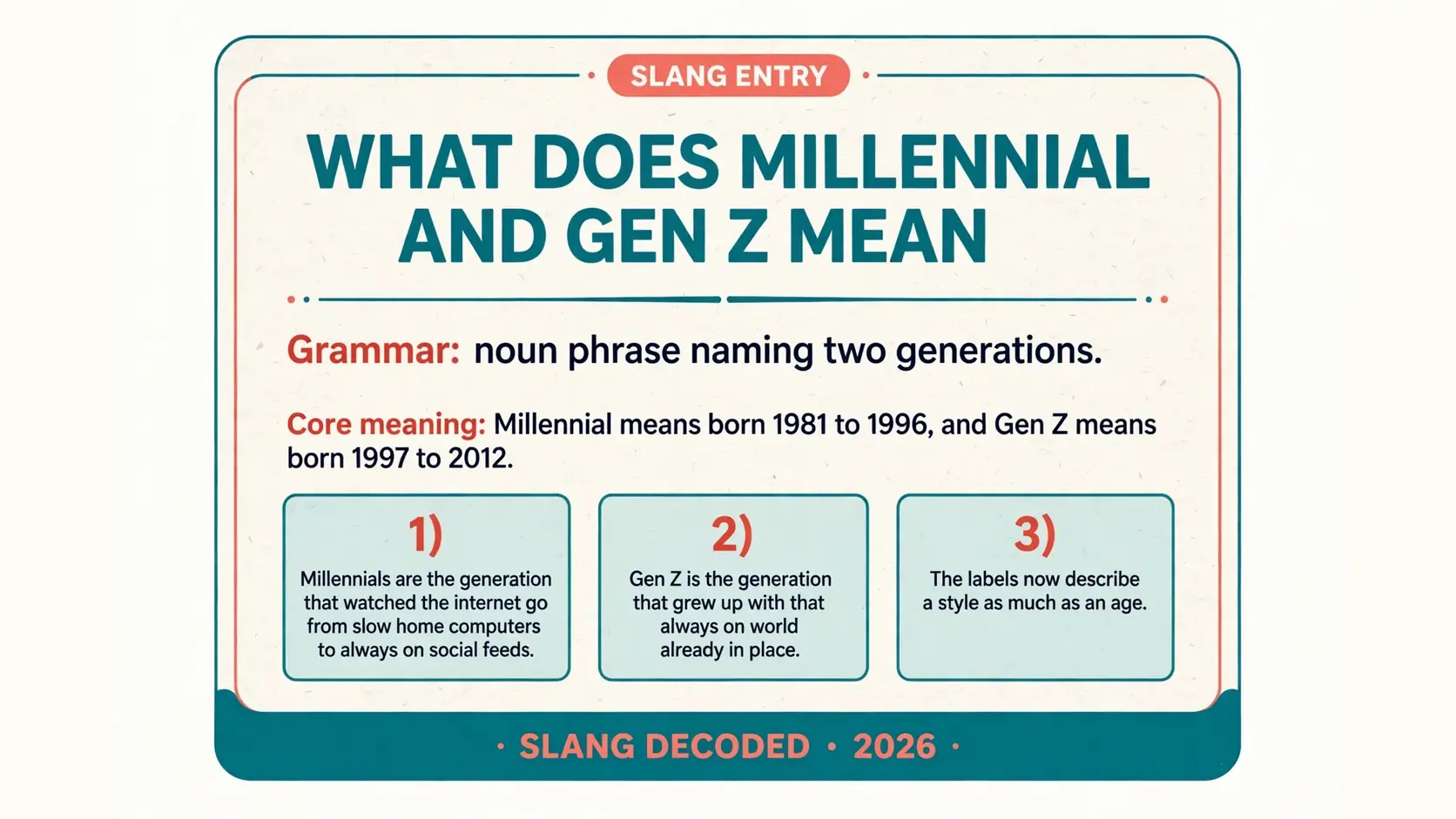
When you ask what does millennial and gen z mean, you are asking about two age groups that grew up on opposite sides of the smartphone shift. Millennials are the generation that watched the internet go from slow home computers to always on social feeds. Gen Z is the generation that grew up with that always on world already in place.
That split shapes how each group talks, works, shops, jokes, and posts. It also explains why the two labels get mixed up so often online, even though their birth years, childhood tech, and cultural touchstones are clearly different once you lay them side by side.
At a Glance Definitions
| Group | Birth Years | Core Identity |
|---|---|---|
| Millennial | 1981 to 1996 | Bridge generation that remembers life before social media |
| Gen Z | 1997 to 2012 | First generation raised fully inside smartphones and short video |
| Millennial nickname | Often called Gen Y | Label used before millennial stuck for the post X group |
| Gen Z nickname | Often called Zoomers | Playful name tied to the Z and fast online style |
| Millennial childhood | Analog to digital switch | Played outside first, then got flip phones and early social sites |
| Gen Z childhood | Digital from the start | Learned on tablets, watched YouTube early, and gamed with friends |
| Millennial adult marker | Came of age near 2000 | Name points to adulthood around the millennium and internet boom |
| Gen Z adult marker | Came of age in the 2010s | Entered teen years as Instagram, Snapchat, and TikTok grew fast |
| Shared trait | Both live online daily | Both use phones for news, banking, shopping, humor, and friends |
What Does Millennial and Gen Z Mean in Group Chats
- When a friend says a joke is so millennial, they mean it feels earnest, nostalgic, or tied to older internet style
- When a friend says a post is so Gen Z, they mean it feels ironic, fast, visual, and built for short video replies
- Millennial in chat may point to a Harry Potter reference, a Friends quote, or a soft, warm photo filter
- Gen Z in chat may point to a TikTok sound, a deadpan caption, or a comment that flips meaning with irony
- In a group chat, the labels work as shorthand for the vibe of a joke before you open the link
- People use the labels to tease kindly, like calling a long caption millennial or a short reply very Gen Z
- The labels can signal age without stating a birth year, which feels lighter and funnier in casual chat
- Sometimes the labels explain a taste gap, such as a polished photo dump versus a messy photo dump
- Used well, the labels help you read the room and tell sincere jokes from sarcastic ones fast
Timeline of the Generational Shift
| Period | What Changed | Why It Matters for You |
|---|---|---|
| Late 1990s | Home internet spread slowly | Millennial kids met the web on a shared family computer |
| Early 2000s | Texting and early social sites grew | Millennial teens built profiles, friend lists, and away messages |
| Mid 2000s | YouTube and smartphones arrived | Older millennials became adults as mobile video felt normal |
| Late 2000s | Social feeds became daily habit | Millennials entered work life as updates turned into a stream |
| Early 2010s | Smartphones reached most teens | Gen Z kids tapped screens early, so touch navigation felt natural |
| Mid 2010s | Short video and Stories took over | Gen Z teens learned to tell stories in seconds with sound |
| Late 2010s | TikTok reshaped discovery | Gen Z found creators through feeds, not friend lists |
| Early 2020s | Remote life went mainstream | Both groups used video calls, but Gen Z knew it from school |
| Mid 2020s | AI tools entered daily feeds | Both groups now sort real clips from edited ones quickly |
Platform Habits Side by Side
| Habit Area | Millennial Pattern | Gen Z Pattern |
|---|---|---|
| Favorite feed style | Curated grids and longer captions | Raw clips, quick cuts, and fast joke captions |
| Messaging style | Longer texts and detailed group threads | Short replies, voice notes, reactions, and meme answers |
| Search habit | Search engines and saved articles | In app search, video answers, and creator explainers |
| Photo style | Polished edits and planned angles | Candid shots, flash photos, and messy dumps |
| Video style | Vlogs and tutorials with clear structure | Looping clips, trends, and remixes rewarding speed |
| News habit | News apps, newsletters, and podcasts | Creator summaries, short clips, and comment threads |
| Shopping habit | Reviews, blogs, and brand sites | Creator demos, live clips, and peer comments first |
| Privacy habit | Careful profiles with chosen audiences | Close friends lists and private accounts for moods |
| Creator habit | Followed experts and polished channels | Followed relatable peers and niche creators |
Everyday Markers You Can Spot
- Millennials often pause before posting, since they learned when every post felt permanent and public
- Gen Z often posts in the moment, since feeds feel like fast conversation rather than a formal record
- A millennial caption might explain the joke and end with a warm sign off for friends reading later
- A Gen Z caption might leave the joke open and let comments finish the punchline
- Millennials often keep work profiles apart from personal profiles, with different photos and tones
- Gen Z often blends humor, work, and personal life in one feed without strict separation
- Millennials may laugh at memes about adulting, bills, and coffee runs matching their life stage
- Gen Z may laugh at memes about school pressure, side hustles, and screen time daily
- Both groups love nostalgia, but millennials reach for 1990s cartoons while Gen Z reaches for 2000s shows
Work and Money Attitudes
| Topic | Millennial View | Gen Z View |
|---|---|---|
| Career path | Expected one steady job, then learned to pivot | Expects many roles, gigs, and skills from the start |
| Remote work | Fought for flexibility after years in offices | Entered work during remote years, so it feels baseline |
| Side income | Built side projects to pay debt and test ideas | Builds creator income and freelance work early |
| Spending style | Values experiences, travel, and quality buys | Values dupes, thrifting, and resale with personal taste |
| Debt view | Remembers student loans and the 2008 crash | Watches housing costs and talks saving openly |
| Brand loyalty | Stays loyal when trust and quality earn it | Switches fast when a brand feels fake or overpriced |
| Job search | Uses job boards, referrals, and polished resumes | Uses video resumes, portfolios, and direct messages |
| Learning style | Takes courses and watches long explainers | Learns through short clips, peer tips, and practice |
| Retirement view | Balances long term saving with rent and bills | Talks openly about saving and investing apps |
Humor and Media Tastes
| Taste Area | Millennial Flavor | Gen Z Flavor |
|---|---|---|
| Comedy style | Sitcom callbacks and relatable adult life jokes | Absurd edits and layered irony through remixes |
| Meme format | Image macros with one clear punchline | Video memes where comments become the joke |
| Music discovery | Radio hits, albums, and shared playlists | Viral sounds and niche artists from short video |
| TV habit | Binge watched prestige shows for weeks | Watched clips, recaps, and comfort shows in pieces |
| Celebrity style | Followed stars through interviews and magazines | Followed creators through daily clips and streams |
| Nostalgia trigger | Blockbuster nights and Saturday cartoons | Early YouTube stars and flip phone games |
| Fandom style | Joined forums with long threads and theories | Joined edits and fan accounts remixing scenes fast |
| Slang pace | Slang spread through blogs over months | Slang spreads through viral clips in days |
| Storytelling | Longer posts with setup, twist, and ending | Fragmented clips where viewers build the story |
Common Mix Ups to Avoid
| Mix Up | The Mistake | The Clearer Read |
|---|---|---|
| Age overlap | Assuming every young adult is Gen Z | Millennials are in their late twenties to mid forties now |
| Tech skill | Assuming millennials are bad with tech | Millennials built early social culture and Gen Z refined it |
| One style fits all | Treating each group as one personality | Place, income, and friends shape taste as much as birth year |
| Label as insult | Using a label only to mock someone | Labels work best as neutral age markers, not punchlines |
| Trend ownership | Crediting one group with every trend | Trends start in one group and get remixed by the other |
| Work ethic claim | Saying one group works harder | Both work hard in different systems and job markets |
| Parent mix up | Calling all young parents millennials | Many new parents are millennials, some are older Gen Z |
| Media panic | Believing every headline about a generation | Headlines pick loud examples, most lives are ordinary |
| Fixed borders | Treating birth years as hard walls | Ranges are guides, and border babies share both sides |
How the Labels Shifted Online
Millennials once owned the word young online. They set the tone for blogs, early memes, and social profiles, and brands chased their attention for years. Then Gen Z arrived with faster feeds, and the center of internet cool shifted toward short video, irony, and creator led trends.
You can feel that shift in comment sections today. A polished, earnest post can read as millennial even if the poster is younger, while a chaotic, self aware clip can read as Gen Z even if the poster is older. The labels now describe a style as much as an age, which is why they travel so well in jokes.
Why People Get the Ages Wrong
People get the ages wrong because the internet flattens age. A 38 year old and a 19 year old can post in the same feed, use the same sounds, and laugh at the same edits, so viewers guess age from vibe instead of birth year. Add in creators who appeal across ages, and the line blurs even more.
If you want to keep exploring how younger users talk about romance online, check out gen z dating terms, relationship slang, and casual relationship for related reads. That wider web of terms helps you see why one label rarely tells the whole story about a person, a joke, or a trend you spot in your feed.
How to Use the Terms without Sounding Outdated
Use the terms as starting points, not verdicts. Say a trend feels millennial or Gen Z, then add what you actually mean, such as earnest, ironic, polished, or chaotic. That extra detail keeps your comment useful instead of turning it into a lazy age joke.
You also sound sharper when you check the birth years before you claim them. A quick pause to ask whether someone is near a border year saves you from a wrong call, and it shows you care more about getting people right than about winning a comment thread.
Frequently Asked Questions
What does millennial and gen z mean in simple terms?
Millennial means someone born from 1981 to 1996, and Gen Z means someone born from 1997 to 2012, with each group shaped by different childhood tech.
Are millennials and Gen Z the same generation?
No, they are two separate generations with different birth ranges, childhood tech, and cultural touchstones, even though they share a lot of online space.
Why do people argue about millennial and Gen Z birth years?
Different research groups use slightly different cutoff years, so people born near a border year may see themselves in either group depending on the source used.
Is Gen Z younger than millennials?
Yes, Gen Z is younger, since millennials came of age around the year 2000 while Gen Z came of age during the smartphone and short video era.
Can a person act millennial or Gen Z without being in that age group?
Yes, style, humor, and platform habits can read as millennial or Gen Z at any age, which is why the labels often describe vibe as well as birth year.