
When you hear the phrase what does crazy mean in a relationship, the core meaning is that someone feels an intense, hard to control emotion about a partner or a romance. It can sound romantic, funny, dramatic, or frustrated, and the exact sense depends on who says it and what just happened.
You might hear it as a compliment, a joke, a confession, or a complaint. That flexibility is why the phrase travels so well online, where a short caption has to carry a whole mood in only a few words.
What Crazy Means in a Relationship at a Glance
| Use | What it usually signals | How it tends to land |
|---|---|---|
| Crazy about you | Strong affection and attraction | Warm and flattering |
| Crazy in love | Deep infatuation or devotion | Romantic and dramatic |
| Drives me crazy | Strong desire or mild frustration | Playful or tense |
| You are crazy | You surprised me or acted boldly | Teasing or shocked |
| Crazy ex | A past partner seen as dramatic | Gossipy and unfair at times |
| Gone crazy for someone | Sudden intense interest | Excited and breathless |
| Crazy together | A couple that shares wild humor | Light and bonded |
| This is crazy | The situation feels unreal | Surprised and overwhelmed |
| Acting crazy | Behavior that seems irrational | Critical or confused |
What Does Crazy Mean in a Relationship When Friends Say It
- You are crazy about him means you cannot stop thinking about him and you light up when his name comes up in conversation.
- She has gone crazy for her new partner means the attraction hit fast and now fills most of her daily thoughts and messages.
- They are crazy together means their humor, energy, and adventures match in a way that looks chaotic from the outside.
- You drive me crazy in a friendly retelling means a partner is both irresistible and occasionally exasperating in equal measure.
- He called her crazy after a fight means he thought her reaction was over the top, even if she felt her feelings were valid.
- That relationship is crazy means the pace, drama, or surprises in it feel extreme compared with a quieter romance.
- I am crazy in love right now means infatuation is running high and every small moment with a partner feels larger than life.
- Do not be crazy about it means a friend is urging you to slow down, breathe, and not overthink one text or one night out.
- It is crazy how well they fit means a friend is impressed by how naturally a couple connects, laughs, and supports each other.
Crazy in Love, Crazy About You, and Crazy for Someone
| Phrase | Focus of the feeling | Typical setting |
|---|---|---|
| Crazy in love | Long lasting devotion and desire | Song lyrics and anniversary posts |
| Crazy about you | Affection and admiration | Early dating and sweet texts |
| Crazy for someone | Fresh and urgent attraction | Crush confessions and fan edits |
| Crazy over you | Admiration mixed with longing | Love letters and captions |
| Mad about you | A close cousin with softer edges | Retro songs and playful notes |
| Head over heels | Falling fast and fully | Romantic stories and vows |
| Obsessed in a fun way | Constant thoughts and excitement | Friend group chats and memes |
| Wild about you | Energetic and unrestrained affection | Party photos and road trip posts |
| Smitten and stunned | Surprise at how strong it feels | First meeting stories |
How Crazy Shows up in Texts and Captions
| Message style | What the sender likely means | Reader takeaway |
|---|---|---|
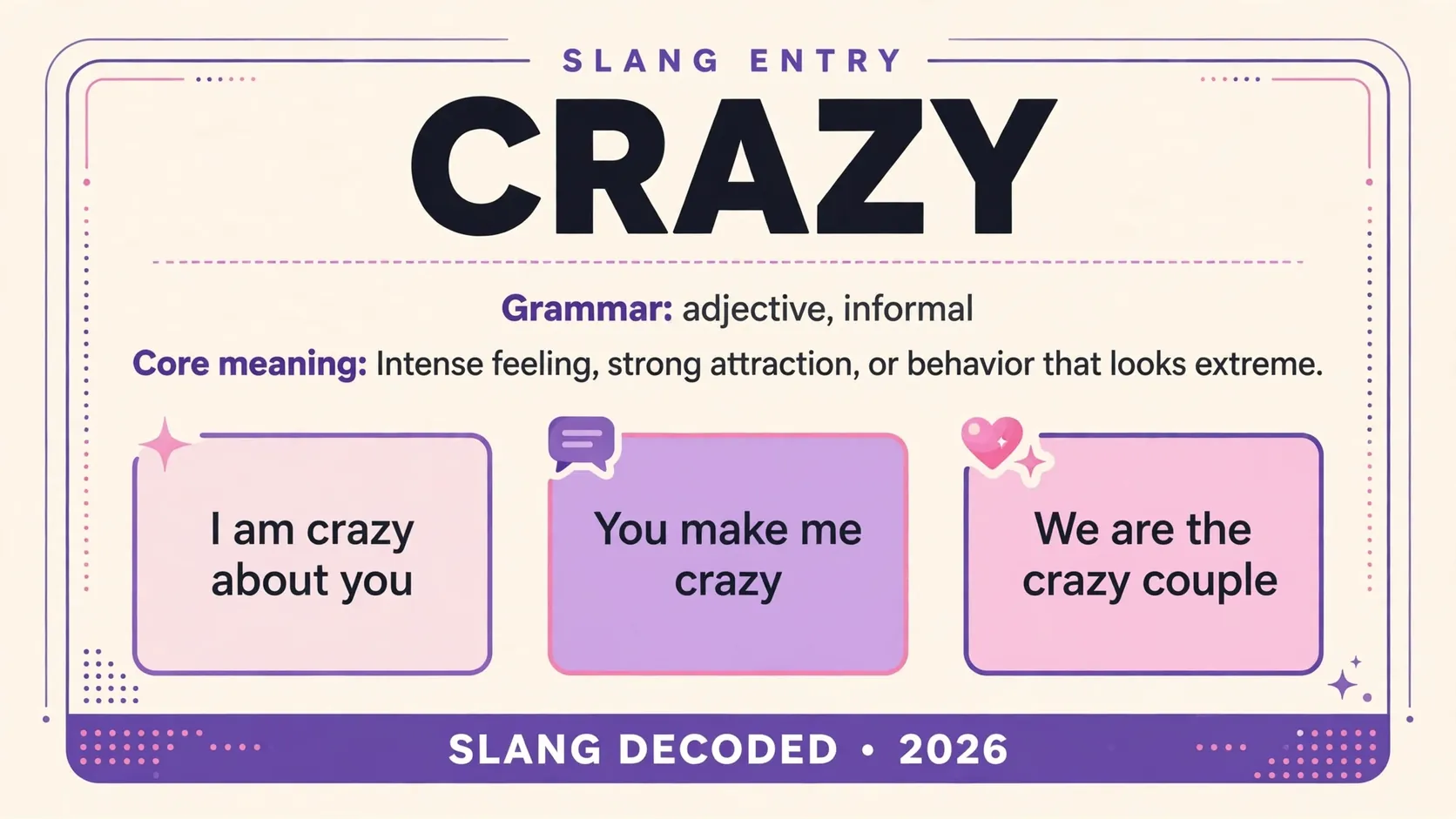
| You make me crazy | You stir up strong feelings in me | Flirty and intense |
| I am crazy about you | I really like you a lot | Sweet and direct |
| This love is crazy | Our story feels unreal | Proud and dramatic |
| You are driving me crazy | I want you close right now | Playful and eager |
| Crazy nights with you | Fun, loud, memorable time together | Nostalgic and happy |
| I went crazy when you left | I missed you more than expected | Honest and vulnerable |
| Stop making me crazy | Your mixed signals confuse me | Frustrated and tired |
| We are the crazy couple | We embrace our loud, fun dynamic | Proud and joking |
| It is crazy I found you | I feel lucky this worked out | Grateful and romantic |
Signs the Word Points to Intensity Rather than Harm
- The speaker pairs it with laughter, affection, or a clear compliment about the partner.
- The context is excitement, such as a surprise visit, a reunion, or a shared joke.
- Both people use the word back and forth, so it reads as shared language rather than a one sided label.
- The feeling described is about attraction, missing someone, or joy, not about fear or control.
- The phrase appears in a song, meme, or caption where exaggeration is part of the humor.
- The couple can talk openly afterward about what was meant, without anyone feeling shut down.
- The word describes a moment, such as one wild weekend, rather than a whole person.
- Friends hearing it understand the tone at once because the story around it is warm and light.
- The speaker quickly clarifies with a softer phrase, such as I really like you or I missed you a lot.
Crazy Versus Intense, Passionate, and Unpredictable
| Word | Closest sense in romance | Key difference from crazy |
|---|---|---|
| Intense | Deep and serious feeling | Sounds more measured and adult |
| Passionate | Strong desire and devotion | Sounds more positive and steady |
| Unpredictable | Hard to guess what comes next | Focuses on behavior, not feeling |
| Wild | Free, loud, and adventurous | Focuses on energy and fun |
| Obsessive | Constant thoughts that will not stop | Sounds heavier and less playful |
| Dramatic | Full of big reactions and scenes | Focuses on style, not emotion |
| Chaotic | Messy and disorganized at times | Describes a situation, not a heart |
| Fiery | Bold, quick, and full of spark | Sounds attractive and confident |
| Overwhelming | Too much to process at once | Focuses on scale, not judgment |
Where Crazy in Dating Talk Comes From
| Source | How it shaped the phrase | What you hear today |
|---|---|---|
| Older English use | Crazy once meant cracked or broken | A sense of something out of balance |
| Love songs | Singers turned intensity into a hook | Crazy in love as a proud claim |
| Movies and sitcoms | Bold romantic gestures became jokes | Over the top confessions and chases |
| Texting culture | Short words had to carry big feelings | Crazy as shorthand for very much |
| Social media captions | Exaggeration earns attention fast | Crazy couple and crazy love posts |
| Meme humor | Friends exaggerate crush behavior | Jokes about checking a phone too often |
| Friend group slang | Groups repeat a favorite tease | You are crazy as affectionate ribbing |
| Pop psychology talk | People name patterns in plain words | Debates about labels in arguments |
| Everyday speech | Lovers borrow dramatic words daily | Crazy about you as a simple compliment |
How Tone, Timing, and Context Change Crazy
| Factor | Affectionate version | Harsher version |
|---|---|---|
| Tone of voice | Warm, laughing, and soft | Cold, sharp, and dismissive |
| Timing | Said during a happy moment | Said in the middle of a fight |
| Who says it | A partner who also listens well | Someone trying to end a discussion |
| Audience | Said privately between two people | Said to embarrass someone publicly |
| Body language | Smiling, relaxed, and close | Turned away, tense, and closed off |
| Follow up words | A compliment or an apology follows | Silence or blame follows instead |
| History | Both people joke this way often | The word has been used to dismiss feelings |
| Intent | To praise, tease, or confess feeling | To label, mock, or win an argument |
| Repair afterward | A quick check in clears the air | No check in leaves hurt behind |
Reading Crazy without Jumping to Conclusions
You will also see writers group this phrase with relationship slang, casual relationship, and lavender relationship when they sort modern dating vocabulary. That grouping alone does not tell you what a speaker meant, so you need the story around the word before you judge it. Ask yourself who said it, when it was said, and whether the rest of the message sounded warm, joking, or frustrated.
A single word rarely carries the whole truth of a romance. If the surrounding talk is full of care, plans, and laughter, crazy likely points to intensity. If the surrounding talk is full of blame, silence, or fear, the same word can point to a very different dynamic that deserves a closer look.
When Crazy Sounds Affectionate
When a partner says they are crazy about you, they usually mean their feelings run strong and happy. You might hear it after a great trip, a thoughtful surprise, or a quiet moment that suddenly felt important. In that setting, the word works like an exclamation mark, turning a simple I like you into something bigger and more memorable.
You can often tell by the follow up. A partner who means it affectionately will keep showing care in ordinary ways, like remembering details, making time, and listening when you speak. The dramatic word then sits on top of steady behavior, which makes it feel safe rather than confusing.
When Crazy Sounds Like a Warning Label
When crazy is used as a label for a person, it can flatten a complex feeling into a single judgment. You might hear it after an argument, when one person wants the other to stop talking about a hurt. In that moment, the word does less describing and more dismissing, even if the speaker did not plan it that way.
You can notice this version by what happens next. If conversation stops, feelings go unheard, and one person feels smaller afterward, the label did real work in the exchange. Naming that pattern in plain words, such as I felt unheard when that word came up, can reopen a talk that a label had closed.
How to Respond When Someone Calls You Crazy
You do not have to accept or fight over the word in the heat of the moment. You can pause, breathe, and ask a simple question, such as what part felt too much for you. That question moves the talk from a label back to a specific behavior or feeling, which is far easier to discuss.
You can also state your own meaning clearly. Try a line like I felt excited, not out of control, or I felt hurt, not irrational. Clear wording gives the other person something real to respond to, and it keeps the conversation about your experience rather than about a word that means too many things at once.
Frequently Asked Questions About Crazy in a Relationship
What does crazy mean in a relationship in simple terms?
It usually means intense feeling, strong attraction, or behavior that looks extreme to the speaker.
Is being called crazy in a relationship always an insult?
No, it can be a tease or a compliment, but it can also sting when it is used to dismiss feelings.
What does crazy in love mean compared with crazy about you?
Crazy in love points to deep devotion, while crazy about you points to strong affection and admiration.
Why do people say you drive me crazy to a partner?
They usually mean a partner stirs up powerful desire, excitement, or mild frustration all at once.
How can you tell if crazy is affectionate or dismissive?
Check the tone, the timing, the follow up words, and whether conversation stays open afterward.