
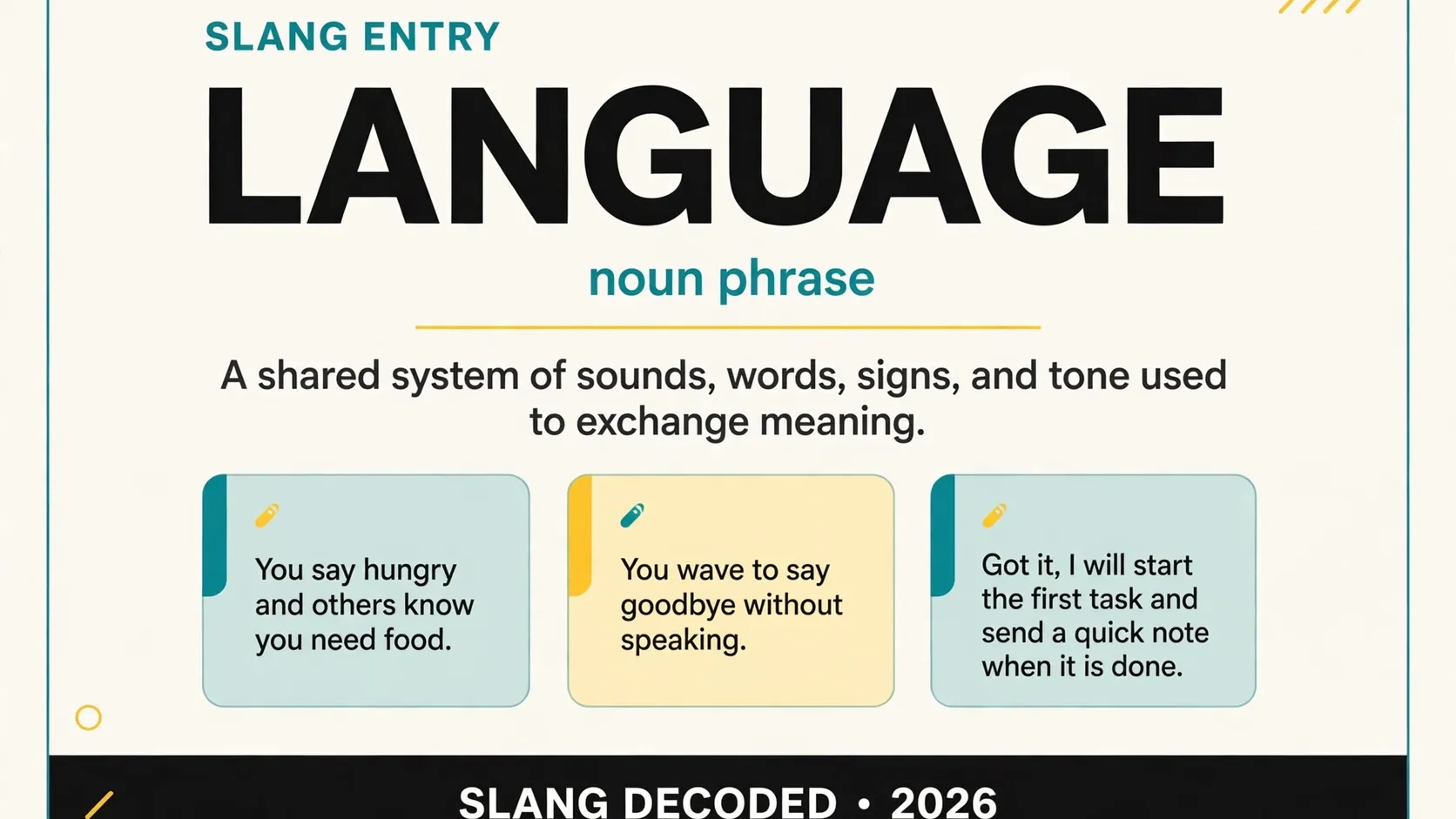
Language in communication means a shared system of sounds, words, signs, gestures, and written marks that people use to exchange meaning with each other. You use it every time you ask a question, react to a message, or follow an instruction from another person.
When that system works, you and the other person end up with a close enough version of the same idea in mind. When it breaks down, you get confusion, missed jokes, and replies that feel off even if every word looks correct on screen.
What Does Language Mean in Communication at a Glance
| Part | What It Does | Everyday Example |
|---|---|---|
| Sounds and speech | Turns voice into units you recognize | You hear hello and know it is a greeting |
| Words | Packs an idea into a reusable form | You say hungry and others know you need food |
| Grammar | Orders words so meaning changes clearly | Dog bites man is not man bites dog |
| Signs and gestures | Adds meaning with hands and face | You wave to say goodbye without speaking |
| Writing | Freezes language across time and distance | You read a fridge note and follow it later |
| Tone of voice | Shows feeling behind the words | You hear nice job and sense praise or sarcasm |
| Context | Supplies background that aids understanding | Inside jokes land only with shared history |
| Feedback | Shows what was understood or missed | You nod or reply got it to confirm |
| Shared rules | Gives a group common forms to use | Friends agree on what an emoji signals |
The Building Blocks You Actually Use Every Day
| Building Block | Simple Meaning | How You Spot It |
|---|---|---|
| Sound units | Smallest speech pieces that separate words | Cat turns into bat with one sound change |
| Word parts | Pieces adding tense or opposite sense | Adding un to happy flips its meaning |
| Vocabulary | Words you know and use quickly | You pick cozy when you want warmth |
| Sentence patterns | Frames holding subject, action, and object | A full sentence shows who did what |
| Pronunciation | Sound, stress, and rhythm in speech | Record shifts stress as noun or verb |
| Spelling | Agreed written form for readers | Night looks odd yet reads clearly |
| Punctuation | Marks showing pauses and questions | A question mark lifts your voice |
| Turn taking | Rules for speaking and listening | You pause so others can jump in |
| Politeness forms | Choices softening a request | Could you sounds softer than a blunt order |
Spoken, Written, and Signed Forms Compared
| Form | Main Channel | Strength | Limit |
|---|---|---|---|
| Spoken talk | Voice and ears | Fast, warm, and rich with tone | Vanishes unless recorded |
| Written text | Letters and screens | Lasts and can be reread | Loses tone and quick repair |
| Signed language | Hands and face | Visual and fully grammatical | Needs sight lines and shared skill |
| Text messages | Typed words and emoji | Quick and easy anywhere | Short forms can hide intent |
| Voice notes | Recorded speech | Keeps tone for later listening | Harder to skim than text |
| Video calls | Voice plus face | Closest to sharing a room | Needs good signal and attention |
| Captions | Words matched to speech | Makes video searchable and clear | Can lag or flatten a joke |
| Symbols and emoji | Small pictures beside words | Fast feeling in one tap | Means shift across groups |
| Body language | Posture and movement | Adds trust in real time | Easy to misread across cultures |
How Meaning Gets Made Between Two People
- You start with an idea and pick words you think will carry it to the other person.
- You shape words for the listener, using plain terms for newcomers and shorthand for close friends.
- You send the message by speech, writing, or signs, adding tone or emoji to guide how it lands.
- The other person filters the message through experience and builds their own version of its meaning.
- They reply with words or a question, showing whether your message landed as you meant it.
- You adjust on the spot, rephrasing a point or adding an example that clears confusion.
- Shared background does quiet work, since a reference can land with one group and fall flat elsewhere.
- Noise and stress can bend meaning, so a tired reader may miss humor that feels obvious when calm.
- Meaning is finished when both sides reach a workable match, not when speaking simply stops.
Online Shifts That Changed How We Talk Now
| Shift | What Changed | Why It Matters to You |
|---|---|---|
| Short messages | Long letters gave way to quick bursts | You expect fast answers and skim for the point |
| Emoji and reactions | Feeling moved into taps and faces | One symbol can soften a blunt line |
| Threads and replies | Posts now hold linked side chats | You follow a chain, not one flat message |
| Voice and video clips | Talk returned inside typing apps | You hear tone without a full call |
| Captions everywhere | Video speech arrives with words | You can watch muted and still follow |
| Searchable talk | Chats and posts stay easy to find | You can quote an old message later |
| Group chats | One note reaches many people at once | You switch tone fast by audience |
| Slang cycles | New words spread in days | You learn a term from a meme first |
| Translation tools | Instant translation sits inside apps | You can cross a language gap in chat |
Common Mix Ups and Clearer Ways to Say Them
| Mix Up | What People Often Assume | Clearer Way to Think About It |
|---|---|---|
| Words equal meaning | Saying it means they got it | Listeners build meaning, speakers do not just send it |
| Tone is optional | Plain words weigh the same always | Tone can turn praise into teasing |
| One word, one sense | A word means one thing everywhere | Words shift with context and time |
| Fluency equals understanding | Fast speech proves clarity | A smooth speaker can still confuse listeners |
| Writing is neutral | Typed words carry no feeling | Readers fill gaps with mood, so text can feel cold |
| Silence means agreement | No reply means they agree | Silence can mean busy or unsure |
| More words mean clearer | Longer always explains better | Extra detail can bury the main point |
| Emoji fix everything | One emoji removes all doubt | Emoji help yet can add another layer |
| Formal equals correct | Only textbook forms count | Relaxed and signed forms follow real rules |
Quick Phrases That Show Language Working in Real Life
- Can you walk me through that step again so I get the order right before I try it.
- I hear you, yet I am unsure what you need next, so name the one action you want.
- That sounded like a joke to me, but tell me if you meant it as a serious point.
- Let me say it back in my own words, then you can spot where my version drifts.
- I read this as good news, but the short reply made me pause and check.
- Thanks for the heads up, I will change the plan and update the group tonight.
- I do not follow that last part yet, so give me a small example of what you mean.
- Got it, I will start the first task and send a quick note when it is done.
- That word means something different in my group, so thanks for explaining your use.
Where You Hear This Question Most Right Now
| Place | Who Asks It | What They Usually Want |
|---|---|---|
| Classrooms | Students studying speech and society | A plain definition for an assignment |
| Work chats | New hires learning team norms | Help reading tone in short messages |
| Language apps | Learners comparing forms | A map of speech, writing, and signs |
| Social feeds | Curious scrollers seeing explainer clips | A fast answer that feels smart |
| Study groups | Friends testing before a quiz | Examples that stick better than textbook lines |
| Family chats | Parents and teens decoding messages | A way to spot jokes and serious notes |
| Creator videos | Viewers wanting talk skills | Tips for sounding clear, not stiff |
| Job interviews | Candidates explaining teamwork | Words showing listening, not just speaking |
| Help pages | Readers fixing confusing exchanges | Steps to repair a message that landed wrong |
Why Context Changes the Same Words Completely
You know this feeling from group chats. The same short reply can feel warm from a close friend and cold from a manager, even when the letters match exactly. Context supplies the missing music, and your brain fills in tone, history, and intent before you even finish reading.
That is why a good communicator watches the room as much as the wording. You check who is listening, what just happened, and what the last message set up, then you pick words that fit that moment instead of words that only sound clever on their own.
How to Read Tone When the Words Look Plain
Plain text hides a lot, so you have to hunt for clues that speech would hand you for free. You look at punctuation, timing, emoji, and the length of the reply, and you weigh those signals against what you know about the sender.
If the clues point in two directions at once, ask a short clarifying question instead of guessing the worst version. You save the chat from a spiral, and you show the other person that you care about getting their meaning right.
Why This Phrase Keeps Showing up in Search
People search this phrase when they want a definition that works in real life, not just a line to copy into a notebook. They want to know how words, signs, and tone work together when they text a friend, pitch an idea, or calm a tense exchange.
You will run into this topic near connection slang, relationship lingo, and colloquial relationship pages when you browse slang guides online. That overlap makes sense, because so much of modern talk happens in chats where meaning depends on shared jokes, timing, and small signals.
What to Notice the Next Time You Text Someone
Watch what happens after you hit send. You can learn a lot from the pause, the reply length, and the question that comes back, because those responses reveal how your message was received.
Try one small change at a time if a chat keeps going sideways. You can add a warm opener, name the action you want, or restate the main point in plainer words, and you will quickly see which change clears the fog.
Frequently Asked Questions About What Does Language Mean in Communication
What does language mean in communication in simple terms?
It means the shared system people use to turn ideas and feelings into signals another person can understand and respond to.
Is language only spoken words?
No, it also includes writing, signing, gestures, tone, and symbols, and each form follows its own patterns for making meaning clear.
Why does the same message feel different in a text and in person?
In person you get tone, face, and instant feedback, while a text strips many of those cues away and leaves more room for guessing.
How can you tell if your message was understood?
You can watch for a clear reply, a matching action, or a restatement, and you can ask the other person to say it back in their own words.
Does language change over time?
Yes, new words appear, old words gain fresh senses, and online habits keep reshaping how people greet, joke, and argue every year.