
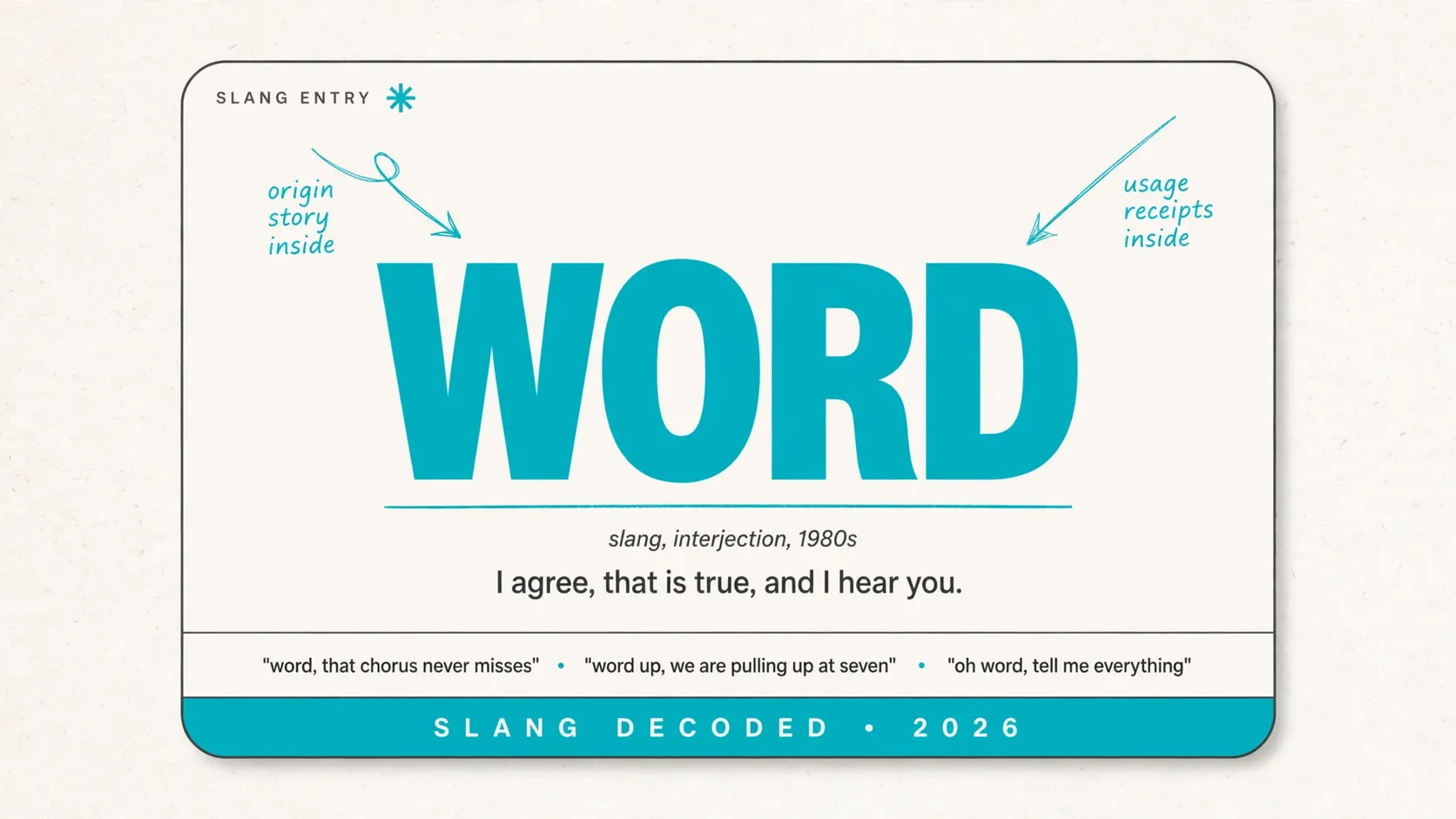
Word slang meaning in english is I agree, that is true, and I hear you, packed into one small reply. When someone answers with a single word after your point, they are usually backing you up, not asking you to define a noun. The context tells you whether it means agreement, acknowledgment, or surprise.
You will hear it in hip hop, group chats, and comment sections, where a longer answer would slow things down. It sounds casual and confident, and it carries history even when it looks like throwaway chat.
What Word Slang Meaning in English Actually Covers When You Hear It
| Reading | What it signals |
|---|---|
| Word | I agree completely and I back your point |
| Word up | I agree, with extra energy and emphasis |
| Word is bond | I promise this is true |
| Oh word | Really, tell me more, I did not expect that |
| Word to your mother | I swear this is true, playfully or seriously |
| My word | I give you my promise |
| Word, word | Yes, yes, I hear you, keep going |
| Word as a greeting | Hello, I see you, let us talk |
| Word as a challenge | Prove it before I believe it |
From a Promise in the Bronx to a One Word Reply
| Period | What happened |
|---|---|
| Older promise language | Your word is your bond meant a promise you kept |
| 1960s | The Five Percent Nation used your word is your bond as a teaching phrase |
| 1970s Bronx | Hip hop block parties turned word into fast call and response |
| Early 1980s | Word was a slang interjection of affirmation, with word up almost as old |
| Mid 1980s | Word up spread as agreement, greeting, and a call to listen |
| 1986 | Cameo released Word Up, a funk hit that spread the phrase widely |
| Late 1980s and 1990s | Word and word to your mother appeared in rap, film, and daily talk |
| Late 1990s onward | Longer forms faded in daily speech, while short word stayed knowing and retro |
| 2000s and 2010s | Texting and memes kept oh word alive as a surprise question |
| 2020s | TikTok, Discord, and gaming chats kept word in use, sometimes as WRD |
Where Word Lands Different on Tiktok, in Texts, and in Real Life
| Platform or place | How word shows up |
|---|---|
| TikTok comments | Lone word means instant agreement, oh word means shocked disbelief |
| Instagram comments | Word works like a nod under a photo or reel |
| Group chats | Word closes a plan fast and confirms time and place |
| Discord and gaming chats | Word is a quick yes during a play, WRD is faster still |
| X posts | Word replies with feeling and adds no new argument |
| Reddit threads | Word can look terse, so readers check the replies for tone |
| YouTube comments | Word under throwback clips often pairs with hip hop nostalgia |
| Real life talk | Voice and face decide whether word sounds warm or distant |
| Work chats | Word feels too casual, a fuller reply reads safer |
Receipts That Show Word Doing Agreement Work in the Wild
word, that chorus never misses
Seen in a TikTok comment under a throwback funk clip It agreed with the praise and needed no extra words
word up, we are pulling up at seven
Seen in a group chat after a friend shared the meetup time It confirmed the plan and closed the thread
word is bond, I got you on Saturday
Seen in a text thread about covering a shift The longer form turned a yes into a promise
word, you said what I was thinking
Seen in an Instagram comment about rising food prices It carried full agreement and shared frustration
word to your mother, that game was unreal
Seen in a Discord chat after a close match The playful oath added emphasis and kept it light
word, I hear you, take your time
Seen in a direct message after a friend shared a rough week It acknowledged the news without rushing toward advice
word up, listen to this part
Seen in a comment under a rap breakdown video It called attention to a lyric listeners might miss
word, no notes, post it
Seen in a group chat after a friend shared a draft caption It meant approval and gave a clear green light
word, best take in this thread
Seen in a Reddit reply chain about a new album It stood out as shorter and calmer than the arguments
How the Tone Flips from Warm to Flat to Sarcastic
| Situation | Tone and risk |
|---|---|
| A friend shares an opinion you share | Warm and loyal, almost no risk |
| A friend shares good news | Bright and supportive, especially with extra energy in text |
| A stranger posts a joke you like | Friendly and low effort, a simple nod |
| A friend vents about a bad day | Gentle with care added, cold if word stands alone |
| A serious announcement lands in a chat | Risky alone, it can look dismissive |
| A claim sounds wild | Playful and skeptical, oh word shows the doubt |
| A boss asks for a deadline check | Too casual, a fuller yes reads more reliable |
| A parent asks a direct question | Fine with family who know it, confusing otherwise |
| A sarcastic thread | Ironic and sharp, agreement clearly means mockery |
Word Next to Bet, Facts, and No Cap without Mixing Them Up
| Term | Key difference from word |
|---|---|
| Bet | Bet locks in a plan, word confirms truth or agreement |
| Say less | Say less means no more detail is needed, word means you agree |
| Facts | Facts points at truth, word adds a personal pledge |
| No cap | No cap stresses honesty, word stresses agreement |
| For real | For real checks sincerity, word answers with steady agreement |
| Deadass | Deadass adds serious weight, word stays lighter |
| True | True is plain agreement, word carries hip hop history |
| I hear you | I hear you centers listening, word centers agreement |
| Right | Right can sound flat in text, word sounds more engaged |
Oh Word Moments When Surprise Does All the Talking
oh word, you moved already
Seen in a text thread after a sudden move to a new city It showed surprise and invited the full story
oh word, she really said that on camera
Seen in a comment under a reality television clip It mixed disbelief with curiosity and asked for confirmation
oh word, the tickets sold out that fast
Seen in a group chat after a concert announcement It matched the group shock and opened backup plan talk
oh word, you got the job
Seen in a direct message after a friend shared good news The warm surprise worked like a cheer
oh word, same jacket as last year
Seen in a comment under a thrift haul video It teased the creator and showed viewers remembered
oh word, they changed the ending
Seen in a forum thread about a movie remake It flagged a twist and pushed toward spoiler talk
oh word, you were there that night
Seen in a voice note reply after a party story Spoken surprise carried more energy than a typed yes
oh word, for real this time
Seen in a comment under a comeback announcement It asked for proof in a friendly way
oh word, tell me everything
Seen in a group chat after a cryptic one line update It turned surprise into an invitation to share more
When Word Lands Kind and When It Lands Cold
| Moment | How word reads |
|---|---|
| You agree with a friend in a debate | Kind and loyal, you stand beside the point |
| You back a creator against unfair criticism | Supportive, it adds weight without drama |
| You confirm a plan with clear details | Helpful and calm, the plan is set |
| You answer a long emotional message alone | Cold, it can look like you skimmed it |
| You reply word to a joke | Flat, the joke deserved more energy |
| You greet an old friend with word up | Warm and nostalgic, it recalls shared music |
| You use word in a formal email | Out of place, the register clashes |
| You say oh word with surprise | Playful and curious, you want the rest |
| You say word with sarcasm | Sharp, the agreement is clearly ironic |
The Literal Noun and the Slang Reply Are Not the Same Job
The ordinary noun word names a unit of language, a promise, or a piece of news, and you use it in sentences about writing and speaking. The slang word works more like a gesture, a nod you can type or say when you want to agree or react without building a full sentence.
That split matters for someone learning English, because a dictionary entry about language will not explain why one word can end a whole exchange. The slang sense borrows weight from the older promise idea, even when the chat is light, so keep the two jobs separate in your head.
Why One Word Survived While Longer Phrases Faded
Word survived because it does a job that longer agreement phrases cannot do as fast, and because it fits the rhythm of rap, texting, and comment threads. A longer phrase asks for attention, while word gives agreement and steps aside, and that speed made it useful where seconds matter.
In everyday feeds you will hear word travel beside bet, no cap, and say less, and each one does a slightly different job even when the vibe feels close. Bet seals a plan, no cap defends honesty, and say less cuts off extra detail, while word stays closer to simple agreement.
How to Use Word without Sounding Forced or Dated
Use word when you truly agree, when you want to acknowledge a point, or when you want to cheer a friend without writing a paragraph. Match the energy around you, and add a follow up question when the moment is emotional, so word opens the reply rather than closing the conversation.
Avoid dropping word into every reply, because repetition drains the punch and can make you sound distant. Save word up and word to your mother for casual friends who know the phrases, and keep the short form for mixed company where the meaning is clear.
What to Listen for Before You Answer with Word Yourself
Listen for the beat of the conversation, because word works best as a response, not as an opening line that carries the whole message. If the speaker just shared news, check whether they want agreement, comfort, or more questions, and let that need shape your reply.
Watch the platform too, because a comment section rewards short replies and a private chat rewards a little more care. Notice who is speaking and who else is reading, since a reply that feels playful with friends can feel abrupt with coworkers.
Word Slang Questions You Actually Hear from New Listeners
Does word slang mean yes in english?
Yes, in slang word most often means yes, I agree, or that is true, depending on the context around it.
Is word slang rude or disrespectful to use?
No, word is usually friendly and casual, but it can feel cold or dismissive if it stands alone after a serious or emotional message.
What does oh word mean when someone asks it as a question?
Oh word as a question usually means really, I am surprised, or tell me more, and it asks for confirmation in a casual way.
Where did word slang come from originally?
Word slang grew from the longer promise phrase your word is your bond, through Black American speech and early hip hop in New York, and it spread further through rap and the 1986 Cameo hit Word Up.
Can you use word in a formal message or at work?
You can, but a fuller reply usually reads safer in formal messages, since word is casual and some readers may not know the slang sense.