
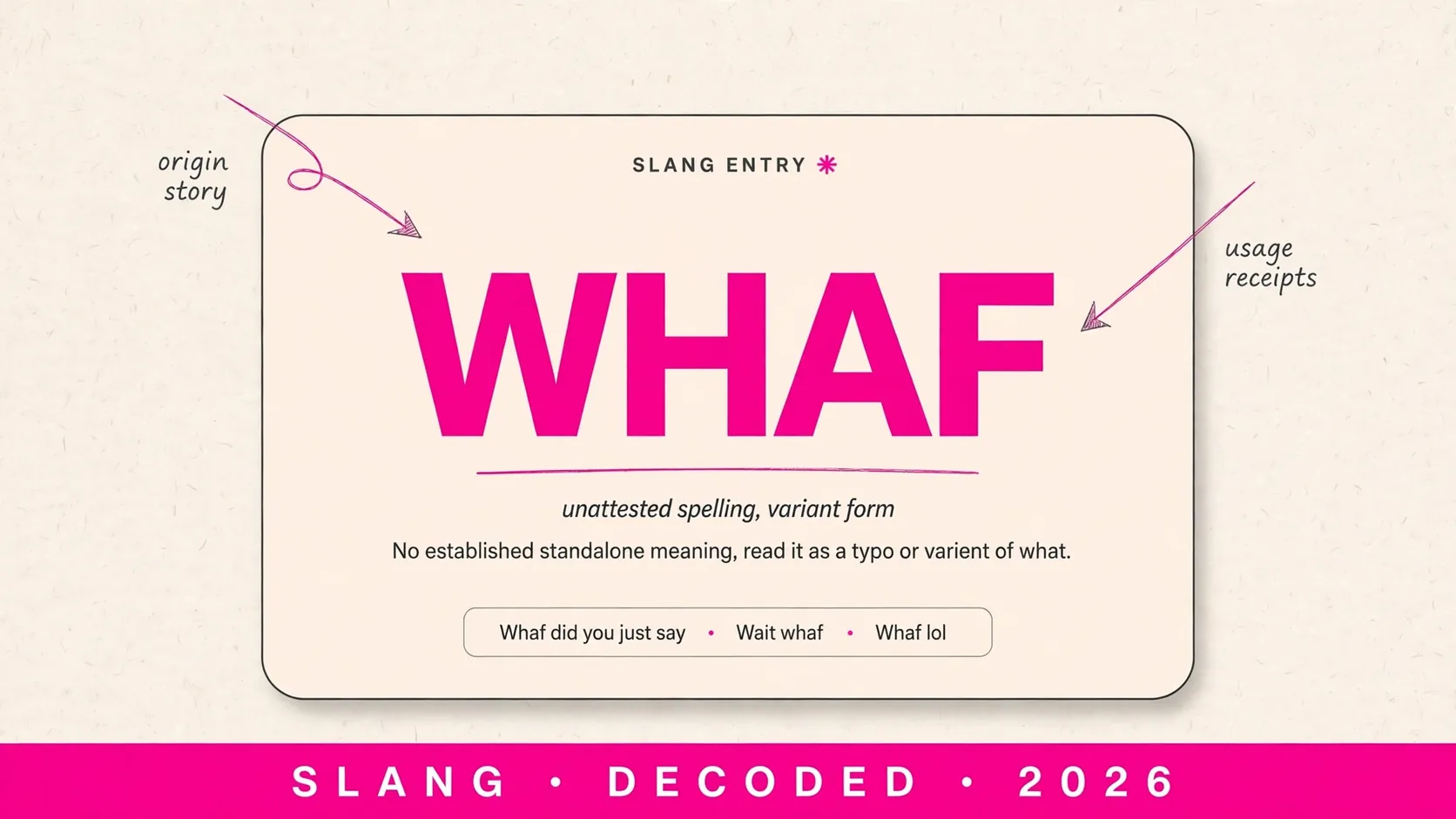
Whaf has no established standalone slang meaning in text, so you should read it as an unattested form, a typo, or a variant of a more familiar word rather than as a word with its own dictionary definition.
When you see what does whaf mean in text in a search box or a chat, the safest move is to check the surrounding words, the sender, and the joke or question being answered before you guess at a meaning because context usually reveals whether it is a slip, a sound, or a playful spelling.
What What Does Whaf Mean in Text Actually Points to When You See It
| Reading | What It Suggests |
|---|---|
| A typo for what | Fast typing added a letter and the intended word was what |
| A sound spelling of wha | A surprised sound stretched out with an abrupt final letter |
| A clipped form of what the | A longer surprised phrase cut short at its start |
| A playful invented spelling | Friends bend a familiar word to make a joke land harder |
| An autocorrect or keyboard slip | One wrong key turned a common word into an unfamiliar string |
| A username or handle fragment | A name chosen for sound or style rather than for meaning |
| A voice transcript error | A mumbled what heard as whaf when the ending was rushed |
| A meme text experiment | One letter changed to test whether readers still catch the joke |
| A search query mistake | Whaf typed for what, with results showing the closest familiar forms |
How to Read Whaf from the Words Around It
| Clue In The Message | How You Should Use It |
|---|---|
| A question mark follows whaf | Treat it as a question and find the topic being asked about |
| Whaf opens a surprised reply | Read it as a reaction and focus on the news just before it |
| Whaf sits beside a name | Check for a nickname, a tag, or a shortened callout first |
| The next line explains the joke | Let the follow up settle the meaning instead of guessing early |
| The sender repeats whaf for laughs | Treat repetition as emphasis or an inside joke in that chat |
| Whaf appears in a search style phrase | Read the rest of the phrase to find the real topic |
| A correction follows quickly | Accept the corrected word and drop any theory about the first spelling |
| The chat is fast and informal | Expect more slips because speed matters more than spelling there |
| Nothing around whaf helps at all | Ask a short neutral question rather than building on a guess |
Whaf Lookalikes That Cause Most of the Confusion
| Lookalike | Key Difference From Whaf |
|---|---|
| What | The standard question word, with whaf looking like one letter changed |
| Wha | A short surprised sound, while whaf adds a final letter |
| Wtf | A widely used shocked reaction, while whaf has no shared definition |
| Waf | A name or short form in some settings, while whaf remains unattested |
| Wham | A sudden impact sound, which whaf does not clearly carry |
| Whiff | A faint smell or a miss, a sense whaf does not share |
| Huh | Direct confusion, while whaf only hints at it with context |
| Whoa | Settled surprise, while whaf lacks a settled place in vocabulary |
| Wth | A familiar shortened reaction, unlike whaf which lacks shared recognition |
Where a Strange Spelling Like Whaf Shows up Most
| Setting | Why It Appears There |
|---|---|
| A fast group chat | Speed and small keyboards make one letter slips far more likely |
| A comment thread | Quick replies leave a typo visible long after the writer moves on |
| A search box | People test a spelling they saw and the query records their confusion |
| A gaming chat | Short bursts and noisy voice chat push writers toward sound spellings |
| A photo caption | A playful caption bends a word and the image carries the joke |
| A meme image | Altered spelling is part of the humor and the picture supplies meaning |
| A voice note transcript | Rushed speech can turn what into whaf when a speaker trails off |
| A username search | A handle may use whaf for style without proving a slang meaning |
| A copied message chain | A typo gains false authority simply by being repeated across chats |
Tone Checks Before You Reply to Whaf
| Situation | Safest Reply Style |
|---|---|
| A friend sends whaf as a joke | Keep it light and answer the joke, not the spelling |
| A stranger sends whaf with no context | Stay neutral and ask what they meant before assuming tone |
| Whaf appears in a serious question | Answer the clear part and restate it in standard words |
| Whaf looks like a typo in work chat | Treat it as what and answer normally without comment |
| Whaf reacts to bad news | Match the serious tone and focus on support, not jokes |
| Whaf shows up in a playful argument | Stay playful but clear so the topic stays in focus |
| A younger relative sends whaf | Ask with curiosity because understanding beats a grammar point |
| Whaf appears beside an emoji | Let the emoji guide tone, since it can change everything |
| You are unsure and stakes are high | Pause, ask one clarifying question, and wait for the answer |
What Not to Assume About Whaf
| Common Assumption | Better Check To Make |
|---|---|
| Whaf must be new slang | Check for a typo, since new slang usually leaves many clear examples |
| Whaf must mean something rude | Look for rude context first, since letters alone prove no intent |
| Whaf must come from one app | A typo can appear anywhere, so one screenshot proves no origin |
| Whaf must have a hidden meaning | Ask whether plain what already explains the message fully |
| Whaf must be a Gen Z code word | Fast typing creates odd spellings in every age group |
| Whaf must be pronounced one way | Readers may say whaff, waf, or what depending on the joke |
| Whaf must be in a slang dictionary | Search curiosity alone does not prove a settled definition |
| Whaf must be safe to repeat everywhere | Keep it casual until the meaning is clear to a new audience |
Messages That Show How Whaf Reads in Real Chats
- Whaf did you just say after a wild story in a group chat, and it reads like a fast typed what with one extra letter.
- Whaf is happening right now under a confusing video, and readers treat it as a reaction to the clip itself.
- Wait whaf after a plot twist in a one to one chat, and the burst works as disbelief despite the nonstandard spelling.
- Whaf do you mean by that as a follow up question, where the rest of the sentence points to a normal what question.
- Bro whaf in a gaming lobby after an unexpected play, where the excitement explains the reaction better than the letters.
- Whaf no way as a caption reply, where the added phrase confirms surprise at something just seen.
- Whaf are we doing today in a morning group chat, where the practical question shows what was almost certainly intended.
- I saw whaf in a search suggestion and wondered if I missed a trend, a doubt that makes unattested spellings feel bigger than they are.
- Whaf lol in a meme thread, where the laugh marker sets a joke tone and the image supplies the missing context.
Quick Checks You Can Run in Ten Seconds
- Read the sentence again and replace whaf with what to see if the message suddenly makes perfect sense.
- Look at the message just before whaf, since reactions usually point back to news, an image, or a joke.
- Check for a correction or follow up line, since writers often fix a slip without drawing attention to it.
- Notice the emoji, punctuation, and caps, since those signals often carry more tone than an odd spelling.
- Ask whether the sender types fast, uses voice notes, or jokes with altered spellings in other messages.
- Recall whether the same sender uses what in similar questions, since a pattern can confirm a simple typo.
- Consider whether whaf could be a name, handle, or tag in that chat rather than a question word.
- Keep your reply short and neutral when unsure, so you can adjust once the sender clarifies the intent.
- Hold any new slang theory until several unrelated writers use whaf clearly in the same sense.
Why an Unattested Spelling Can Still Feel Like Slang
You see a strange string, your brain searches for a pattern, and the internet rewards that search with pages, guesses, and jokes. That loop can make an ordinary typo feel like a secret code even when no shared definition sits behind it. Curiosity is doing the work, not a dictionary entry, and that is why a calm check beats a confident guess.
The honest answer protects you in a useful way. When you admit that whaf is unattested, you stop forcing it into a meaning it cannot support and you leave room for the sender to explain. You also avoid spreading a made up definition that the next reader might copy as if it were fact.
How to Ask What Someone Meant without Killing the Joke
A short question works better than a lecture about spelling. Try a line that repeats the clear part of their message and asks about the unclear part, then let them laugh, correct it, or explain the joke. That approach keeps the chat moving and shows that you care about their point rather than their keyboard.
Terms like wtf, wha, and huh travel beside whaf in search results and chats because readers try to match an unfamiliar string to a familiar sound. You can use that instinct wisely by naming the closest familiar word you see and asking whether that was the intent. Most senders will confirm quickly, and the mystery ends without any drama.
A Calm Way to Answer When Someone Asks You About Whaf
Start with the plain truth that whaf has no established standalone meaning, then point to the most likely reading in their example. If their example looks like a typo for what, say so in one sentence and show how the sentence reads with what in place. That answer is short, respectful, and easy to reuse the next time the spelling appears.
Avoid building a story around whaf to make your answer sound more complete. No invented origin, no first sighting, and no platform claim will help a reader who simply needs to understand one message. A clear statement about what is known, plus a note about what remains unclear, is stronger than a polished invention.
When to Leave Whaf Alone and Move On
Some messages do not need a full investigation. If the joke landed, the question got answered, and nobody is confused anymore, then whaf has already done its job as a rough reaction or a fast typo. Moving on saves time and keeps a casual chat casual instead of turning every slip into a language lesson.
Save your energy for moments when meaning truly matters. A work message, a serious question, or a message that could be read as rude deserves a quick clarification. In those cases a polite check protects the relationship, while in low stakes chats a laugh and a normal reply are usually enough.
Questions People Ask About Whaf in Text
What does whaf mean in text?
Whaf has no established standalone slang meaning, so it is best read as a typo, a sound spelling, or a variant of what unless context proves otherwise.
Is whaf a real slang word?
No, whaf is not an established slang word with a shared definition, even though search curiosity can make it look like one.
Could whaf be a typo for what?
Yes, a typo for what is the most likely reading in most messages, especially when replacing whaf with what makes the sentence clear.
Should I correct someone who writes whaf?
Only correct it when clarity matters, and otherwise answer the message normally so a small slip does not derail a casual chat.
How do I reply when I do not understand whaf?
Ask one short neutral question about the unclear part and let the sender confirm whether they meant what or a playful reaction.