
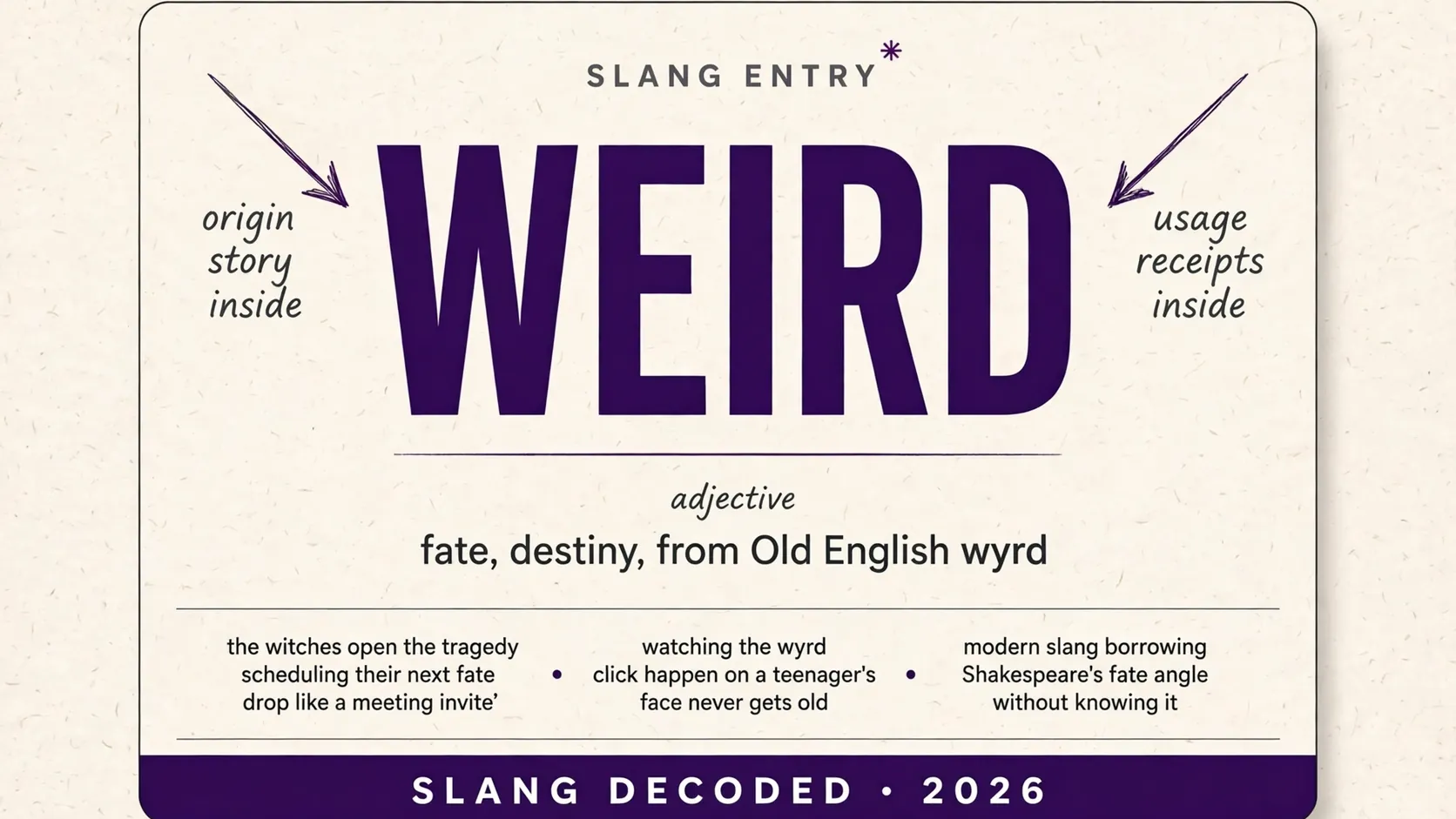
If you searched what does weird mean in macbeth, here is the twist. In the play, weird does not mean strange. It means fate, and the three witches are called the Weird Sisters because they reveal destiny, not because they are creepy. Shakespeare pulled the word from the Old English wyrd, the idea of fate that shaped how his audience heard prophecy and doom.
That one root changes everything. You stop seeing the witches as Halloween props and start seeing them as the engine of the tragedy.
The Wyrd Hiding Inside the Word, Decoded
| Meaning layer | What it actually means in the play |
|---|---|
| wyrd | Old English for fate or destiny, the script the witches read from |
| Weird Sisters | Not creepy sisters but fate sisters, plugged into destiny itself |
| weird | In 1606 it meant fate dealing or fateful, never odd |
| prophecy | The fate the witches reveal, which Macbeth mistakes for permission |
| strange | The modern meaning, arriving centuries after Shakespeare died |
| fate vs free will | The engine of the tragedy, unleashed when Macbeth believes |
| the witches job | Agents of fate, not inventors of it, and that difference matters |
| the original audience | They heard fate in the word, so the title landed heavier |
| your takeaway | Swap strange for fate and the play clicks into place |
A Timeline of How Wyrd Became Weird
| Era | What happened to the word |
|---|---|
| before 900 | wyrd rules Old English texts as fate, luck, and destiny in one |
| 800s to 1000s | Anglo-Saxons treat wyrd as a force you respect, not dodge |
| 1606 | Macbeth premieres and the Weird Sisters name drop fate on stage |
| 1600s | Readers still hear weird as fateful, as Shakespeare meant it |
| 1700s | The fate meaning fades as strange takes over everyday speech |
| 1800s | weird settles into its modern job, meaning odd, eerie, or off |
| 1900s | Classrooms rediscover wyrd and the old meaning gets a comeback |
| 2010s | TikTok edits borrow the witches for endless spooky season content |
| 2026 | You are here, decoding a 400 year old word before the debate |
Where the Word Lives Online and on Stage
| Platform | How weird shows up there |
|---|---|
| English classrooms | The number one habitat, usually during the witch scenes |
| SparkNotes | Where most students first meet the wyrd definition, often late |
| TikTok | Spooky season edits plus POV you are the fourth witch skits |
| YouTube | Video essays on fate vs free will at exhausting length |
| Tumblr | Witch aesthetic posts with the Weird Sisters at the center |
| Threads arguing whether the witches are fate or frauds | |
| BookTok | Clips of people annotating the moment wyrd finally clicks |
| theater stages | Directors lean into the fate angle with eerie sound and fog |
| your group chat | Someone drops weird sisters energy and everyone plays along |
The Tone Meter for This Tragic Word
| Tone | When it fits perfectly |
|---|---|
| ominous | The witches chant and the air gets heavy with what is coming |
| scholarly | You drop wyrd in an essay and your teacher nods approvingly |
| dramatic | Quoting the play with full stage voice at a costume party |
| spooky | October captions that borrow the witches minus the homework |
| ironic | Calling your chaotic friend group the weird sisters, lovingly |
| philosophical | Debating fate vs free will over very late night snacks |
| meme | Weird sisters reaction images for predicting your own bad decisions |
| reverent | Honoring how old and powerful this little word is |
| chaotic | Yelling fair is foul when your plans fall apart spectacularly |
Words That Orbit the Same Tragic Energy
| Related term | How it connects to weird |
|---|---|
| wyrd | The original Old English root and boss of the word family |
| fate | What weird actually meant, the destiny nobody outruns |
| doom | The darker flavor of fate, on brand for this tragedy |
| prophecy | Fate with a delivery date, courtesy of three witches |
| destiny | The modern word quietly doing wyrd’s old job |
| ominous | The mood following every Weird Sisters appearance |
| uncanny | Where the old fate meaning meets the new strange one |
| witchy | The internet aesthetic the witches invented centuries early |
| main character | Macbeth, who heard his fate and took it personally |
Who Says It and Why They Say It
| Speaker | Context | Energy |
|---|---|---|
| The First Witch | Opens the play asking when the three shall meet again | Mysterious and plotting |
| The Second Witch | Answers with thunder and lightning right on cue | Theatrical and loud |
| The Third Witch | Closes the chant that frames the entire tragedy | Final and chilling |
| Macbeth | Repeats their prophecies like reading his own horoscope | Obsessed and unraveling |
| Banquo | Hears the same fate and wisely refuses to chase it | Cautious and grounded |
| English teachers | Break the wyrd news to stunned sophomores every fall | Triumphant and nerdy |
| TikTok creators | Lip sync the witch scenes every spooky season | Campy and committed |
| study guide authors | Translate 1606 slang into 2026 brain language | Helpful and dry |
| you | Dropping weird sisters when fate feels suspiciously scripted | Smug and correct |
Receipts from the Play and the Internet
“When shall we three meet again in thunder, lightning, or in rain”
Act 1, Scene 1, the play’s first line, scheduling their next fate drop like a meeting invite.
“Fair is foul, and foul is fair”
Chanted as the witches vanish into fog, their motto and the internet’s favorite plot twist caption.
“All hail, Macbeth, hail to thee, Thane of Glamis”
Act 1, Scene 3 on the heath, a spoiler for a future he has not earned yet.
“All hail, Macbeth, hail to thee, Thane of Cawdor”
The second greeting in that same heath scene, true within minutes, which hooks Macbeth.
“Thou shalt get kings, though thou be none”
Said to Banquo right after Macbeth’s prophecies, the better deal with the wiser response.
“Something wicked this way comes”
The Second Witch announcing Macbeth in Act 4, Scene 1, reacting to his weird energy.
“weird sisters” in every modern meme edit
Across TikTok spooky season compilations, a label for any trio predicting chaos.
“weird sisters energy” in group chats
Texts about friend trios with main character plans, borrowing Shakespeare’s fate angle unknowingly.
How Each Generation Learned This Tragic Word
Boomers met it in school plays and classic films, where the witches were pure spooky set dressing
They learned weird as strange and never got the fate memo, which explains a lot.
Gen X caught it in 90s adaptations loaded with fog machines and dramatic lighting
The vibe was gothic horror, so fate took a back seat to the aesthetic.
Millennials found it through SparkNotes the night before the essay was due
Speed reading taught the plot but skipped the entire wyrd deep dive.
Older Gen Z discovered it through Tumblr witch aesthetic posts
Reblogged cauldron art carried the word into a new fandom with zero classroom context.
Younger Gen Z met it on TikTok through POV skits and dramatic line readings
Fifteen second clips made the witches funny first and fateful a distant second.
Gen Alpha is learning it through meme compilations and video game references
They meet weird sisters as a meme format before they ever meet the play.
Theater kids of every era learned it the correct way, out loud on a stage
Saying the lines yourself makes the fate meaning land in your bones.
Teachers relearn it every September when a student finally asks the question
Watching the wyrd click happen on a teenager’s face never gets old.
So What Does Weird Mean in Macbeth When the Witches Start Talking
Picture the opening scene. Thunder cracks, three figures step from the fog, chanting about when they will meet again. Your brain hears weird and files them under spooky, but Shakespeare’s audience heard fate and felt a chill. These are not random monsters. They are the announcement that destiny walked on stage.
If this old English rabbit hole is not the weird you were hunting, no shame. You might actually be looking for what does weird mean in psychology, what does weird mean in california, or what does weird mean in english, each living in a totally different corner of the internet. But if fate and witches are your thing, you are in the right article.
Why Shakespeare Called Them the Weird Sisters
Shakespeare did not invent the word. He borrowed wyrd from the Old English tradition where fate shaped kings and battles, then dressed it in witch costumes for maximum drama. Calling them the Weird Sisters told his audience these women were plugged into destiny. It was a job title, not an insult.
That is why the witches never cast the deciding spell on Macbeth’s soul. They hand him prophecies and let ambition do the murdering, exactly how fate works in the old stories. It names the ending and watches you sprint toward it. You decide whether that is terrifying or weirdly comforting.
How Strange Stole Weird’s Original Job
Languages drift, and weird drifted hard. Over the 1700s and 1800s the fate meaning faded while strange took over everyday speech, until dictionaries listed odd and eerie first. Shakespeare’s original sense became trivia instead of common knowledge. The word got a full rebrand without telling anyone.
That rebrand is why the witches read as Halloween decorations instead of destiny’s messengers. Modern readers bring the new definition to an old play and miss the engine underneath. Flip it back to fate and scenes you skimmed in school hit like spoilers. Your English teacher was right about that one little word.
Dropping Wyrd Knowledge without Sounding Like a Lecture
The trick is timing. Save the wyrd reveal for when someone calls the witches creepy, then hit them with the fate fact like a plot twist. You will watch their read of the play rearrange in real time. It is the rare lit fact that lands at parties.
You can also borrow the energy for your own captions. Calling a chaotic group chat the weird sisters works because fate is funnier than strange when plans are doomed anyway. Just remember the real meaning under the joke. You are quoting 400 year old destiny slang, cooler than any filter. The Scottish play’s weird is one flavor, and our breakdowns of shout, skull, and combo serve the modern ones.
Questions You Still Have About Weird in Macbeth
Does weird mean strange anywhere in Macbeth?
Not once. Every use points back to fate, destiny, or the witches who deal in it.
Why are they called the Weird Sisters instead of just the witches?
Because weird was their job description. They are the sisters of fate, which sounds way more powerful than a generic witch label.
Did Shakespeare invent the word weird?
Nope. He borrowed wyrd from Old English and gave it stage presence, but the word was already ancient.
Is wyrd pronounced like weird?
Basically yes, with a slightly rounder vowel, and knowing that makes you sound effortlessly smart in class.
Can I use weird sisters as modern slang?
Absolutely. Use it for any trio that predicts chaos, just know you are really saying fate sisters.