
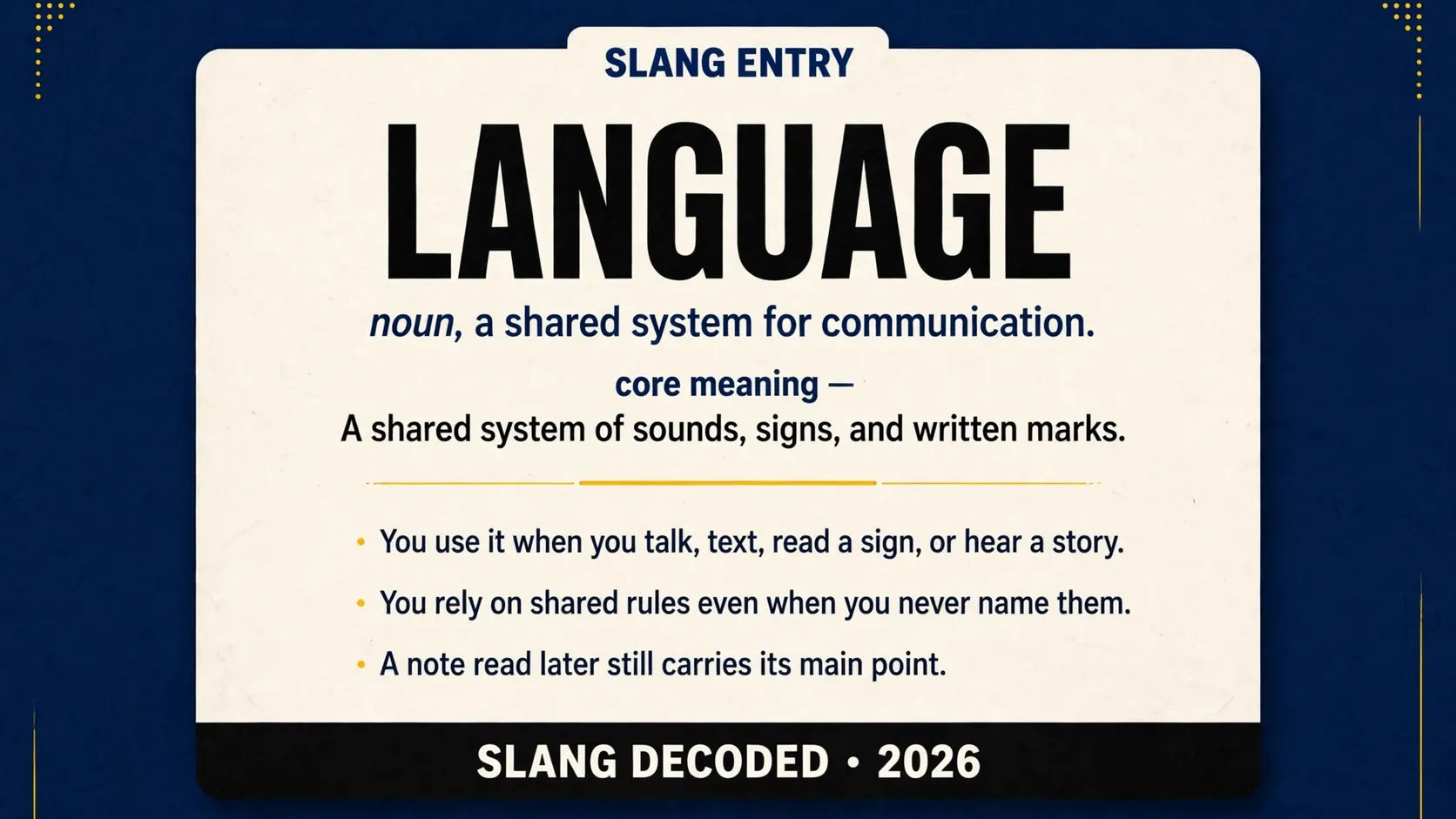
If you ask what does language mean in english, the short answer is that it means a shared system of sounds, signs, and written marks that people use to share thoughts, feelings, and instructions with each other in a way others can understand and answer back.
You use it when you talk, text, read a sign, or hear a story. You rely on shared rules even when you never name them, and those rules turn a sound or a mark on a page into an idea in someone else’s mind.
What Does Language Mean in English in Everyday Talk
In daily life the word covers a whole system, one named system like English, and a personal style of speaking. The table sorts those uses so you can spot the intended meaning from context.
| Setting | What language means there | Example in plain words |
|---|---|---|
| At home | Household talk, jokes | Private jokes outsiders miss |
| At school | System you study | Spelling rules guide readers |
| Online comments | Group words, shorthand | Friends grasp phrases fast |
| News stories | National community system | Documents translated for readers |
| Manuals | Precise job terms | Exact part names prevent confusion |
| Arguments | Tone, word choice | Harsh words sting despite facts |
| Songs | Sound, rhythm, feeling | Lines stick, feel vivid |
| Legal forms | Careful, doubt-free wording | Each word changes duties |
| Debates | Clear argument skill | Reasons first, then listen |
Core Parts You Use without Thinking About Them
Sounds become words, words join into phrases, and phrases build sentences you can follow from start to finish. You use these parts together without stopping to label them.
| Part | Job it does | How you notice it |
|---|---|---|
| Sounds, letters | Small speech pieces | Changed sound, new word |
| Words, parts | Names, actions, ideas | Endings shift time, number |
| Word order | Shows actor, acted-on | Swapped words flip stories |
| Grammar | Links words clearly | Missing piece feels unfinished |
| Meaning, context | One word, many situations | Warm or sharp by context |
| Tone, stress | Feeling, emphasis | Flat voice sounds cold |
| Gestures, faces | Movement supports speech | A nod answers silently |
| Written marks | Speech recorded durably | Old notes keep meaning |
| Conversation rules | Turn taking, repair | Repeats restore flow |
Sounds Words and Grammar in Plain Form
Grammar can sound stiff in a textbook, yet in real life it is just the habits that keep meaning from sliding around. You use those habits when you stress the word that matters most.
| Topic | Plain explanation | Try it yourself |
|---|---|---|
| Sounds | Contrasts change meaning | Feel the flip aloud |
| Spelling | Letters freeze sounds | Rebuild speech from notes |
| Word families | Shared root sense | Root grows noun, verb |
| Word order | Actor versus acted-on | Swap nouns, change story |
| Verb time | Action placed in time | Ending moves timeline |
| Plurals | One versus many | Mark creates a group |
| Questions | Order, rising tone | Voice lift asks answers |
| Negatives | Small word reverses claims | Listeners rethink points |
| Long sentences | Joining words link ideas | Links clarify relationships |
How English Grew into a World Language
English did not start as a global default. Trade, migration, empire, science, media, and the internet stacked up over centuries, and you still hear that layered past in its mixed vocabulary and many accents.
| Force | What it did | Lasting mark you can hear |
|---|---|---|
| Germanic roots | Core everyday grammar | Home words, family, work |
| French influence | Law, food, art words | Fancier terms beside plain words |
| Latin learning | Study, science words | Long words in formal writing |
| Trade, travel | Words into markets | Trade words traveled far |
| Migration | Speakers into regions | New accents, local words |
| Printing | Spelling fixed, texts spread | Written forms steadied slowly |
| Empire, schooling | Schools, offices abroad | Courts, classrooms far away |
| Pop media | Songs, films, shows | Phrases precede travel |
| Internet | Common online bridge | Guides, chats across groups |
Spoken Written and Signed Forms Side by Side
Language is not only speech. Speech moves through air, writing moves through marks on a screen, and signing moves through hands and face, yet all three share the same core job of building meaning.
| Form | How it travels | Strength you can count on |
|---|---|---|
| Everyday speech | Sound waves to listeners | Fast, warm, tonal |
| Formal speech | Prepared lectures, debates | Structure guides large groups |
| Handwriting | Pen marks on paper | Personal, portable, screen-free |
| Print, screens | Typed text, many readers | Searchable, shareable, revisable |
| Signing | Hands, face, space | Visual, complete language |
| Braille, touch | Raised dots, fingers | Reading without sight |
| Symbols, signs | Pictures, icons | Quick, widely shared meaning |
| Codes, shorthand | Short marks, longer words | Speed for trained users |
| Recorded media | Audio, video stored | Replay tone later |
Common Mix Ups That Blur the Meaning
Many confusions come from using one short word for several related ideas. When you ask whether someone means a system, a skill, a style, or a code, you stop arguing past each other.
| Mix up | Clear difference | Quick test |
|---|---|---|
| Language, jargon | Job talk inside | Terms learned, grammar kept |
| Language, dialect | Dialect, variety within | Share grammar, vocabulary |
| Language, accent | Pronunciation only | Words match, sound differs |
| Language, slang | Fresh layer inside | Full grammar still used |
| Language, speech | Act, not system | System survives silence |
| Language, communication | Broader, includes signals | Signals lack full language |
| Language, tongue | Literal or poetic | Organ, speech, or system |
| Language, literacy | Reading, writing skill | Fluent speakers may struggle reading |
| Language, code | Fixed symbol swaps | Training in cipher required |
Signs You Are Getting the Hang of English
- You follow fast chats without translating every word
- You catch jokes built on wordplay or tone
- You switch formal and casual styles with ease
- You repair muddles by rephrasing, not giving up
- You guess new words from context and land close
- You smooth out sentences that sound stiff
- You ask clear follow ups when points stay fuzzy
- You sum up short articles in your own words
- You write messages strangers can follow easily
Ways People Learn and Use English Today
- You watch shows with subtitles and repeat lines aloud
- You join comment threads and pick up fresh phrases
- You read news and guides on topics you love
- You practice speaking in short bursts with friends
- You keep a notebook of words that trip you up
- You listen to podcasts and note useful expressions
- You write short posts or journal entries daily
- You play word games that test spelling under pressure
- You translate thoughts until both versions feel clear
Why the Definition Still Matters Online
You might wonder why a simple definition deserves a full guide, and the answer is that online talk moves fast and blurs meanings in real time. When you know what language means at its core, you can tell a real shift in usage from a passing joke, and you can avoid reading too much into one viral clip.
When you browse related guides you may also meet language, relationship slang, and gen z dating terms, and each one points back to how people label connection in plain speech. That shared habit of naming and renaming shows why a clear core definition helps you stay grounded while slang keeps spinning around it.
How You Can Test Your Own Understanding
Try explaining the idea to a friend in one breath without reaching for a textbook phrase, and watch whether your friend can repeat it back in different words. If your friend can do that, you have grasped the core, because true understanding survives a change of wording without losing the point.
Try a second test by sorting examples into systems, skills, styles, and codes, and see whether each example lands in only one box. When an example fits two boxes at once, you have found a useful edge case, and naming that overlap will sharpen your sense of the word even more. You can also test yourself by writing the definition from memory and then comparing it with the version you started from.
What Changes When Language Moves to Screens
Screens reward short bursts, strong openings, and visual cues, so your writing now competes with images, captions, and autoplay clips for attention. You still need clear grammar and word choice, but you also need line breaks and a steady rhythm that lets a busy reader scan and still catch your main point.
Screens also preserve your words in ways speech never did, which means a hasty comment can travel far beyond its first audience. You can use that permanence well by drafting once, reading your words as a stranger would, and trimming anything that could sound harsher than you intended.
A Calm Way to Keep Learning from Here
Pick one small habit and keep it steady rather than chasing a grand plan that fades in a week. Read a little every day, note words that surprise you, and use one new expression in a real message so it moves from a list in your head into living speech you can trust.
Be patient with yourself when progress feels slow, because language skill grows in quiet layers rather than sudden jumps. You will notice the change later when a hard sentence suddenly feels easy, and that ease is the real reward for steady practice. Keep your notes close, revisit them often, and let small wins build your confidence week by week.
Frequently Asked Questions About Language in English
What does language mean in english in the simplest possible terms?
It means a shared system of sounds, signs, and written marks that people use to share meaning with each other.
Is language only about spoken words?
No, it also covers writing, signing, and other shared systems that follow rules and let people build meaning together.
Where did the English word language come from?
It came through French from the Latin word for tongue, and it widened over time from speech itself to a whole system of communication.
How is a language different from a dialect or an accent?
A language is the full system, a dialect is a variety within that system, and an accent is mainly a pattern of pronunciation.
Can you learn a language just by memorizing words?
No, you also need grammar, word order, context, and practice, because words alone do not carry full meaning without those links.