
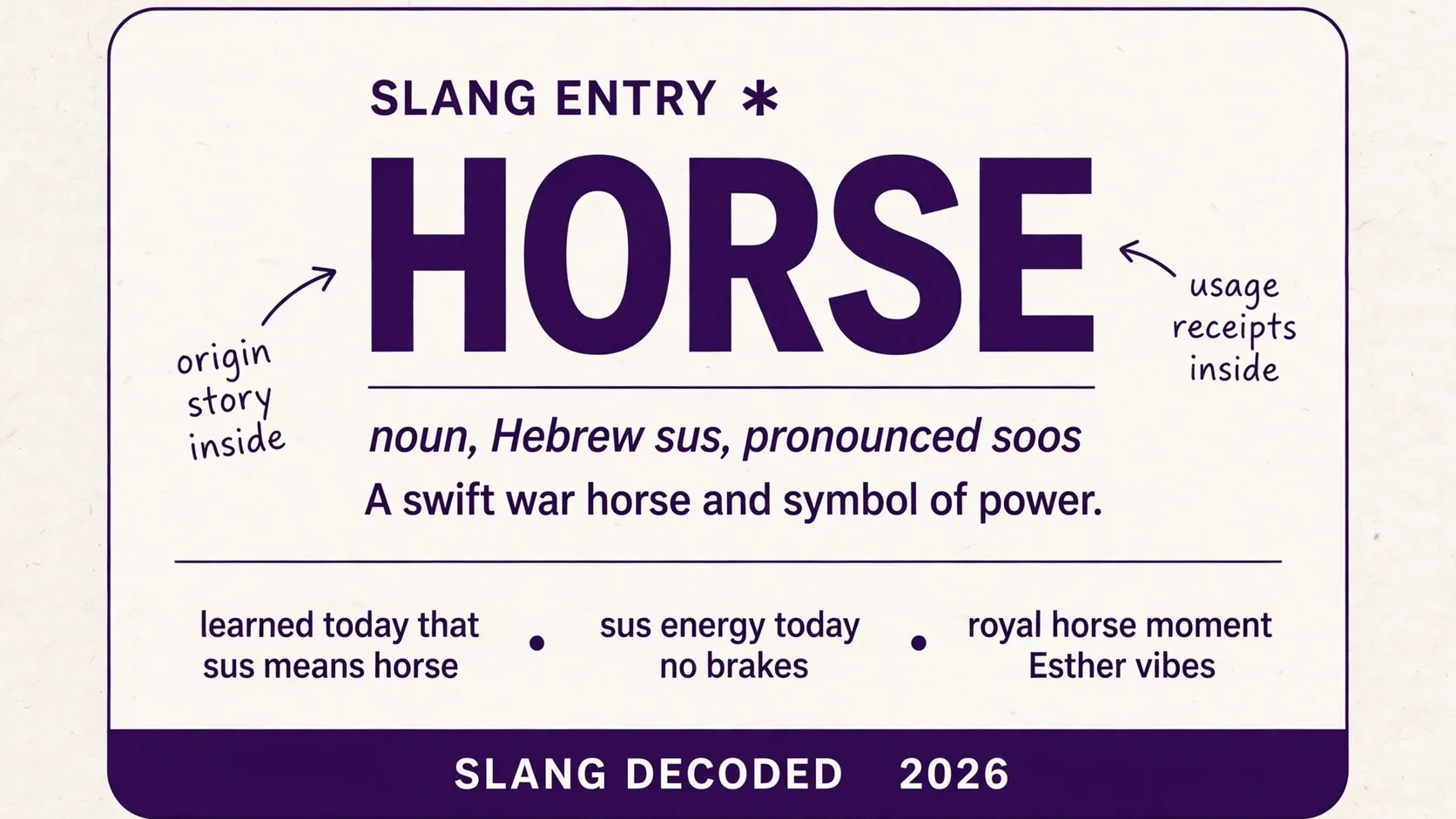
In Hebrew, horse means sus, a swift and powerful animal that stood for speed, strength, and war power in the ancient world. If you are asking what does horse mean in hebrew, you are really asking about one short word that carried a whole army on its back.
You will see it most often in Bible study notes, language videos, and comment threads where people trace an old word into modern Hebrew. It is not slang in the usual TikTok sense, but it travels online the same way, as a word people look up, quote, and reuse.
What Does Horse Mean in Hebrew When You Look It up Fast
| Word detail | What it means for you |
|---|---|
| Hebrew spelling | Sus, spelled samekh, vav, and samekh |
| Pronunciation | Soos in modern speech, with a long oo |
| Part of speech | A masculine noun, paired with masculine forms |
| Core meaning | A horse, especially a riding or war horse |
| Strong number | H5483 in the classic Hebrew word list |
| Root idea | A root linked to skipping or leaping |
| Plural form | Susim, used for more than one horse |
| Female form | Susah, used for a mare in particular |
The War Horse Job That Made Sus Famous
| Biblical job | Why it mattered in the story |
|---|---|
| Chariot horse | It pulled the fighting chariot into battle |
| Cavalry mount | It gave a rider speed and shock power |
| Royal parade horse | It showed public honor for a favored person |
| Imported war asset | Kings bought horses from Egypt for alliances |
| Symbol of trust | Trusting horses meant trusting military power |
| Symbol of pride | A huge horse force felt unbeatable before battle |
| Symbol of reversal | In the sea story, the enemy horse force falls |
| Symbol of judgment | Prophets picture horses cut off in disarmament |
Lines Where Sus Shows up and Sticks in Your Memory
“The horse and his rider hath he thrown into the sea.”
Appeared in the Song of the Sea in Exodus chapter 15 Context note. The line celebrates a total reversal for a strong army.
“Some trust in chariots, and some in horses.”
Appeared in Psalm chapter 20 verse 7 Context note. Human horsepower is set against a different confidence.
“An horse is a vain thing for safety.”
Appeared in Psalm chapter 33 verse 17 Context note. Muscle alone is warned against as false rescue.
“I will cut off the horses from you.”
Appeared in Micah chapter 5 verse 10 Context note. Peace is pictured by taking the war machine away.
“He delighteth not in the strength of the horse.”
Appeared in Psalm chapter 147 verse 10 Context note. Showy strength is pushed back in favor of trust.
“The horse is prepared against the day of battle.”
Appeared in Proverbs chapter 21 verse 31 Context note. Preparation is praised, but outcome lies beyond the stable.
“Woe to them that go down to Egypt for help, and stay on horses.”
Appeared in Isaiah chapter 31 verse 1 Context note. Leaders are warned against shopping for foreign military help.
“I have compared thee to horses in Pharaohs chariots.”
Appeared in Song of Songs chapter 1 verse 9 Context note. The finest royal horses become a romantic compliment.
How Sus Lives in Modern Hebrew Today
| Modern use | What you will hear or read |
|---|---|
| Everyday animal | Sus is the normal word for a horse |
| Riding lesson | Sus rechiva means a riding horse |
| Horseback riding | Rechiva al susim means riding as a hobby |
| Racehorse | Sus merutz is a horse built for racing |
| Work horse | Sus avoda is a literal or hardworking horse |
| Toy horse | Sus etz shows up in kids toy shops |
| Horse power | Susim can echo horsepower for engines |
| Place names | Sus appears in stable and riding school names |
Forms and Cousins of the Word You Should Not Mix Up
| Form or cousin | How it is different from plain sus |
|---|---|
| Susim | The plural, for a herd or cavalry group |
| Susah | The feminine form, used for a mare |
| Suson | A small horse or pony sense in modern use |
| Merkavah | A chariot, the vehicle the horse pulled |
| Rechev | A chariot force term, not the animal |
| Parash | A horseman, the person on the horse |
| Deherah | A gallop, the fast movement of charging |
| Agalah | A wagon, pulled by animals but not a chariot |
How People Actually Drop Sus into Chats and Captions
“Just learned sus means horse and now chariot verses hit different.”
Appeared in a language learning comment thread Context note. One translation unlocks a whole set of war images.
“Sus energy today, no brakes, just forward.”
Appeared in a gym caption and study motivation post Context note. Horse speed and stamina describe a workday push.
“My Hebrew word of the day is sus, and I keep saying soos.”
Appeared in a short video about daily Hebrew words Context note. The joke is about fun pronunciation practice.
“They trusted horses and chariots, we trust something else.”
Appeared in a Psalm 20 reflection post Context note. The writer paraphrases the psalm for modern readers.
“That plot twist was pure susim and chariots chaos.”
Appeared in a book club chat about a battle scene Context note. The plural form describes a messy dramatic action scene.
“If your plan needs a stable full of susim, it is too big.”
Appeared in a leadership meme about overbuilding a project Context note. An ancient buildup becomes a warning about scope creep.
“Learning sus, susim, and susah made Hebrew plurals click.”
Appeared in a grammar help thread Context note. One animal family teaches masculine, plural, and feminine forms.
“Royal horse moment, Esther chapter 6 vibes.”
Appeared in a caption about getting dressed up Context note. The royal parade means honor that is public and visual.
What the Horse Stands for When Writers Use It as a Symbol
| Theme | What the horse signals in the text |
|---|---|
| Military power | An army that moves fast and strikes hard |
| Human pride | Confidence in weapons, wealth, and alliances |
| Speed and urgency | News or judgment arriving before you prepare |
| Royal honor | Public celebration and a parade through the city |
| False security | A strong backup plan that cannot save you |
| Freedom and wildness | An untamed force that resists control |
| Beauty and strength | A creature admired for looks and muscle |
| Judgment on empires | A great power brought down with its army |
What Horse in Hebrew Does Not Mean, so You Can Avoid the Mixups
| Common mixup | The clearer reading |
|---|---|
| It does not mean a unicorn | No horn or magic, just a real horse |
| It does not mean a donkey | A donkey is chamor, a different animal |
| It does not mean a camel | A camel is gamal, built for desert travel |
| It does not mean a rider | The rider is parash, not the animal |
| It does not mean a chariot | The chariot is merkavah, the pulled vehicle |
| It does not mean a swallow usually | That sense is rare, horse is normal |
| It does not mean a car spec | Engine talk only borrows the horse image |
| It does not mean a slang insult | Sus is neutral and descriptive, not a putdown |
Why the War Horse Image Sticks in Your Head
You remember sus because it is visual and loud in your mind. You can picture dust, hooves, and chariot wheels, and that picture does more work than a dictionary definition ever could. When a writer says horse, you instantly feel speed and danger, and that is why the image survived for thousands of years.
It also sticks because it is tied to big turning points. The sea crossing, the royal parade, and the prophetic warnings all use the same animal to mark a moment when power changes hands. Once you see that pattern, you start spotting sus everywhere in the story, and it feels like a secret code you finally cracked.
How to Say It without Sounding Like a Textbook
Say soos, keep it short, and let the context do the heavy lifting for you. If you are in a Bible study, you can say the Hebrew word is sus and it means horse, then read the verse out loud and let people hear the image land. If you are online, a quick line like learned today that sus means horse works better than a long lecture.
If you liked this one, you will also want to check what does dove mean in hebrew, what does lion mean in hebrew, and what does eagle mean in hebrew next. Those animal words work the same way, with one short Hebrew term opening up a whole set of pictures and stories. You can compare them side by side and see how each animal carries a different kind of meaning.
Using Sus in Conversation without Forcing It
You can use sus when you are learning Hebrew, talking about a verse, or joking about your own energy for the day. Try it in a sentence about a lesson, like today I learned sus, or in a caption about a ride, like nothing beats a morning with the susim. The word is simple enough that people get it fast, even if they have never studied Hebrew before.
Keep it natural and do not overload your sentence with grammar terms. You do not need to explain Strong numbers or root theories in a casual chat, and your friends will thank you for it. Save the deeper word study for when someone actually asks how you know, and then you can share the fun details.
What to Remember Before You Post It
Remember that sus is mostly about a real horse first and a symbol second. Start with the animal, then add the symbolism only if the verse or conversation calls for it. That order keeps you honest and stops you from turning every horse mention into a grand theory about empires.
Remember too that ancient horses were war animals more than farm pets. That context explains why so many verses sound intense, and why a modern reader might miss the point if they picture a gentle pony. When you keep the war horse in mind, the warnings about trusting horses start to make perfect sense.
Frequently Asked Questions About What Does Horse Mean in Hebrew
What does horse mean in hebrew in one simple sentence?
It means sus, pronounced soos, the Hebrew word for a horse, especially a riding or war horse.
Is sus slang or a normal Hebrew word?
It is a normal Hebrew word, both ancient and modern, that people look up online the same way they look up slang.
Why do so many Bible verses mention horses?
Because horses were the fastest military technology of the ancient world, so they became the go to picture for power, pride, and speed.
What is the plural of sus in Hebrew?
The plural is susim, and the feminine form for a mare is susah.
Can I use sus in a modern Hebrew conversation?
Yes, you can use it for a real horse, a riding lesson, or a racehorse, and native speakers will understand you right away.