
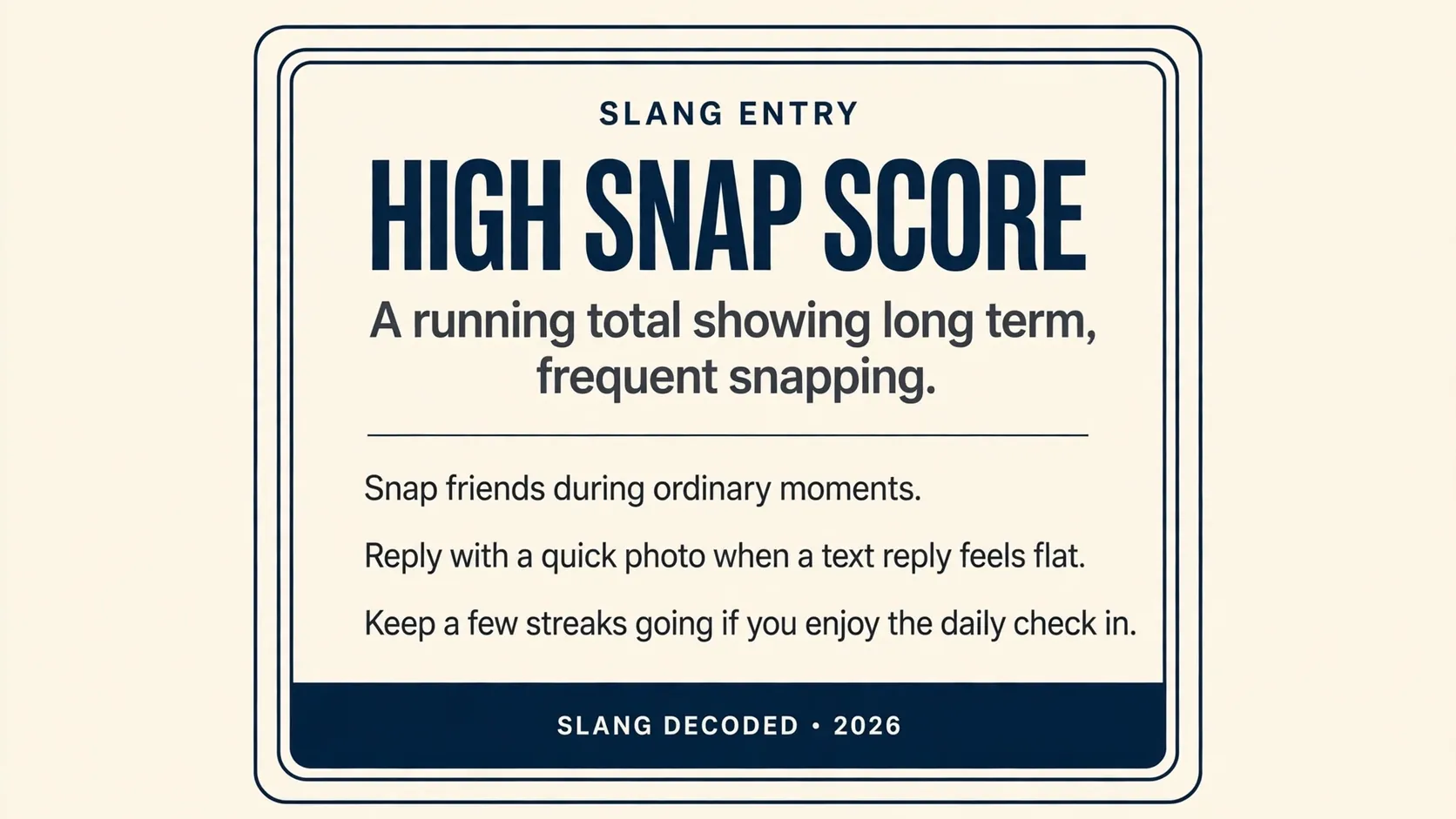
A high snap score means that a Snapchat user has been very active on the app over time, because the score is a running total that grows when you send and receive snaps. You can read a large number as a sign of frequent snapping and long term use, not as a grade or a measure of real life popularity. When you see it on a profile, in a screenshot, or in casual chat, it mainly tells you that the person has spent a lot of time snapping friends.
What a High Number Really Tells You About a Snapchat User
A high snap score tells you mainly about volume and time. It suggests that the person has sent many snaps, opened many snaps, and stayed active on Snapchat for a long stretch. It does not tell you how many close friends they have, how quickly they reply, or whether they are fun to talk to in person.
| Signal | What it usually means | What it does not mean |
|---|---|---|
| A very large total | Frequent long term use | Many close friends |
| A steady rise | Regular snap activity | Faster replies always |
| Many stories too | Comfort posting often | A famous account |
| Few chats too | Lots of snap activity | Deep talks daily |
| A sudden jump | A busy group phase | A personality change |
| A flat score | Less snapping lately | A lost friendship |
| A hidden score | Privacy or new contact | An account problem |
| A score above yours | More snap activity | A better person |
How Your Snap Score Grows Day by Day
Your snap score grows when you take part in the snap based parts of Snapchat. Sending a photo or video snap to a friend usually adds to your total, and opening a snap you receive usually adds to it as well. Posting a story and keeping a streak going can also play a part, although Snapchat has not published a complete exact formula for the public to check.
| Action | Likely effect | How to think about it |
|---|---|---|
| Sending a snap | Usually adds points | A direct snap action |
| Opening a snap | Usually adds points | Part of the exchange |
| Posting a story | May add points | A broader snap action |
| Keeping a streak | Linked to regular snapping | A habit signal |
| Sending many snaps | Adds up across snaps | Volume matters |
| Watching a story | Not the main driver | Viewing is not snapping |
| Text chat only | Less central here | Social but not snap based |
| Just opening the app | Little direct effect | Presence is not activity |
The Everyday Habits Behind a Very High Score
People with very high scores often share a few habits, even if they never try to chase the number on purpose. They snap friends when something funny happens, they reply with a photo instead of only words, and they keep several conversations going at once. Over months and years, those small actions add up into a total that looks huge to someone who opens the app only now and then.
- Snap friends during ordinary moments, not only on special days.
- Reply with a quick photo when a text reply feels flat.
- Keep a few streaks going if you enjoy the daily check in.
- Post a story when many friends should see one update.
- Open snaps you receive instead of letting them pile up.
- Send a snap to more than one friend when it fits them all.
- Try lenses and filters when they make a snap more fun.
- Come back regularly, since long gaps slow the total down.
- Treat the score as a side effect, not the reason to snap.
What Does Not Raise a Snap Score in the Way People Expect
A lot of confusion comes from actions that feel active but do not center on snaps. Watching stories for an hour, scrolling through Spotlight videos, or reading long chats can keep you busy on Snapchat, but those actions are not the same as sending and receiving snaps. Your score may stay almost flat after a long session if you did not snap much during it.
| Action that feels active | Why it may not move the score much |
|---|---|
| Watching many stories | Viewing is not sending a snap |
| Scrolling Spotlight videos | Watching is not snap exchange |
| Reading long text chats | Chats are not snap based |
| Editing your profile often | Profile edits are not snaps |
| Adding many new friends | Friends alone create no points |
| Liking or reacting a lot | Reactions are not snaps |
| Opening the app often | Brief visits without snaps add little |
| Saving memories privately | Saving is storage, not exchange |
High, Average, and Low Scores Side by Side
There is no official cutoff that turns a normal score into a high score, so the label depends on context. A score that looks high to a new user might look ordinary to someone who has snapped daily for years. Your friend group and how long you have used the app both shape what feels high, so a single number never tells the full story.
| Rough range | How people often read it | A fairer reading |
|---|---|---|
| Under 1,000 | New or light use | Early days or small circle |
| 1,000 to 10,000 | Getting started | Regular but casual use |
| 10,000 to 50,000 | Clearly active | Steady snapping over time |
| 50,000 to 100,000 | Very active | Frequent snaps and streaks |
| 100,000 to 500,000 | High by most standards | Long term heavy use |
| 500,000 to 1,000,000 | Extremely high | Years of daily snapping |
| Over 1,000,000 | Rare and striking | Exceptional volume over years |
| Any score alone | Hard to judge fairly | Ask about habits instead |
How to Read a Score without Jumping to Conclusions
When you see a high snap score, pause before you turn it into a story about the person. A high number could belong to someone who snaps a big group chat every morning, someone who has used Snapchat for years, or someone who simply loves sending silly photos all day. It could also belong to someone who is quiet in person but expressive through snaps, and that contrast is completely normal.
- Look at the score as one clue, not a full profile.
- Remember that group snaps can raise a score fast.
- Remember that years of use can beat months of heavy use.
- Do not assume a high score means many close friends.
- Do not assume a low score means someone is ignoring you.
- Check how the person actually talks with you daily.
- Ask lightly if you are curious, rather than guessing loudly.
- Keep the tone friendly, since scores can feel personal.
- Let friendship actions matter more than any total.
The Slang Words That Travel with Snap Score Talk
Snapchat talk has its own short vocabulary, and that vocabulary can make a simple number feel like insider language. When you hang out in Snapchat chats, you will run into snap score, snap, and snd, and each one points to a different part of the same app experience. A snap is the photo or video message itself, a snap score is the total tied to that activity, and snd is a short form people use in casual chat, often as a quick way to write send.
| Term | Plain meaning | Where you see it |
|---|---|---|
| Snap score | Running activity total | On a friend profile |
| Snap | Photo or video message | In a chat thread |
| Snd | Short for send | In quick typed messages |
| Streak | Days of back and forth snapping | Next to a friend name |
| Story | Snap shared with many friends | On a profile or feed |
| Spotlight | Short public videos | In the video feed |
| Bitmoji | Cartoon version of a user | On a profile or chat |
| Score check | Looking at a profile total | In jokes or casual talk |
Myths, Jokes, and Honest Limits Around High Scores
Jokes about high snap scores are everywhere, and they often stretch the truth for humor. You might hear that a huge score proves someone never puts their phone down, that it means they talk to hundreds of people daily, or that it unlocks special powers in the app. Those lines can be funny, but they are not reliable facts, and repeating them as facts can make a normal user feel judged for a number they never tried to grow.
| Common claim | How to handle it |
|---|---|
| A high score means huge popularity | Treat it as a myth |
| A high score unlocks secret features | No confirmed unlock is shown |
| A low score means a boring person | Treat it as a joke |
| You can buy a real high score safely | Avoid shortcuts and outside tools |
| Exact points per snap are fully known | Exact values are not confirmed |
| A score jump means cheating | A busy week can explain it |
| Friends must match scores to get along | Friendship needs no equal totals |
| A score proves phone addiction | Totals do not prove a habit |
How to Talk About a High Snap Score with Friends
You can talk about a high snap score with light humor and no pressure. Ask how long someone has been snapping instead of teasing them about the number, and focus on shared memories and streaks you both enjoy.
If a friend is proud of a high score, celebrate the consistency without making it a contest. If a friend is embarrassed by a low score, remind them it tracks only one kind of app use.
How to Reply When Someone Asks About Your Score
When someone asks about your score, you do not owe a long explanation. Share it if you are comfortable, laugh it off if you prefer privacy, or steer the chat toward a snap you both liked.
If the question feels pushy, change the subject without making it awkward. Ask about a favorite lens, suggest a new streak, or send a snap that moves the chat forward.
Keeping a High Score in Healthy Perspective
A high snap score can be a fun milestone, but it works best in the background of your friendships. You might enjoy watching it climb or celebrating a round number with a friend, because those moments connect to real people.
Step back if chasing the number starts to feel stressful. If you snap only to raise a total or feel bad when it stalls, take a break from checking it. Snapchat should help you stay close to friends, not add pressure.
Using Snap Score Talk without Turning It into Pressure
Snap score talk works best when everyone feels included. Joke about a high total or admire a long streak, as long as no one feels left out for having a lower number.
Set a kind example by praising replies, humor, and thoughtfulness, not only totals. Thanking a friend for a funny snap shows the friendship matters more than the counter.
Frequently Asked Questions
What does high snap score mean in simple terms?
It means a user has been very active with snaps over a long time, not that they are more popular in real life.
Does a high snap score mean someone talks to a lot of people?
Not always, since group snaps and long term use with a few friends can also build a very high total.
What counts most toward a high snap score?
Sending and receiving snaps over time counts most, while just watching videos or reading chats matters much less.
Is there an official number that counts as high?
No official cutoff exists, so high is informal and depends on how long someone has used Snapchat and how often they snap.
Can you raise your snap score quickly and safely?
No safe shortcut exists, so steady everyday snapping is the honest path, and outside tricks can risk your account.