
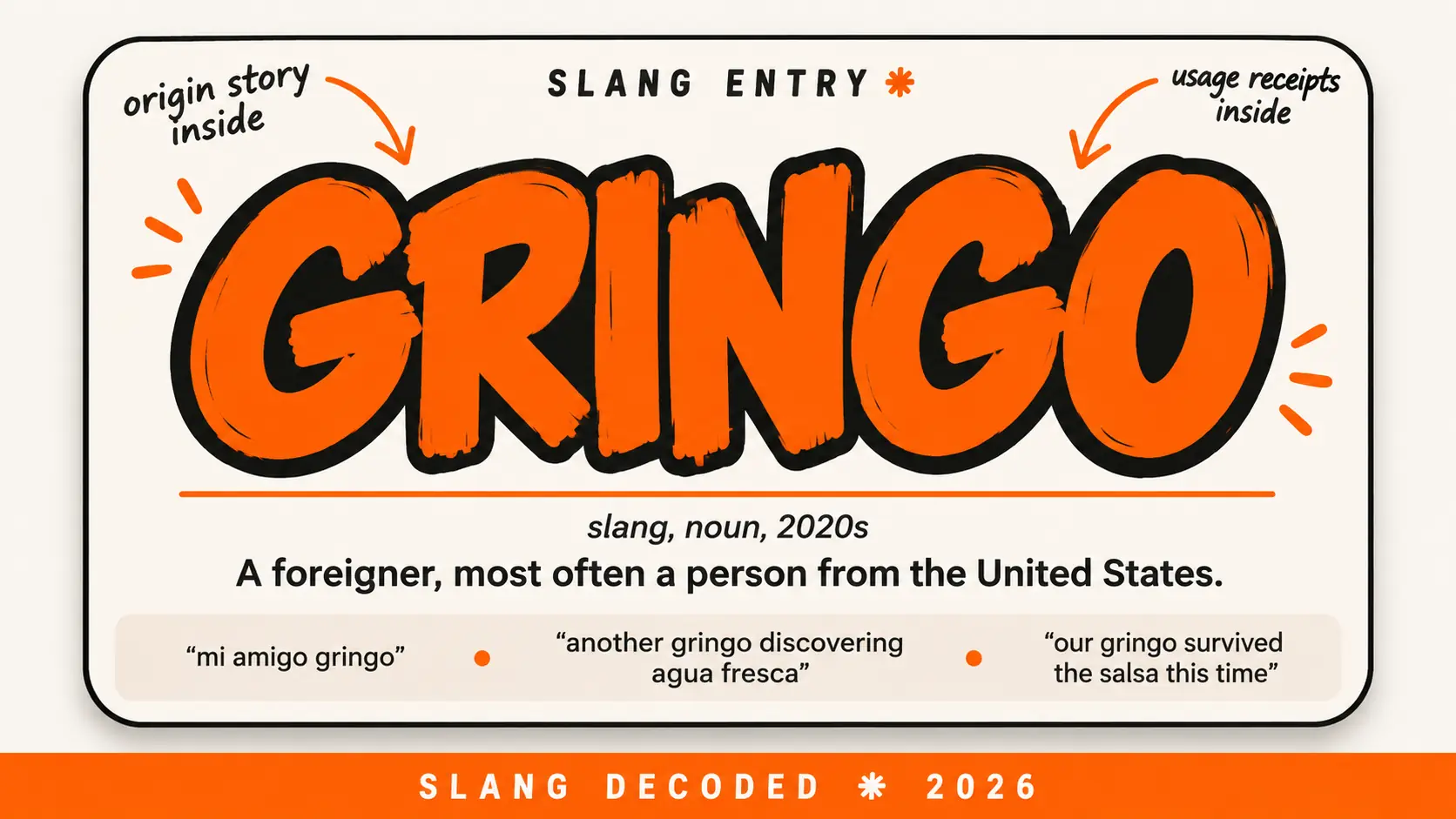
Gringo usually means a foreigner, most often a person from the United States, but the exact target changes depending on where you hear it. If you are asking what does gringo mean in slang, the safest decode is American or visibly foreign outsider, with tone doing a lot of the work.
The word is centuries older than social media, so there is no TikTok origin story hiding behind it. In Mexico it commonly points to Americans, while in Brazil it can mean basically any foreigner. Depending on delivery, it can sound neutral, teasing, affectionate, self-mocking, or openly hostile.
The Meaning Changes as Soon as You Cross a Border
| Place or context | What gringo usually points to | Typical vibe |
|---|---|---|
| Mexico | Person from the United States | Often neutral or teasing |
| Mexican American speech | Anglo American or noticeably American person | Familiar, joking, sometimes critical |
| Brazil | Almost any non-Brazilian foreigner | Casual and broad |
| Chile | Foreigner, often English-speaking or North American | Context dependent |
| Colombia | American, foreigner, or sometimes a pale foreign-looking person | Casual to mocking |
| Peru | American, foreigner, or in some uses a fair-skinned person | Neutral to teasing |
| Ecuador | Foreign visitor, especially North American | Informal |
| Central America | Frequently a U.S. citizen | Usually conversational |
| English-language use | Latin American label for an American or English-speaking outsider | Often heard as more negative |
| Online self-description | A foreigner joking about being obviously foreign | Self-aware or playful |
The Real Academia Española records both the broad older sense of foreigner and country-specific senses meaning a person from the United States. Brazilian Portuguese dictionaries make the contrast even clearer by defining gringo broadly as someone born outside Brazil.
Before Memes There Was a 1787 Dictionary
| Period | What happened |
|---|---|
| 1787 | Esteban Terreros y Pando records gringos in Spain for foreigners whose speech sounded unusual |
| Late 1700s | The label was especially associated in the cited dictionary tradition with foreigners such as Irish people |
| 1805 | A Don Quixote edition notes usage for Germans, Swiss people, and other northern Europeans |
| Early 1800s | The word continues traveling from Spain into wider Spanish-language usage |
| 1831 | An English-language novel includes the comic name Mr. O’Gringo for an Irish character |
| By 1841 | English documentation shows gringo used in a Chilean setting for a non-Latin European or Anglo-American |
| 1800s onward | American Spanish varieties increasingly develop their own local targets for the label |
| 1900s | In Mexico and several Latin American countries, the U.S. meaning becomes especially recognizable |
| Internet era | The word shows up in travel talk, bilingual memes, Latino humor, tourism arguments, and expat content |
| 2026 | Regional meaning still matters more than any one universal internet definition |
One popular story says gringo came from Mexicans hearing U.S. soldiers sing something beginning with “green grow.” Historical evidence works against that story because the word was documented in Spain decades before the Mexican-American War. Its deeper etymology remains disputed, with a possible connection to griego, Spanish for Greek, often compared with the idea of unintelligible foreign speech.
Gringo Did Not Blow up on One App
| Platform or space | How gringo shows up there | What to notice |
|---|---|---|
| TikTok-style short video | Locals joking about tourists, accents, food reactions, or foreigners adapting to Latin America | Delivery often turns it into friendly teasing |
| YouTube | Travel creators and bilingual comedians use it in titles about foreigners learning local customs | Often self-aware |
| Long arguments over whether the word is neutral, offensive, or country-specific | Regional disagreement is obvious | |
| Captions about being the foreign friend, foreign boyfriend, traveler, or obvious tourist | Usually lighter | |
| Travel forums | Questions like whether Canadians or Europeans count as gringos | Meaning depends heavily on destination |
| Group chats | Friends teasing someone for bad Spanish or stereotypically American habits | Relationship determines tone |
| Gaming chat | Can become trash talk aimed at U.S. players | Sharper and more competitive |
| Expat communities | Foreign residents may use it about themselves | Often reclaimed or humorous |
| News comments | Appears in political, tourism, migration, or U.S. related arguments | More likely to sound hostile |
| Bilingual memes | Used as shorthand for the American outsider who does not understand local habits | Comic stereotype |
Unlike slang such as rizz or delulu, gringo never had a single social platform where it suddenly became a new word. YouTube creators were already building jokes around the label years ago, while Reddit discussions continue showing how differently Latin American users define it.
The Tone Can Flip in Two Words
| Situation | How it lands |
|---|---|
| “mi amigo gringo” between close friends | Usually warm or teasing |
| A local identifying an American tourist as “el gringo” | Often descriptive |
| Someone calling themselves “un gringo en México” | Usually self-deprecating |
| A joke about a foreigner struggling with spicy food | Playful stereotype |
| “gringo” during an argument | More likely insulting |
| Adding a swear before it | Clearly more aggressive |
| Using it in a political protest slogan | Confrontational |
| Saying it to someone who dislikes the label | Risky regardless of local custom |
| Brazilian friends calling a European visitor gringo | Often ordinary informal speech |
| English speakers using it without understanding local norms | Can sound forced or provocative |
That is why dictionary labels do not tell the whole story. Cambridge and Collins flag the English-language term as disapproving or offensive, while native-speaker discussions from Mexico frequently describe ordinary local usage as a descriptor whose force depends on tone and surrounding words.
Who Actually Gets Called Gringo
| Person | Likely result |
|---|---|
| U.S. tourist in Mexico | Very likely |
| U.S. expat living in Mexico for years | Still commonly possible |
| Canadian tourist in Mexico | Sometimes, especially if mistaken for American |
| British traveler in Latin America | Depends on country |
| German traveler in Mexico | Usually not in the narrow Mexican sense |
| German traveler in Brazil | Yes, easily |
| Brazilian visiting Mexico | Usually not automatically |
| Mexican American visiting Mexico | Can be called gringo or gringa if strongly U.S.-coded |
| White Latin American | Not automatically gringo |
| Foreign tourist speaking weak Spanish | More likely to receive the label in broad-use regions |
This is where English explanations often flatten the term too much. A Reddit question from Austrian visitors in 2026 produced Mexican replies saying gringo primarily means American there, while broader Latin American discussions show Brazilian users applying it to virtually any foreigner.
The Words That Travel Beside Gringo
| Term | How it differs |
|---|---|
| estadounidense | Neutral Spanish word for a person from the United States |
| americano | Common for American, though some Spanish speakers avoid it because America also names the continents |
| yanqui | Yankee, often meaning U.S. person and sometimes carrying political flavor |
| gabacho | In Mexican usage can refer to the United States, Americans, or things associated with them and may sound rougher |
| extranjero | Straightforward word for foreigner |
| forastero | Outsider or person from elsewhere, not specifically American |
| güero | Mexican label connected more to light coloring or appearance than nationality |
| pocho | Often used for a U.S.-raised person of Mexican heritage, especially around language and cultural identity |
| turista | Tourist, which describes travel status rather than nationality |
| gringa | Feminine form of gringo |
These words overlap without being interchangeable. Calling someone estadounidense simply states nationality. Güero can be about appearance. Pocho points toward Mexican American identity. Gringo carries the outsider angle, especially the American outsider angle in Mexico.
Sightings That Show How People Really Use It
“gringo is only for people from USA”
Where it appeared Reddit discussion in r/mexico
Context A European visitor asked whether he counted as a gringo in Mexico. Several Mexican commenters treated the term as shorthand for U.S. nationality rather than every foreigner.
“gringo just means from the United States”
Where it appeared Reddit comment in r/AskMexico
Context A 2025 discussion asked whether a Finnish person could use the word. The replies again framed Mexican usage as mainly American, while noting tone can still change the effect.
“Descriptor. But kinda depends on the tone though.”
Where it appeared Reddit discussion in r/AskMexico
Context A 2026 thread asked directly whether gringo is an insult. The top responses separated the basic label from the aggressive language that can surround it.
“It just means ‘American’. At least in Mexico”
Where it appeared Reddit thread about Latin American regional differences
Context The discussion immediately shows why you cannot apply one country’s definition to every Spanish-speaking community.
“in Brazil it means any foreigner”
Where it appeared Latin American Reddit discussion
Context Brazilian usage repeatedly comes up as the major exception to the American-only assumption. That broad sense also matches Portuguese dictionary definitions.
“I present super gringo but speak decent Spanish”
Where it appeared Travel discussion about Mexico
Context The speaker uses the label on himself, showing how foreigners can adopt it jokingly to mean visibly or culturally American.
“they’ll make digs at how gringa you are”
Where it appeared Reddit discussion involving a Mexican American traveler
Context Here gringa is less about ancestry and more about seeming culturally U.S.-raised in Mexico.
“Gringo Explaining Mexican Words”
Where it appeared YouTube video title
Context The label becomes part of a comedy setup where the outsider understands Spanish but still misses local Mexican expressions.
A Second Batch of Real Context Clues
Travel caption
“three days in and this gringo finally learned how to order properly”
Context Self-deprecating use frames the foreigner as the person still learning local routines rather than as an enemy.
Group chat
“bro you put ketchup on those tacos you’re never beating the gringo allegations”
Context The joke is about stereotypically American behavior, not a literal nationality check.
Friend comment
“our gringo survived the salsa this time”
Context Possessive phrasing among friends can make the term sound affectionate and teasing.
Gaming chat
“these gringos keep rushing the same side”
Context Competitive settings make the word sharper because nationality becomes part of the trash talk.
Travel forum
“would a Canadian be considered a gringo there”
Context This confusion appears constantly because Mexican usage and broader dictionary definitions do not perfectly match.
Expat bio
“gringo viviendo en cdmx”
Context Foreign residents often use the word themselves as a quick identity joke.
Local comment section
“another gringo discovering agua fresca”
Context The tone is usually eye-rolling humor about outsiders discovering something ordinary to locals.
Political comment
“gringos telling us how our country should work again”
Context Now the word carries resentment because the complaint is about U.S. influence rather than a random tourist.
Brazilian group chat
“o gringo chegou ontem”
Context In Brazilian Portuguese the person could be American, German, Japanese, Australian, or almost any other foreign nationality.
Bilingual family joke
“you forgot all your spanish already gringa”
Context A U.S.-raised relative may get labeled gringa because of accent, vocabulary, or cultural habits even inside a Latino family.
What Does Gringo Mean in Slang When Someone Says It to You?
If someone calls you gringo, first look at where you are. In Mexico, the speaker probably thinks you are from the United States. In Brazil, they may simply mean you are not Brazilian. In another Latin American country, nationality, language, appearance, and local habit can all affect the label.
Then listen to the sentence around it. A laughing friend saying mi gringo is operating in a different universe from someone shouting the word during an angry confrontation. The noun itself carries history and outsider status, but the surrounding tone supplies much of the emotional charge.
Why the Green Go Story Keeps Surviving
The catchy myth says Mexican civilians heard U.S. soldiers singing songs containing the words green grow during the Mexican-American War and turned the sound into gringo. It survives because it is memorable, simple, and fits a tidy wartime story.
The problem is timing. A Spanish dictionary printed in 1787 already records gringo, decades before that war began in 1846. That older evidence is why modern etymology references reject the soldier-song explanation even though social media posts keep recycling it.
How Gringo Shifted from Foreign Speech to American Identity
The earliest documented idea was broader than the modern Mexican version. It centered on foreigners whose speech sounded unfamiliar, and older references connect the label with several European nationalities rather than Americans alone.
As the word moved through the Spanish-speaking Americas, local meanings narrowed or widened in different directions. Mexico strongly associated it with people from the United States, while Brazil borrowed the Spanish term and expanded it into an everyday label for foreigners generally.
Why the Internet Still Cannot Agree Whether Gringo Is Offensive
English dictionaries often mark gringo as offensive, disapproving, or potentially derogatory. That warning makes sense because English speakers frequently encounter it in confrontational movie dialogue, political slogans, or arguments rather than ordinary Latin American conversation.
Native usage is messier. Mexican commenters routinely describe the word as neutral unless the tone or surrounding insult makes it hostile, while some Americans say they have only heard it negatively. Both reactions can exist because they come from different social settings, countries, and relationships.
Faqs About Gringo
Does gringo always mean American?
No, it commonly means American in Mexico, but in places such as Brazil it can mean almost any foreigner.
Is gringo a swear word?
No, it is not inherently profanity, although it can become insulting when used aggressively or with hostile language.
Can a Latino person be called gringo?
Yes, especially if that person is U.S.-raised or is being perceived as culturally American in a Latin American setting.
Does gringo mean white person?
Not exactly, although some regional uses can overlap with fair skin or a stereotypically foreign appearance.
Did gringo come from soldiers saying green go home?
No, the word was already documented in a Spanish dictionary in 1787, long before the Mexican-American War.