
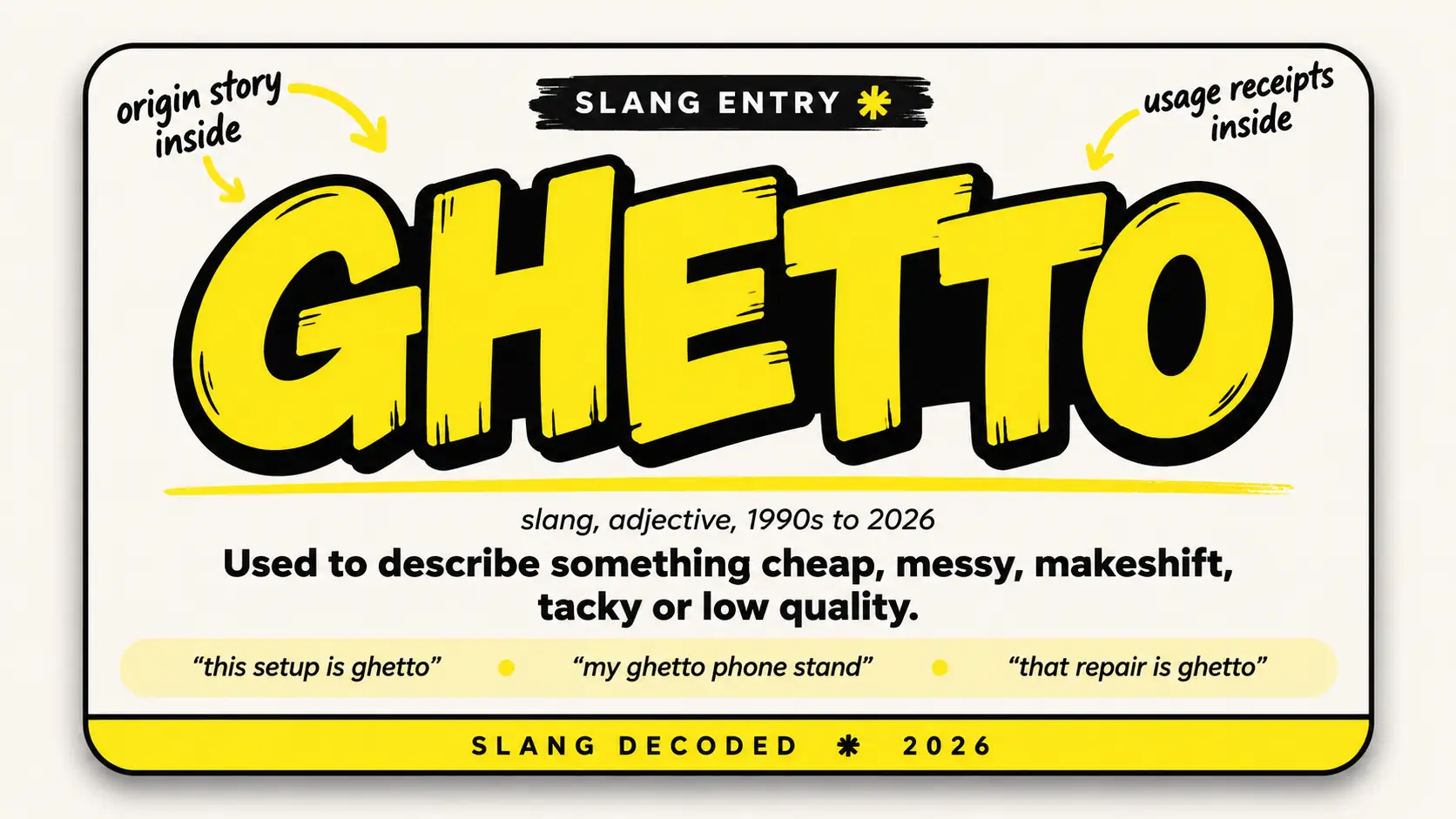
In slang, ghetto usually means cheap-looking, makeshift, messy, rough, overly flashy, or put together in an improvised way. If someone on your feed says a setup is ghetto, they are probably judging the execution, not literally describing a neighborhood. That adjective sense became especially visible in American popular culture around the late 1990s.
The word carries way more history than a normal roast, though. It started as a name connected to the compulsory Jewish quarter established in Venice in 1516, later became associated with segregated urban neighborhoods, and eventually picked up slang meanings through American urban culture, hip-hop, entertainment, and online conversation.
What Does Ghetto Mean in Slang When It Hits Your Feed?
| Slang use | What someone usually means | Mini example |
|---|---|---|
| Cheap | Looks noticeably low-budget | this table setup is ghetto |
| Makeshift | Improvised instead of properly built | my ghetto phone stand actually works |
| Messy | Poorly organized or presented | this whole setup is ghetto |
| Shabby | Worn down or badly maintained | the hallway looks ghetto |
| Crude | Put together without much polish | that repair is kinda ghetto |
| Flashy | Loud styling judged as excessive | those decorations look ghetto |
| Improvised | A workaround made from whatever is available | ghetto engineering but it worked |
| Tacky | Seen as lacking conventional taste | the fake gold trim is ghetto |
| Chaotic | Disorderly in a funny or frustrating way | this party setup got ghetto fast |
The slang adjective is documented with senses such as makeshift, garish, crass, shabby, crude, and low-quality. That explains why the same word can describe a taped-together charger one minute and somebody’s outfit the next.
From Venice in 1516 to a Modern Slang Adjective
| Period | What changed |
|---|---|
| 1516 | Venice confined Jewish residents to a designated district that became associated with the word ghetto |
| Early 1600s | English records begin using ghetto for Jewish quarters |
| 1800s | The meaning expands beyond specifically Jewish districts |
| Late 1800s | American usage increasingly connects the word with crowded minority urban neighborhoods |
| Early 1900s | Ghetto is established as an adjective as well as a noun |
| Mid-1900s | U.S. usage becomes strongly tied to racial segregation and economically isolated Black neighborhoods |
| 1960s | The word becomes highly visible in discussions of American cities, inequality, and Black urban life |
| 1990s | Hip-hop culture helps push phrases such as ghetto fabulous into mainstream entertainment and fashion |
| Around 1999 | Reference histories date the modern slang adjective sense to roughly this period |
| 2000s to 2026 | Texting, memes, videos, comments, and captions carry the adjective into everyday internet speech |
There is no clean historical case for saying TikTok invented this meaning. The modern slang usage predates TikTok and even the social-media era. The 1990s hip-hop and entertainment boom is a much more important bridge between neighborhood meaning and the later lifestyle or quality judgment.
Where Ghetto Lives Online Now
| Space | Typical use | Vibe |
|---|---|---|
| TikTok | Reacting to DIY fixes, chaotic situations, outfits, homes, or behavior | Comic to judgmental |
| Comments on styling, decorations, beauty looks, parties, and presentation | Often appearance-focused | |
| YouTube | Criticism of performances, fashion, behavior, or production quality | Can become harsh |
| X | Fast reactions to public situations or visibly low-budget solutions | Sarcastic |
| Snapchat | Casual description of something awkward or makeshift | Friend-group humor |
| Group chats | Teasing a friend’s improvised solution | Usually playful if trust is high |
| Gaming chats | Describing a janky setup, strategy, or hardware fix | Comic |
| Meme pages | Labeling absurdly improvised solutions | Exaggerated |
| Voice notes | Storytelling about messy situations | Tone depends heavily on speaker |
YouTube discussion threads provide older internet evidence of ghetto being used adjectivally to criticize style and behavior, while current slang guides note the word appearing across TikTok, Snapchat, Instagram, texting, and other social spaces.
The Tone Flip Is Bigger than the Definition
| Situation | Likely reading | Risk level |
|---|---|---|
| Calling your own DIY fix ghetto | Self-deprecating humor | Lower |
| Friend calling your taped charger ghetto | Teasing | Lower |
| Calling a badly organized event ghetto | Criticism of execution | Medium |
| Calling cheap furniture ghetto | Low-quality judgment | Medium |
| Calling someone’s clothing ghetto | Taste and class judgment | Higher |
| Calling someone’s speech ghetto | Social and racial stereotype can enter quickly | High |
| Calling a Black person ghetto | Can sound explicitly racialized | High |
| Calling an entire neighborhood ghetto | May mean poor or segregated, but can flatten the people living there into a stereotype | High |
| Saying ghetto fabulous | Can signal bold street glamour, irony, authenticity, or tackiness depending on context | Context-heavy |
Research on attitudes toward African American English notes that ghetto is sometimes applied to Black vernacular speech and that the term can also be used playfully within Black communities. That makes speaker, target, and relationship unusually important here.
Scrapbook Sightings of Ghetto in Casual Speech
“my ghetto little phone stand”
Where it fits: TikTok-style caption Context: Someone has balanced a phone against random household objects and is joking about how improvised the setup looks.
“this is so ghetto but it works”
Where it fits: Group chat Context: The speaker knows the solution looks ridiculous but cares more about the fact that it solves the problem.
“why is the checkout setup so ghetto”
Where it fits: Comment Context: A user is criticizing a store or event for looking temporary, disorganized, or underfunded.
“not the ghetto extension cord situation”
Where it fits: Story caption Context: Humor aimed at a messy collection of cables rather than a literal place.
“we made a ghetto tripod”
Where it fits: Behind-the-scenes caption Context: Everyday shorthand for DIY equipment assembled from whatever was available.
“that repair is ghetto as hell”
Where it fits: Voice note Context: Someone is roasting a visibly rough repair that technically functions.
“the decorations got ghetto real quick”
Where it fits: Group chat Context: The word shifts from improvised to tacky or overdone.
“they called her outfit ghetto”
Where it fits: Comment discussion Context: Much more loaded because the judgment is now attached to a person, style, class signal, and potentially race.
“ghetto fabulous actually describes the vibe”
Where it fits: Fashion caption Context: The meaning flips toward bold glamour, street-rooted luxury, exaggeration, and intentional flash.
These patterns show the main internet divide. Ghetto aimed at an object or your own workaround can read like a joke. Point it at a person’s speech, appearance, or identity and the baggage becomes much harder to separate from the insult.
Ghetto Fabulous Changed What the Word Could Signal
| Usage | Meaning in context |
|---|---|
| ghetto fabulous | Street-rooted glamour mixed with conspicuous luxury |
| ghetto glam | Flashy style with urban or DIY influence |
| straight ghetto | Intensifies a negative judgment |
| kinda ghetto | Softens the criticism slightly |
| ghetto fix | Crude or improvised repair |
| ghetto rig | Makeshift technical workaround |
| ghetto setup | Low-budget or improvised arrangement |
| from the ghetto | Usually literal background or neighborhood reference, not the slang adjective |
| ghetto style | Ambiguous, potentially fashion-related or disparaging |
The positive side matters because ghetto has not always traveled as a simple synonym for bad. The 1990s phrase ghetto fabulous was tied closely to Black music, fashion, glamour, authenticity, and the collision of street aesthetics with visible luxury. Danyel Smith was writing about the expression in The New Yorker in 1996, and hip-hop titles helped push it further into the mainstream later that decade.
Words That Sit Beside It without Meaning Exactly the Same Thing
| Term | Key difference |
|---|---|
| janky | Usually badly made, unreliable, awkward, or malfunctioning |
| ratchet | More often describes chaotic behavior, style, places, or situations |
| tacky | Mainly a taste judgment |
| cheap | Focuses directly on cost or low quality |
| busted | Broken, unattractive, or in bad condition |
| sketchy | Suggests suspiciousness or lack of safety |
| bootleg | Often implies unauthorized, fake, unofficial, or imitation |
| DIY | Neutral and can even be complimentary |
| low-budget | Describes limited spending without automatically insulting anyone |
| hood | Can refer to neighborhood culture or identity and has its own separate racial and cultural history |
Calling a lamp janky tells you it may fall apart. Calling it ghetto can suggest the same roughness but adds social imagery about class, neighborhoods, and urban stereotypes. That extra layer is why the words are not perfect substitutes.
Who Uses It and What They Usually Mean
| Speaker or setting | Common pattern |
|---|---|
| Black American speakers | Can range from in-group humor and self-description to sharp criticism |
| Millennials | Often familiar with 1990s and 2000s meanings, especially ghetto fabulous and that’s ghetto |
| Gen Z | More likely to encounter it beside newer terms such as ratchet, janky, messy, or bootleg |
| Older Americans | May hear the literal neighborhood meaning first |
| Fashion communities | Sometimes use it through the history of ghetto fabulous aesthetics |
| DIY creators | May use it jokingly for improvised builds |
| Friend groups | Often shorthand for cheap, chaotic, or slapped together |
| Outsiders describing people | The word can land much more negatively because racial and class stereotypes become harder to ignore |
There is no single community that owns every modern use. What matters is that the slang adjective developed inside an American landscape where ghetto was already heavily connected to race, segregation, poverty, housing, and Black urban culture.
Receipts That Show How the Meaning Changes
“ghetto fabulous”
Where it appeared: Fashion and music culture Context: By the 1990s, the phrase could celebrate loud, aspirational glamour rather than simply insult something as poor-quality.
“ghetto cars”
Where it appeared: Published slang example Context: The adjective is used for cheap vehicles that are treated as disposable rather than glamorous.
“very ghetto, door-knocker bamboo earrings”
Where it appeared: Fiction excerpt reproduced by a dictionary Context: Here the word points toward a recognizable urban fashion aesthetic, not a broken object.
“chewing gum when accepting an award very ghetto”
Where it appeared: Magazine example reproduced by a dictionary Context: The target is etiquette and behavior, showing how the word expanded into judgments about manners.
“poor kid who grew up in the ghetto”
Where it appeared: Dictionary usage example Context: This is the noun meaning, referring to a neighborhood rather than the slang adjective.
“I’m from the ghetto”
Where it appeared: Dictionary usage example Context: Again, literal background and place identity rather than ghetto meaning tacky.
“straight up ghetto”
Where it appeared: Older online discussion of adjectival usage Context: The intensifier turns the word into a direct judgment about appearance or behavior.
“ghetto fabulous” as an album title
Where it appeared: Mystikal’s 1998 hip-hop album Context: A major example of the phrase circulating through late-1990s rap culture.
The Word Was Online Slang Before Tiktok Got Hold of It
If you first encountered ghetto beneath a TikTok showing a plastic chair holding up an air conditioner, TikTok can make the term look recent. It isn’t. The slang adjective was already established around the turn of the millennium, and its cultural runway goes through 1990s hip-hop, fashion, magazines, television, comedy, and everyday speech.
What TikTok and short-form video changed was the visual punchline. You can now see the sketchy wiring, duct-taped repair, overloaded table, or wild party setup before reading a two-word judgment underneath it. That makes the cheap or improvised sense easy to understand even if you have never heard the older cultural references.
Why Ghetto Can Sound Funny in One Chat and Brutal in Another
The cleanest distinction is usually the target. If you call your homemade phone holder ghetto, the joke is mostly about your own resourcefulness. If you describe a person’s accent, hair, clothes, neighborhood, or family that way, you have moved from roasting an object into judging social identity.
That shift matters because the literal word spent generations connected with forced segregation, minority neighborhoods, racial discrimination, and economic exclusion. In American speech especially, Black communities became strongly associated with the word during the twentieth century. The slang meaning inherited some of those associations even when the speaker only intends to say cheap.
The Positive Meaning Usually Comes Through Reclaiming and Style
There is a genuinely positive lane for the word, but it is narrower. Ghetto fabulous could communicate creativity, authenticity, survival, flash, ambition, and a street-rooted style that refused quiet ideas of respectable luxury. In 1990s fashion culture, that aesthetic moved from Black urban scenes toward mainstream entertainment.
That is different from somebody sneering that’s ghetto at an outfit. Same base word, different social move. One can frame excess or resourcefulness as part of the appeal. The other can dismiss the exact same visual language as cheap or classless.
In 2026, Context Still Does Most of the Work
If somebody texts this setup is ghetto, your safest read is usually cheap, improvised, shabby, or awkwardly put together. If they write ghetto fabulous, expect a fashion or cultural reference where street aesthetics and glamour collide. If the word describes an actual district, the literal historical and sociological meaning may be doing the work instead.
You therefore cannot decode ghetto from the word alone. Look at what it modifies, who is talking, whether the speaker is joking about themselves, and whether the target is an object, behavior, place, or person. Those clues tell you which version you are actually hearing.
Faqs About Ghetto Slang
Does ghetto mean poor in slang?
Sometimes, but in slang it more often means cheap-looking, shabby, makeshift, tacky, or badly put together rather than simply lacking money.
What does “that’s ghetto” mean in a text?
It usually means the speaker thinks something looks low-budget, messy, improvised, tacky, or socially embarrassing.
Is ghetto the same thing as ratchet?
Not exactly, because ratchet often targets chaotic behavior or style while ghetto carries stronger neighborhood, class, and racial associations.
What does ghetto fabulous mean?
It usually describes flashy, street-rooted glamour that mixes urban style, conspicuous luxury, resourcefulness, and attitude.
Did ghetto become slang because of TikTok?
No, the modern adjective was circulating before social media, with strong visibility in 1990s hip-hop, fashion, entertainment, and early-2000s popular speech.