
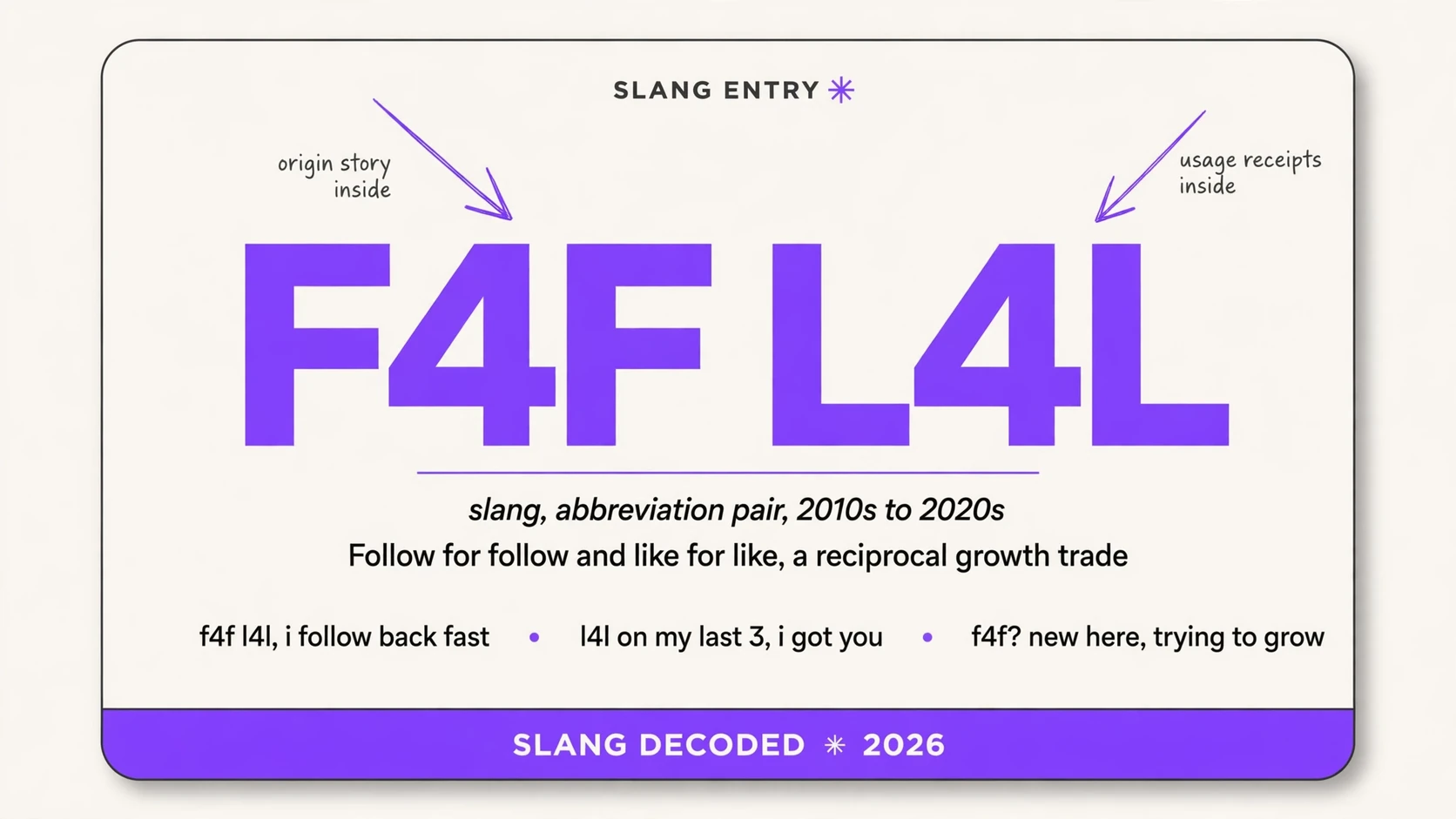
F4F means follow for follow and L4L means like for like, and together they offer a simple trade. You follow my account and I follow yours back, you like my post and I like yours back. That swap is the whole deal behind what does f4f and l4l mean.
You will spot it in bios, captions, comments, hashtags and direct messages, usually in lowercase. It can read friendly between small accounts, and pushy when it floods a comment section. The meaning stays steady.
Two Halves That Make One Growth Deal
| Half of the pair | What it asks you to do |
|---|---|
| F4F | Follow an account and expect that account to follow you back |
| L4L | Like a post and expect the other person to like one of yours back |
| The 4 in the middle | Stands in for the word for, the same shortcut seen in old text speak like b4 |
| F4F plus L4L together | A combined offer to trade both a follow and a like in one line |
| F4F on its own | A longer commitment, since a follow stays in your feed until someone unfollows |
| L4L on its own | A lighter touch, since a like takes one tap and changes little day to day |
| Followback | The action itself, following someone back after they followed you first |
| The unwritten rule | Both sides should keep up their end for a while, or the trade feels broken |
How a Hashtag Habit Turned into Feed Culture
| Period | What changed for the pair |
|---|---|
| Early hashtag era on Twitter | Short tags made reciprocal deals easy to search |
| Early Instagram growth years | Visual accounts adopted the pair fast, since counts sat beside every photo |
| Mid 2010s hashtag stacking | Bios and captions piled up tags, and small accounts used them to reach strangers |
| Late 2010s comment trading | The deal moved into comments and direct messages, one account at a time |
| Early 2020s creator boom | New creators kept the pair alive in Discord servers and group chats as hashtag browsing faded |
| 2010s fan and meme pages | Fan and meme pages spread the pair through captions, since volume and discovery mattered more than deep ties |
| Recent years on TikTok and Reels | Short video comments revived the ask under videos from brand new accounts |
| 2026 feed reality | The words are still understood instantly, but the trade now competes with saves, shares and watch time |
Where You Will Bump into the Pair Today
| Platform | How the pair shows up there |
|---|---|
| In bios, captions, story replies and comments, often stacked with other growth tags | |
| TikTok | In video comments and bios from new accounts, as a short ask under an early video |
| X, formerly Twitter | In replies and hashtag posts, where follow back culture has long been normal |
| YouTube | Rarely in this exact form, since sub for sub fits subscriptions better |
| Discord | Inside growth and promo servers, where the trade is organized in channels |
| Snapchat | Less often in public posts, more often as a private add back deal between people building a friend list |
| Facebook groups | In promo threads where page owners trade follows and likes for a new page |
| Twitch | In chat from small streamers, paired with a follow back promise during a live stream |
Receipts from Bios, Comments and Dms
“f4f l4l, i follow back fast”
Seen in an Instagram bio. The note is speed, since a fast follow back makes the trade feel worth it.
“l4l on my last 3, i got you”
Seen in an Instagram comment. The note is scope, since three posts is a bigger ask than one tap.
“f4f? new here, trying to grow”
Seen in a TikTok comment. The note is honesty, since the account names its goal outright.
“follow for follow and like for like, no ghosting”
Seen in a direct message. The note is trust, since ghosting means never returning the follow.
“f4f l4l sfs, lets grow together”
Seen in a fan page caption. The note is stacking, since three growth terms signal growth is the point.
“l4l, just dropped a new reel”
Seen in a comment on a dance reel. The note is timing, since the ask rides on fresh content.
“f4f, i always check who followed”
Seen in an X reply. The note is checking, since some accounts audit new followers.
“like for like? say less, done”
Seen in a group chat between friends. The note is ease, since the trade feels casual between friends.
“f4f l4l, small creators only”
Seen in a Discord promo channel. The note is belonging, since the limit feels like mutual help.
Reading the Tone Before You Reply
| Situation | Tone you are likely to hear |
|---|---|
| A new account asks politely in a comment | Hopeful and nervous, like asking for a chance |
| A bio stacks the pair with five other tags | Hustling and direct, with growth as the main message |
| Friends trade likes in a group chat | Warm and playful, closer to hyping each other up |
| The same ask floods every post you open | Tiring and spammy, since repetition feels automatic |
| A fan page offers the pair to other fan pages | Cooperative, since both pages want the same audience |
| Someone follows, then unfollows a day later | Sour, since the quick unfollow breaks the deal |
| A creator adds the pair to a strong post | Confident, since the content can stand alone |
| A brand account uses the pair in comments | Awkward, since a business trading follows can look less credible |
The Crew That Always Travels with the Pair
| Related term | How it connects to F4F and L4L |
|---|---|
| SFS | Shoutout for shoutout, a trade of posts or stories between pages in one niche |
| C4C | Comment for comment, a trade of comments that takes more effort than a like |
| S4S | Shoutout for shoutout in its shorter form, used much like SFS when two accounts promote each other |
| Sub4sub | Subscriber for subscriber, the YouTube cousin of the pair, built on the same reciprocal idea |
| Followback | The plain word for returning a follow, the action every F4F deal needs |
| LB | Like back, a short request for a returned like, often left as a comment on the newest post |
| R4R | Repost for repost or retweet for retweet, a trade of shares that spreads a post to a second audience |
| Pod | A small group that likes and comments on each member post on schedule |
| Engagement group | A larger chat where members trade likes, comments and follows in a loop |
Who Drops the Pair and What They Want from It
| Group | Style and typical goal |
|---|---|
| Brand new creators | Direct and hopeful, using the pair when almost nobody sees a post |
| Fan pages and edit accounts | Friendly and niche focused, trading with pages that love the same show or team |
| Small shops and side hustles | Practical, hoping a follow turns into a shop visit |
| Teen friend groups | Casual and supportive, trading likes like friends hyping a post |
| Millennial creators who grew up with hashtags | Nostalgic, using the pair as a familiar shortcut |
| Gamers and streamers | Chatty and live, offering a follow back during a stream |
| Meme pages | Blunt and fast, stacking growth terms because volume matters |
| Non native English speakers | Clear and simple, using the short pair because it crosses language gaps |
Stacked Lines You Will See in the Wild
“f4f l4l, follow me and i will follow you”
Seen in an Instagram caption. The note is a full sentence version of the deal.
“#f4f #l4l #followback #likeforlike”
Seen as a hashtag stack under a photo. The note is discovery, since it is built to be found.
“l4l f4f, lets support each other”
Seen in a TikTok bio. The note is softening, since support language sounds like community care.
“f4f only, no l4l today”
Seen in a comment. The note is choice, since each half can stand alone.
“l4l on this post only, be real”
Seen under a Reel. The note is a limit, since one post keeps the trade small.
“f4f l4l c4c, the full package”
Seen in a Discord promo message. The note is escalation, since adding comments makes the trade heavier.
“new account, f4f l4l, thank you”
Seen in an X post. The note is manners, since a thank you softens the ask.
“f4f, i follow back everyone”
Seen in a bio. The note is a promise, judged fast if the follow back never arrives.
“l4l, drop yours and i will return it”
Seen in a comment thread. The note is turn taking, since each person waits for the return tap.
Why the Pair Took Off in the First Place
You can see why the idea spread so fast when follower counts were the loudest proof that an account mattered. A follow back was free, it took seconds, and it made both accounts look a little more established to the next stranger who landed on the profile. The pair gave new accounts a way to move, and it gave small communities a shared language for helping each other get seen.
The 4 in the middle helped too, because it kept the whole deal to three characters per half and fit neatly into bios, hashtags and short comments. You did not need a long pitch or a clever caption to join in, you just needed the letters and a willingness to return the favor. That simplicity is why the pair survived platform changes that killed plenty of longer growth tricks.
What Changed When Hashtags Stopped Doing the Work
Hashtag feeds used to be a busy street where strangers could find each other through a shared tag, and the pair thrived in that traffic. Now most discovery runs through For You feeds, Reels, search and suggested accounts, so a tag alone rarely brings a wave of new eyes. The trade did not vanish, it just moved into comments, group chats, Discord servers and direct messages, where one person can ask another person directly.
That shift also changed what the trade can deliver for you. A follow from someone who never watches your videos will not lift watch time, saves or shares, and a like from someone who never returns will not build a loyal audience. The numbers can still rise for a day, but the feed quickly learns who actually sticks around and who only passed through for a swap.
How to Read the Deal without Getting Played
If you use the pair, treat it like a handshake and not like a shortcut to a real audience. Follow accounts you would not mind seeing tomorrow, like posts you actually enjoyed, and return the favor when you promised it, because a fast unfollow after a trade is the move that gives the whole practice a bad name. You will keep more credibility if your feed stays full of accounts you chose on purpose instead of accounts you collected in a rush.
If you hang around this corner of the feed long enough you will also bump into SFS, C4C and followback culture, and each one trades a different kind of attention for the same basic promise. Knowing the difference helps you decide what you are really offering, whether it is a follow, a like, a comment or a shoutout, and whether that trade is worth your time. The smartest use is small and selective, with content strong enough to turn a traded follow into a real fan.
The Credibility Question Hanging Over Every Swap
Brands, sponsors and sharp viewers have learned to look past a big follower count and check the comments, the saves and the repeat viewers instead. An account with thousands of traded follows and almost no conversation under its posts can read hollow, even when every follow was returned in good faith. That does not make the pair a trick, it just means the pair was built to move a number, and numbers alone were never the whole story.
Your best signal is still the work itself, since a post people save, share and talk about will travel further than a post that only collected traded likes. Use the pair if it helps you meet other new creators, learn what your niche likes, and get your first honest reactions, then let the content do the heavier lifting. A traded follow can open a door, but only something worth watching will keep a person in the room.
Faqs About What Does F4f and L4l Mean
What is the difference between F4F and L4L in what does f4f and l4l mean?
F4F trades a follow for a follow, while L4L trades a like for a like, so one changes your follower list and the other only changes a post like count.
Can you use F4F without L4L, or L4L without F4F?
Yes, each half works on its own, and many people ask for only the follow or only the like depending on what they need that day.
Do F4F and L4L still work in 2026?
They still get understood and still bring some follows and likes, but they work far less for lasting reach than saves, shares, watch time and real comments.
Does using F4F and L4L hurt your reach or credibility?
It can hurt credibility when traded followers never engage, since a quiet audience can make future posts look less interesting to the feed and to sponsors.
What is the etiquette if someone unfollows right after an F4F trade?
It is seen as breaking the deal, so most people either return the follow, keep it for a fair while, or skip the trade rather than promise what they will not keep.