
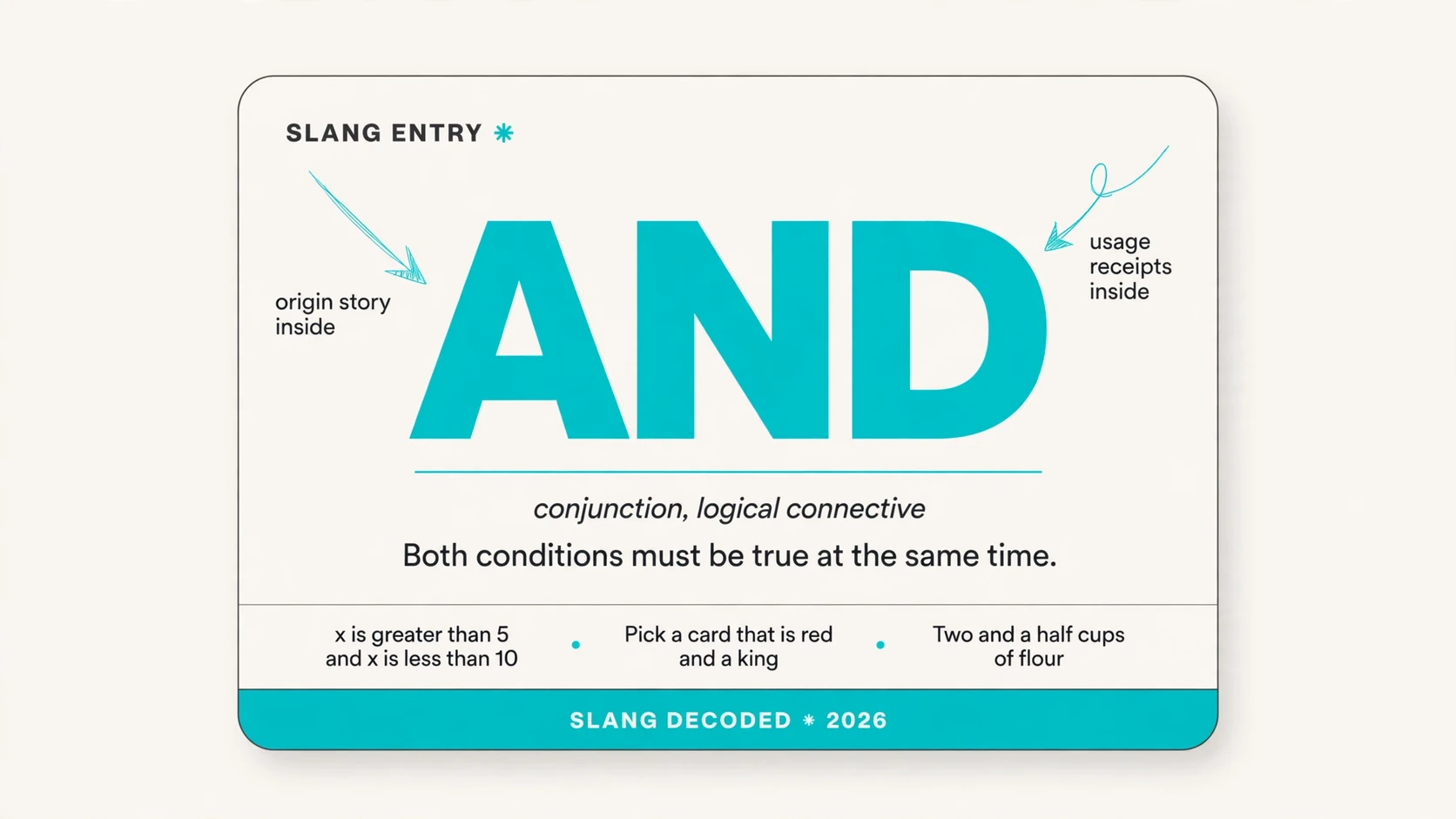
what does and mean in math is a question about a small word that does a strict job, because and means both things must be true at the same time. It is not slang or a code word from a feed. In math, and joins two conditions and keeps only cases where every joined condition holds.
You meet it in sentences, symbols, sets, and word problems, and the job stays the same even when the surface changes. If one part fails, the whole and statement fails, and that rule clears up most confusion in class.
Both at Once, the Meaning Breakdown for And
| Meaning | Where you meet it |
|---|---|
| Both conditions must hold | Logic and truth tables |
| Only shared members count | Set intersection |
| Number sits between bounds | Compound inequalities |
| Two events both happen | Probability questions |
| Join parts into one total | Everyday counting stories |
| Decimal point in speech | Numbers read aloud |
| Two requirements, one answer | Filters and puzzle rules |
| Stricter than either part | Sorting with every check |
| Two facts for one claim | Geometry and algebra |
The Four Rows That Settle Every and Claim
| First part | Second part | Result |
|---|---|---|
| True | True | True, both hold |
| True | False | False, second fails |
| False | True | False, first fails |
| False | False | False, neither holds |
| Number is even | Number exceeds ten | Even numbers above ten only |
| Shape has four sides | Shape has equal sides | Square or rhombus only |
| Card is red | Card is a king | Red kings only |
| Quiz passed | Homework turned in | Both school tasks done |
| It is raining | It is cold | Rainy and cold days only |
Where You Actually Meet and in Class, on Paper, and in Search
| Setting | How and shows up |
|---|---|
| Logic lesson | Connective joining two statements |
| Set theory chapter | Word behind intersection |
| Algebra homework | Inequalities with two limits |
| Geometry proofs | Claims needing two properties |
| Probability unit | Two outcomes in sequence |
| Word problem practice | Two groups or conditions |
| Money and mental math | Spoken cents and decimals |
| Coding lessons | Test needing every check |
| Search and study guides | Plain student question |
When and Feels Strict, When It Feels Loose, and When It Tricks You
| Situation | Reading |
|---|---|
| Two test conditions | Both must pass, check each part |
| Snack list in a story | Add groups for a total |
| Decimal read aloud | Marks the decimal point, not addition |
| Two draws in probability | Independence decides the arithmetic |
| Inequality with two bounds | Clear both bounds to pass |
| Venn diagram overlap | Only the middle region counts |
| Filter with two labels | Item needs both labels |
| And plus or together | Grouping decides the result |
| Trick quiz question | One false part sinks the claim |
And Next to or, Not, Plus, and the Words Students Mix It up With
| Nearby word | Key difference |
|---|---|
| Or | Needs one part true |
| Not | Flips one statement |
| Plus | Adds numbers for a sum |
| Times | Multiplies equal groups |
| If then | Promises one claim from another |
| Intersection | Names the set result |
| Union | Gathers from either set |
| Both | Stresses two items together |
| Also | Adds information loosely |
Who Leans on and, from First Graders to Coders
| Group | How they use and |
|---|---|
| Elementary students | Join groups before counting |
| Middle school students | Read inequalities and Venn diagrams |
| High school students | Build truth tables part by part |
| College students | Write rules with several conditions |
| Teachers | Set rubrics needing every skill |
| Tutors | Ask if each part is true |
| Test writers | Hide one false part |
| Programmers | Write tests needing every check |
| Puzzle designers | Require two collected items |
Nine Times and Showed up and Meant Both, No Exceptions
“x is greater than 5 and x is less than 10”
Where it appeared, an algebra worksheet on inequalities Context note, only values between 5 and 10 work
“It is even and it is a multiple of 3”
Where it appeared, a middle school number sorting task Context note, 6, 12, and 18 pass both
“The shape is a rectangle and it has equal sides”
Where it appeared, a geometry review sheet on quadrilaterals Context note, the joined claim points to a square
“She scored a goal and her team won the game”
Where it appeared, a logic example in a classroom slide deck Context note, one true part cannot rescue a false one
“The book is on the shelf and the shelf is in the library”
Where it appeared, a starter logic lesson joining statements Context note, both location facts must hold
“Pick a card that is red and a king”
Where it appeared, a probability warm up with a deck Context note, only two cards pass both tests
“Enter a number that is prime and greater than 20”
Where it appeared, a coding exercise with a two part filter Context note, 23 passes, 21 fails the prime test
“Two and a half cups of flour”
Where it appeared, a recipe card read aloud in class Context note, and marks the fractional part
“The answer is correct and the work is shown”
Where it appeared, a grading note on returned homework Context note, full credit needed both parts
Nine Word Problems Where and Tells You What to Check First
“Maya has 4 red pens and 6 blue pens, how many in all”
Where it appeared, an early addition problem in a workbook Context note, count both groups for 10 pens
“A bag holds 2 red balls and 3 yellow balls, draw red and then red with replacement”
Where it appeared, a probability set about draws with replacement Context note, draws are independent, so multiply
“A bag holds 2 red balls and 3 yellow balls, draw red and then red without replacement”
Where it appeared, the next problem in the same set Context note, the first draw changes the second
“Find numbers divisible by 2 and divisible by 5”
Where it appeared, a multiples hunt in a worksheet Context note, shared answers are multiples of 10
“Tom reads 20 minutes and practices piano 15 minutes, how long in total”
Where it appeared, a time addition story in homework Context note, and joins two blocks for 35 minutes
“A rectangle is 5 units wide and 3 units tall, what is its area”
Where it appeared, a geometry problem with two side lengths Context note, and supplies both measurements for area
“List students who play soccer and play chess”
Where it appeared, a class survey turned into a Venn diagram Context note, only students in the overlap belong
“A number is between 10 and 20 and it is odd, name one value”
Where it appeared, a number sense question on a quiz Context note, 11, 13, 15, 17, and 19 work
“Sara buys 3 packs of 4 pencils and 2 loose pencils, how many pencils”
Where it appeared, a mixed multiplication and addition story Context note, multiply first, then add 2
How What Does and Mean in Math Changes in a Word Problem
In a word problem, and is a signal to pause, because the same small word can join groups, conditions, or events. The same both conditions habit also helps you read or, not, and plus without swapping their jobs, and it saves you from turning every and into a plus sign. Read the full sentence and check whether it wants a total, a shared set, or a joint outcome.
A total question wants combined amounts, a shared set question wants only what passes every test, and a joint outcome question wants two happenings tracked together. Start with a plain reading, then test it with a simple number that passes one part and fails the other.
The Decimal Point Habit and the and That Is Not a Plus Sign
Spoken math gives and a second job that trips up learners, because two and a half means two plus a half in speech, yet the word marks a place value break, not a fresh operation. You hear it in money, measurements, and recipes. In writing, the decimal point does the same work.
The trap is carrying that spoken habit into logic and set problems, where and means both, and where addition gives the wrong set or truth value. Keep the two uses separate. For truth or membership, ask whether both parts hold, and for a spoken amount, listen for the place value break.
Why and Means Multiply Only Sometimes in Probability
Probability teachers often say and means multiply, and that shortcut works only when two events do not change each other. Draw a ball, put it back, and draw again, and the second chance matches the first, so multiplying gives the chance both happen. Keep the first ball out, and the bag changes, so you must use the updated second chance before you multiply.
That difference is the whole lesson, because and never promised multiplication, it promised both events happen. Multiplication counts joint outcomes only with independence or an updated second chance. For dependent events, write both chances, with the second chance updated, and only then combine them.
The Both Test You Can Run in Five Seconds
The fastest check for any and claim is a two part test you can run before you touch a calculator. Say the first part aloud and decide true or false, say the second part aloud and decide the same, and call the claim true only with two yes answers in a row. One no stops it, and that strictness keeps sloppy claims from passing.
Use the test on inequalities, set membership, logic homework, and spreadsheet filters. For greater than 5 and less than 10, 12 fails the second part, 4 fails the first, and 7 passes both.
Faqs About and in Math
Does what does and mean in math always mean you should add the numbers?
No, and joins conditions or amounts, and addition fits only when the question asks for a combined total.
What does and mean in math when you see it in a set problem?
It points to intersection, so you keep only members belonging to both sets at once.
Why does and mean multiply in some probability problems and not in others?
It means both events happen, and multiplication fits only when events are independent or the second chance is updated.
What does and mean in math when you hear it in a spoken decimal like two and a half?
It marks the decimal point in speech, separating the whole part from the fractional part.
Can one false part make a whole and statement false in logic?
Yes, a conjunction is true only when every joined part is true, so one false part makes the whole statement false.