
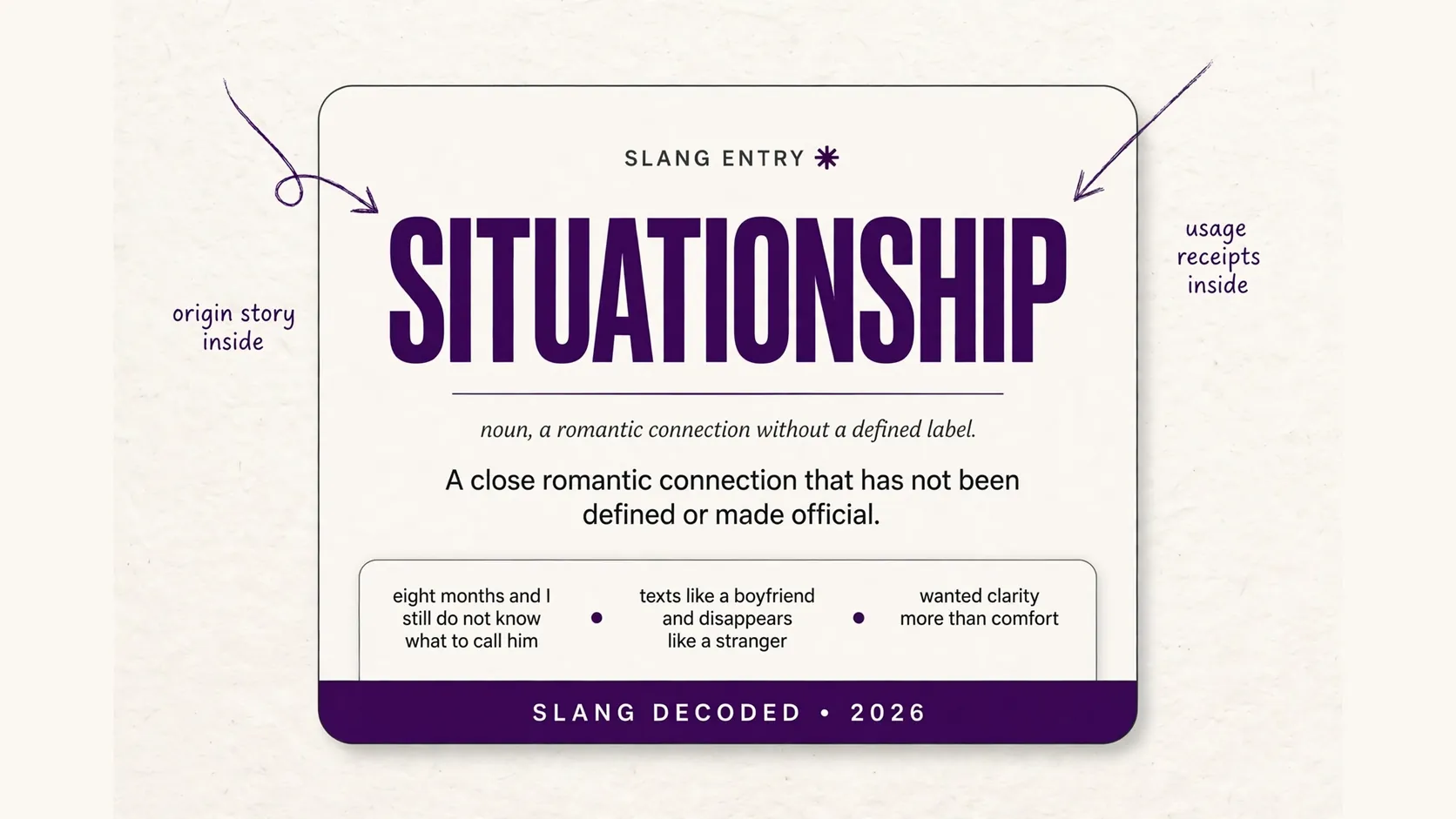
A situationship slang origin story starts with a simple idea. It names a romantic or sexual connection that feels real, close, and ongoing, yet never gets defined or made official.
You will recognize it at once. You text every day, you meet up often, you act like a couple in private, and still you cannot answer the question of what you actually are. That gap between feeling and label is exactly why the word caught on. This guide traces its rise, decodes its tone, and helps you talk about it with clarity and care.
How Two Ordinary Words Built One Messy Label
The word is a blend, and the blend does the explaining for you. It takes the mess of a situation and joins it to the promise of a relationship, leaving you with something that sounds both serious and unfinished. That tension is the whole point, because the word admits that a connection can matter deeply even when it has no formal name or agreed future.
| Piece of the word | What it adds to the meaning |
|---|---|
| Situation | A state of affairs that is complicated, unclear, or hard to name |
| Relationship | Closeness, care, routine, and romantic or sexual involvement |
| Ship ending | A playful shortcut that turns the whole mix into one label |
| The full blend | More than friendship, less than a committed partnership |
The Slow Burn from Internet Whisper to Mainstream Word
The word did not appear in one viral moment. It surfaced in online dating talk in the late 2000s, spread through blogs and social posts in the mid 2010s, and then exploded when major magazines and dating apps gave it a spotlight. Different people likely used it on their own at first, which is why no single inventor can claim it cleanly.
| Time period | What happened to the word |
|---|---|
| Late 2000s | Early uses appear in online and British dating chatter |
| Early 2010s | The blend spreads as a joke and a complaint about undefined dating |
| 2014 to 2017 | Mainstream magazine writing brings it to a much wider audience |
| 2017 | A widely shared Cosmopolitan piece by Carina Hsieh helps define it for many readers |
| Early 2020s | TikTok, memes, and dating app trends push it into everyday speech |
| 2022 | Tinder trend reporting treats it as a real dating status young users recognize |
| 2026 | It now works as standard slang, not just a punchline |
The Tell-Tale Signs You Are Living the Label
You do not need a quiz to spot one. You need an honest look at how you talk, plan, and show up for each other. If most of these sound familiar, you are probably not imagining the ambiguity. The pattern matters more than any single sign, because one unclear week is normal while months of guessing usually point to a real lack of agreement.
- You talk daily and share personal news, but you never agreed on exclusivity
- You have couple routines like regular sleepovers, favorite shows, and shared jokes
- You avoid the define the relationship talk because you fear changing what you have
- You feel unsure about introducing the person as a partner, a friend, or something else
- You make future plans in vague terms, like someday or soon, never with dates
- You feel jealous or hurt, yet you feel you have no right to say so
Where It Sits on the Modern Dating Map
A situationship is not the same as every undefined connection. Its power comes from its middle place, and that middle place explains why friends often argue about it. One friend may call it almost dating, while another may call it a red flag, and both can be describing the same connection. It has more feeling than a fling, more contact than a crush, and less agreement than a committed relationship.
| Connection type | Defined or not | Typical feeling level |
|---|---|---|
| Crush | Not defined | Strong feeling, little contact |
| Talking stage | Not defined | Curiosity, testing, early flirting |
| Situationship | Not defined | Real closeness without a label |
| Friends with benefits | Often loosely agreed | Physical closeness, limited romance |
| Committed relationship | Defined | Closeness plus agreed commitment |
Who Says It Loudest and Where You Hear It
The word belongs to dating culture, but it travels well. You will hear it from students, young workers, creators, and anyone trying to describe modern romance without sounding old fashioned or overly formal. It also works across ages now, because older daters returning to apps meet the same undefined stage younger daters named years ago.
| Place or group | How the word usually shows up |
|---|---|
| TikTok and Reels | Storytimes, vent videos, and funny skits about undefined dating |
| Dating apps | Profile talk, trend reports, and chats about what users want |
| Group chats | Friends helping each other decode mixed signals |
| Podcasts and magazines | Advice pieces about boundaries, attachment, and modern love |
| Campus and work talk | A quick label for a connection everyone can see but no one can name |
Lines You Will Hear in the Wild
Listen for the word in jokes, complaints, and confessions. It often appears when someone is trying to be honest about a connection that feels too big for the word dating and too small for the word partner. Notice how often it shows up with a time span, because duration is what turns a casual phase into a story worth telling.
- We have been in a situationship for eight months and I still do not know what to call him
- She said she was not ready for a label, so we stayed in our little situationship
- I ended my situationship because I wanted clarity more than comfort
- We agreed on a no labels situationship and honestly it works for both of us
- My situationship texts like a boyfriend and disappears like a stranger
What the Tone Tells You Before the Words Do
The same word can sound funny, sad, frustrated, or perfectly calm. Tone is your clue, and it often reveals more than the definition. A light laugh can hide real worry, while a flat delivery can hide real hope, so listen for what your friend is not quite saying. A joking use usually means the speaker feels safe enough to laugh. A tired use usually means the ambiguity has started to hurt.
| Tone you hear | What the speaker often means |
|---|---|
| Playful and joking | We both know this is messy and we are fine with it for now |
| Wry and weary | I am tired of guessing where I stand |
| Honest and direct | Let us name this so we can decide what to do next |
| Defensive | I do not want a label, so please stop asking for one |
| Hopeful | I like this person and I hope a label comes later |
How the Meaning Has Shifted Over Time
At first the word sounded like a joke about dating confusion. Over time it grew into a useful tool. Now you can use it to describe a choice, a stage, or a problem, and the context tells your listener which one you mean. That flexibility is a strength for honest talk, but it also means you should never assume two people mean the same thing when they use it.
| Earlier use | How people use it now |
|---|---|
| A funny label for a messy fling | A neutral name for any undefined romantic connection |
| A warning about commitment fear | A way to discuss boundaries without blame |
| A niche internet joke | A mainstream dating term in articles and app reports |
| Mostly negative | Sometimes mutual, calm, and chosen by both people |
Why the Word Feels so Useful Right Now
You live in a dating world where labels arrive late, if they arrive at all. You can meet someone on an app, move to texts, share routines, and still never have a formal talk about what you are. The word fills that silence with something short and shareable.
It also lets you vent without writing an essay. You can say one word in a group chat and your friends get the whole picture at once. They understand the closeness, the confusion, and the risk of asking for more.
Why the Word Can Also Keep You Stuck
A useful label can become a comfortable hiding place. You might keep using it because it sounds lighter than saying you want commitment, or because it helps you avoid a hard talk. That comfort can cost you clarity over time.
If you notice the same worry returning week after week, the label may be doing more harm than good. You deserve to know whether your connection can grow, pause, or end with respect. A word should help you talk, not replace the talk itself.
How to Use It without Sounding Careless
You can use the word with warmth and respect when you keep the other person in mind. Say it about your own experience first, and check how the other person feels about being described that way. Some people find it funny, while others find it cold or dismissive.
Try pairing the label with a clear feeling. You might say you enjoy the connection but want more clarity, or that you are happy without a label for now. That small addition turns slang into honest communication, and it keeps a trendy word from doing damage.
What to Do When You Want More than a Label
Start with what you already know. You know how often you talk, how you spend time together, and how you feel when plans change. Use those facts, not accusations, when you bring up the talk. You might say you value the connection and want to know if you are moving in the same direction.
, ghosting, and the talking stage, a situationship stands out because both people often know the connection matters, even when neither one will name it yet.breadcrumbing, ghosting, and the talking stage, a situationship stands out because both people often know the connection matters, even when neither one will name it yet.
Frequently Asked Questions
What does situationship mean in simple terms?
It means a romantic or sexual connection that feels close and ongoing but has not been defined or made official.
Where did situationship slang origin really begin?
It grew from online dating talk in the late 2000s as a blend of situation and relationship, then spread widely in the mid 2010s and early 2020s.
Is a situationship always a bad thing?
No, it can be mutual and calm when both people want the same level of closeness, but it hurts when one person wants commitment and the other does not.
How is a situationship different from dating?
Dating often moves toward a shared understanding, while a situationship stays undefined even after regular contact and real emotional closeness.
When should you end a situationship?
You should consider ending it when the lack of clarity keeps hurting you, your needs stay unmet, or you both want clearly different futures.