
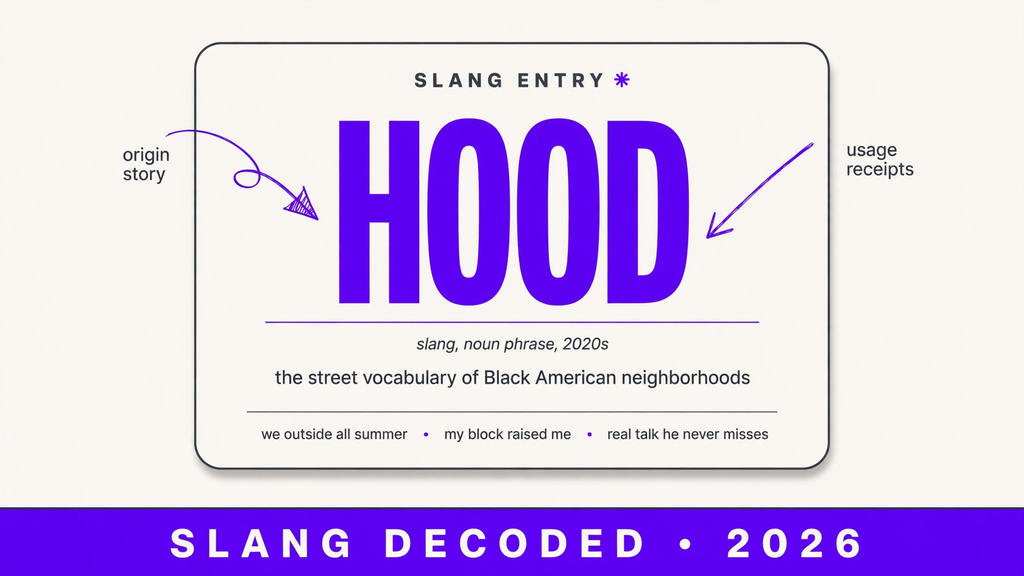
Hood slang and meaning starts with a plain fact, it is the everyday vocabulary of Black American neighborhoods, spread through hip hop and social media into everyday speech. When people call a word hood slang, they mean it carries the sound and the attitude of the block, direct, playful, and coded enough that outsiders need a minute.
You hear it in lyrics, in captions, and in group chats, and you probably already use some of it. This guide breaks down where the language comes from, what it means, and how to read the room before you repeat it.
What hood slang actually covers when you hear it on the street
| Meaning | Context | Mini Example |
|---|---|---|
| The block itself | Talking about your neighborhood | i grew up on that block, everybody knows everybody |
| Street smarts | Describing survival skills | she got street smarts, she reads people fast |
| Real talk | Honest direct speech | let me give you the real talk, that plan will not work |
| A warning | Telling someone to watch out | watch your back out there, it gets wild after dark |
| Loyalty code | Neighborhood loyalty | we look out for each other, that is just how we move |
| Hustle language | Work and grind talk | he is out here grinding every single day |
| Playful roasting | Friendly teasing between friends | you really wore that fit out the house, be serious |
| Respect talk | Earning respect in the community | you earn respect by how you carry yourself |
Receipts from the timeline, captions and comments that show it in the wild
- “that fit is so hood, i love it” spotted in an Instagram comment under a streetwear post, where a follower praised the outfit
- “real talk, he never misses” spotted in a TikTok comment on a rap clip, where a fan praised the artist
- “the block is hot tonight” spotted in a tweet about a neighborhood party, where the writer warned friends
- “she got that hood wisdom” spotted in a YouTube comment under an interview, where a viewer praised the guest
- “we outside all summer” spotted in a Snapchat caption, where friends announced summer plans
- “stop playing, you know the vibes” spotted in a group chat screenshot shared on X, where friends hyped each other up
- “that bar was straight from the hood” spotted in a Reddit thread about lyric writing, where a user praised the line
- “he talks like he from the trenches” spotted in a TikTok caption, where a creator joked about a friend
- “my block raised me” spotted in an Instagram bio, where the owner claimed the neighborhood that shaped them
How the language traveled from the block to your feed
| Period | What Happened |
|---|---|
| 1970s | Neighborhood slang grew in Black American communities and showed up in funk, soul, and early street storytelling |
| 1980s | Hip hop turned block language into lyrics, and slang like dope and fresh reached national radio |
| 1990s | Gangsta rap and R and B pushed hood vocabulary into movies, TV, and suburban bedrooms |
| 2000s | Reality TV, mixtapes, and early YouTube spread the language wider |
| 2010s | Twitter and Vine turned short hood phrases into memes that traveled far |
| 2018 | TikTok sounds carried hood slang into dance trends, skits, and comedy clips worldwide |
| 2020 | Lockdown scrolling pushed neighborhood phrases into group chats and gaming lobbies |
| 2023 to 2026 | Creators now mix hood slang with internet irony, so old words gain new layers |
Where each platform keeps the language alive
| Platform | How the Term Is Used There | Vibe |
|---|---|---|
| TikTok | Sounds, skits, and storytimes built around hood phrases | Fast, funny, and trend driven |
| Captions, reels, and comments that flex neighborhood pride | Stylish and boastful | |
| X | Quick jokes, quote tweets, and hot takes in street voice | Sharp and competitive |
| YouTube | Interviews, reaction videos, and lyric breakdowns | Long form and detailed |
| Threads that debate meanings and trace word origins | Analytical and nerdy | |
| Twitch | Streamers and chat using slang during live gameplay | Loud and playful |
| Group chats | Inside jokes, voice notes, and roasts between friends | Intimate and unfiltered |
| Music lyrics | Rappers and singers weaving hood vocabulary into verses | Raw and rhythmic |
Group chats and voice notes, the other half of the receipts
- “yo, pull up, we outside” spotted in a group chat message, where a friend invited the crew to meet up
- “nah, that is cap, he was not even there” spotted in a voice note, where a friend called out a fake story
- “the vibes was immaculate last night” spotted in a Snapchat story caption, where a partygoer summed up the night
- “bro thinks he tough now” spotted in a Discord message, where friends roasted a teammate after one win
- “she really from the hood, respect” spotted in a TikTok comment, where a viewer praised the creator
- “we eating good tonight, no cap” spotted in a family group chat, where a cousin announced a big home cooked meal
- “stop capping in front of everybody” spotted in an Instagram live comment, where a viewer told a guest to stop
- “that is real hood classic energy” spotted in a YouTube comment, where a fan praised an old video
- “i am not going back to that block” spotted in a tweet, where a user joked about avoiding a rough area
Reading the room, when the tone lands and when it does not
| Situation | Tone | Safe or Risky |
|---|---|---|
| Friends roasting each other | Playful and warm | Safe |
| Quoting a lyric you love | Excited and appreciative | Safe |
| Talking about your own neighborhood | Proud and personal | Safe |
| Joking with strangers online | Sarcastic and unpredictable | Risky |
| Using it at work with a boss | Casual and out of place | Risky |
| Imitating an accent for laughs | Mocking and disrespectful | Risky |
| Arguing with someone in the street | Heated and confrontational | Risky |
| Writing a caption for your own photo | Confident and expressive | Safe |
Who actually says it and how they flip it
| Group | How They Use It |
|---|---|
| Neighborhood locals | Everyday speech about home, friends, and survival |
| Rappers and singers | Lyrics that paint vivid pictures of block life |
| TikTok creators | Skits, sounds, and storytimes that remix street phrases |
| Comedians | Jokes that play on the gap between street talk and polite talk |
| Teens and students | Group chats, captions, and hallway banter |
| Gamers | Trash talk and hype in lobbies and streams |
| Parents and elders | Old school phrases mixed with warnings and wisdom |
| Non native speakers | Borrowed slang picked up from music and social media |
The same words can lift you up or call you out
| Usage | Meaning | Example |
|---|---|---|
| Positive hype | Praising someone real and solid | she is solid, always keeps it a hundred |
| Positive pride | Celebrating where you come from | my hood made me who i am today |
| Positive loyalty | Showing love for your people | we ride for each other, always |
| Positive humor | Roasting a friend with love | you are wild for that outfit, i respect it |
| Negative warning | Telling someone danger is near | the block is hot, stay inside tonight |
| Negative callout | Exposing a fake story | that is cap, you were not even there |
| Negative threat | A serious warning to back off | do not come around here starting trouble |
| Negative judgment | Calling out disrespectful behavior | he has no respect for anybody out here |
The line between borrowing the language and biting the culture
Hood slang did not appear out of thin air, it grew out of real neighborhoods where people built a way of speaking that was fast, coded, and full of personality. When a phrase jumps from a block in Atlanta or Chicago to a trending sound, it carries history with it, even if the new users never see it. That is why the same word can feel like a compliment from one person and a cheap imitation from another.
The test is simple and it lives in how you use the words. If you learned a phrase from the people who live it, and you use it with respect for where it came from, it usually lands fine. If you grab it only because it sounds cool, and drop it where it does not belong, people will notice fast. Language travels, but the respect has to travel with it.
Why some hood words go mainstream and others stay on the block
A word goes mainstream when it is catchy, easy to say, and useful in a caption or a punchline. Short words with a strong sound spread fast because they fit in a tweet, a comment, or a chorus. You will see the same pattern in opp, no cap, and say less, words that started in specific scenes and then exploded once creators and musicians gave them a bigger stage.
Other words stay local because their meaning depends on knowing the people, the streets, and the unspoken rules behind them. Those words are not secrets exactly, but they lose flavor when they leave the neighborhood. They stay in group chats and on the block, where everyone already knows the backstory. That split is part of what keeps hood slang alive, some words belong to everybody now, and some still belong to home.
How to use it without sounding forced
The biggest mistake is forcing slang you do not actually use into every sentence. People can tell when a phrase is borrowed for effect, and the harder you push it, the more it sounds like a costume. Start with the words you genuinely hear and understand, use them where they fit, and let the rest come with time.
Listen more than you talk, especially at first. Pay attention to who says a word, when they say it, and what happens right after. Tone, timing, and audience matter just as much as the definition. Once you understand the context, the words stop being a performance and start being part of how you talk.
Hood slang questions people actually Google
What does hood slang mean?
Hood slang means the informal vocabulary that grew out of Black American neighborhoods, covering street life, loyalty, humor, and everyday survival.
Is hood slang the same as African American Vernacular English?
No, hood slang is a smaller slice of street vocabulary, while African American Vernacular English is a full dialect with its own grammar, history, and rules.
Where did hood slang come from?
It grew out of Black American neighborhoods in cities like New York, Chicago, Atlanta, and Los Angeles, then spread through hip hop, movies, and social media.
Is it offensive to use hood slang?
It depends on context, using it respectfully and naturally is usually fine, while imitating it to mock people or sound tough is offensive.
Why does hood slang change so fast?
New words spread through TikTok, music, and group chats in days, so meanings shift quickly as creators remix old phrases into new jokes and trends.