
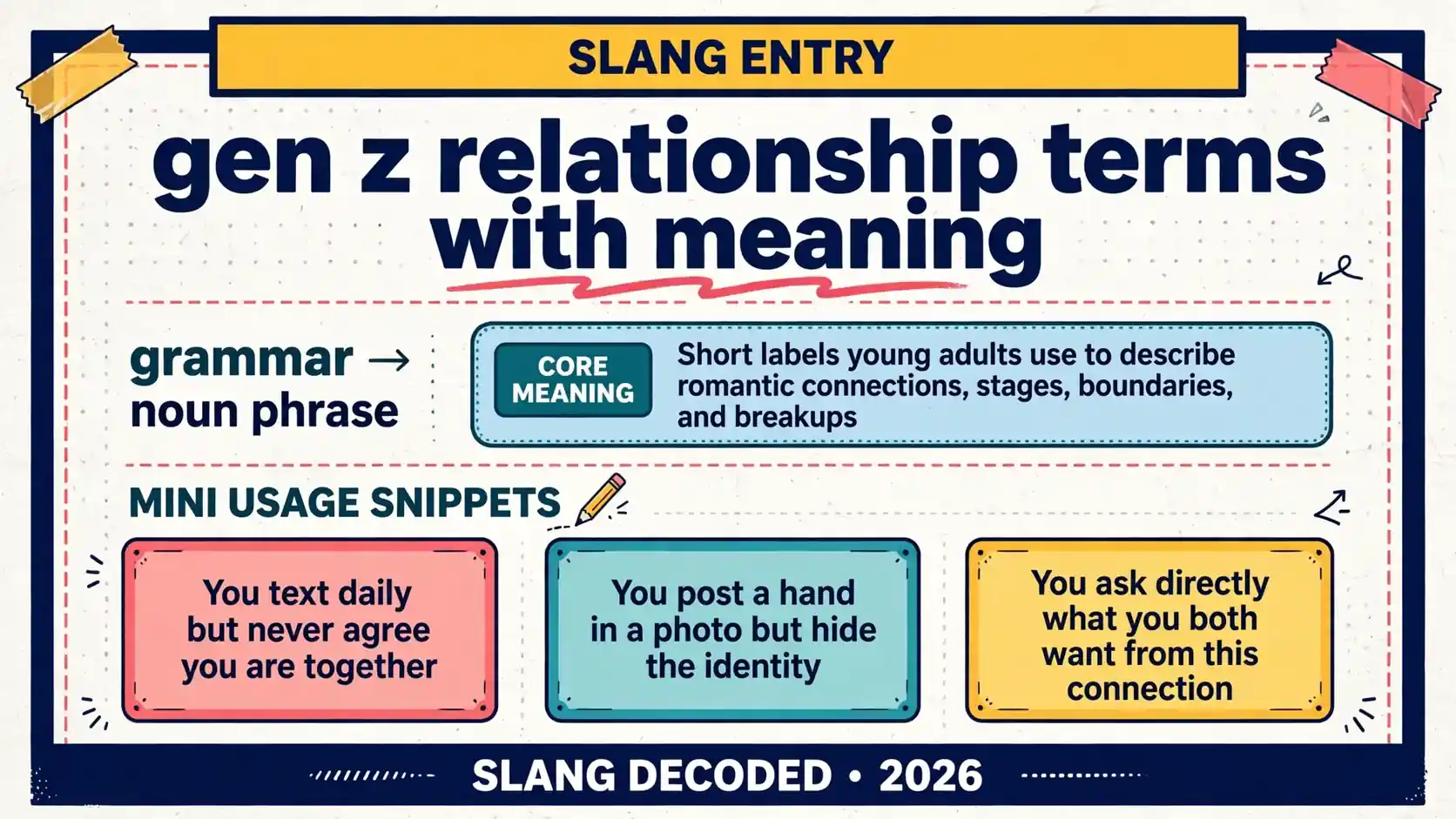
Gen z relationship terms with meaning are the short labels young adults use to describe romantic connections, stages, boundaries, and breakups in plain online talk. You will see these words in captions, comments, group chats, and voice notes, and they help you say quickly whether a connection is casual, serious, private, or over.
You do not need to use every term here. You only need to recognize what people mean when they use one, and you can choose words that fit your own style and ask clearer questions.
Core Gen Z Relationship Terms You Will Hear First
| Term | Meaning | Example in use |
|---|---|---|
| Situationship | A romantic connection with closeness but no clear label or commitment | You text daily but never agree you are together |
| Talking stage | The early phase when two people get to know each other before committing | You swap playlists and learn each other’s daily routines |
| DTR | A define the relationship talk that clarifies where you stand | You ask directly what you both want from this connection |
| Roster | A small group of people someone is seeing at the same time | You keep your options open before you choose one person |
| Cuffing season | The colder months when people want a cozy steady partner | You pair up for fall comfort and shared movie nights |
| Exclusive | An agreement to see only one person romantically | You stop seeing other people after you both agree |
| Lowkey relationship | A real relationship that stays mostly private online | You are together but rarely post couple photos |
| Open relationship | A consensual setup with agreed rules for seeing other people | You both agree on clear limits before anything starts |
Dating Stage Terms That Define Where You Stand
| Term | Meaning | Example in use |
|---|---|---|
| Honeymoon phase | The early period when everything feels exciting and easy | You laugh at every message and plan constant meetups |
| Almost relationship | A deep connection that feels like a partnership without the title | You act like a couple but never make it official |
| Talking exclusively | A stage where you talk to only one person but are not official yet | You focus on one person while you decide together |
| Back burner | Someone kept as a backup option while you explore other connections | You reply sometimes but never make real plans |
| Dating around | Seeing several people casually to learn what you want | You go on different outings before settling down |
| Going steady | A classic phrase for a committed and regular partnership | You see each other often and call each other partners |
| On a break | A planned pause in a relationship to get space and clarity | You agree to step back and check in later |
| Rekindling | Restarting feelings or contact after time apart | You reconnect and find the spark is still there |
Texting and Dm Terms for Modern Romance
| Term | Meaning | Example in use |
|---|---|---|
| Ghosting | Ending contact suddenly without an explanation | You stop getting replies after a great week together |
| Breadcrumbing | Sending small flirty signals without real commitment | You get occasional likes but never a real plan |
| Orbiting | Watching someone online after stopping direct contact | You still view stories but never send a message |
| Benching | Keeping someone interested while you focus on another person | You get just enough attention to stay hopeful |
| Dry texting | Sending short low effort replies with little warmth | You get one word answers that kill the conversation |
| Double texting | Sending a second message before getting a reply | You follow up because you worry you were ignored |
| Left on read | A message that was seen but never answered | You see the read receipt and hear nothing back |
| Soft ghosting | Slowly fading replies until contact quietly stops | Your chats shrink from daily talks to rare likes |
Commitment and Boundary Terms in Plain Words
- Boundaries are the limits you set around time, space, and contact so both people feel respected and safe.
- Dealbreaker is a trait or behavior that would make you end a connection even if everything else feels good.
- Green flag is a positive sign like honesty, patience, and respect for your time and your friends.
- Red flag is a warning sign like controlling behavior, dishonesty, or disrespect for your limits.
- Beige flag is a small odd habit that is neither good nor bad but makes someone memorable.
- Ick is a sudden loss of attraction caused by a small habit or awkward moment.
- Emotional availability means being open to honest feelings, support, and real conversation when things get hard.
- Attachment style is the pattern you follow in closeness, such as seeking reassurance or needing more space.
Soft Launch and Social Media Relationship Signals
| Term | Meaning | Example in use |
|---|---|---|
| Soft launch | Hinting at a partner online without showing their face or name | You post a hand in a photo but hide the identity |
| Hard launch | Announcing a relationship clearly with a full photo or post | You post a couple photo with a clear caption |
| Instagram official | A relationship confirmed by a public post on that app | You appear together on a main feed post |
| Story mention | Tagging a partner in a short story that disappears in a day | You tag them in a dinner photo for close friends |
| Photo dump clue | A small partner detail hidden inside a casual photo set | You spot their jacket in the third photo |
| Private story partner | Someone added to a close friends story list for personal posts | You share everyday moments with a smaller circle |
| Couple post | A shared photo or video that presents two people as partners | You post a trip recap with your partner front and center |
| Digital footprint | The trail of likes, tags, and posts that reveals a connection | Your friends connect the dots from your tagged photos |
Breakup and Moving on Terms without the Drama
| Term | Meaning | Example in use |
|---|---|---|
| Clean break | Ending a relationship fully with no mixed signals afterward | You stop contact and give each other real space |
| Mutual split | A breakup both people agree is the right choice | You part kindly because you want different things |
| Closure talk | A final honest conversation to understand why it ended | You ask clear questions and listen without arguing |
| No contact | A rule of zero messages or check ins after a breakup | You mute profiles and avoid late night texts |
| Rebound | A new connection started quickly after a breakup | You start seeing someone before you have fully healed |
| Closure text | A short final message that ends the conversation with respect | You thank them and say you are moving on |
| Moving on era | A personal phase focused on growth after a split | You rebuild routines and focus on your own goals |
| Healing era | A quiet period spent resting and processing a breakup | You take time for friends, rest, and self care |
Flirty and Playful Terms You Can Use Lightly
- Rizz is charm and smooth confidence in flirting, especially in conversation and playful teasing.
- Crush is a strong fondness for someone you admire, often mixed with nerves and excitement.
- Flirty banter is light teasing and joking that shows interest without heavy pressure or promises.
- Butterflies are the nervous excited feeling you get when you see or hear from someone you like.
- Sparks are the instant sense of chemistry and excitement when two people click right away.
- Chemistry is the natural ease and attraction that makes conversation feel fun and effortless.
- Eye contact game is the playful habit of holding a glance a little longer to signal interest.
- Compliment culture is the habit of giving kind specific praise that makes someone feel noticed.
How Gen Z Relationship Terms with Meaning Show up in Real Life
| Scenario | Term in use | What it tells you |
|---|---|---|
| Group chat gossip | Situationship | Your friend is close to someone but has no label yet |
| Getting ready chat | Soft launch | Your friend plans a subtle hint about a new partner |
| Texting after a meetup | Talking stage | Two people are still learning about each other |
| Asking a friend for advice | Ick | A small moment changed how your friend feels |
| Writing a caption | Hard launch | A couple is ready to go public with their news |
| Replying to a comment | Green flag | A partner showed respect in a way worth praising |
| Replying to a story | Orbiting | An ex is still watching without sending messages |
| Sending a voice note | DTR | Someone wants a clear talk about where things stand |
Why These Terms Spread so Fast Online
You see a new term once in a video and then everywhere in comments the next day because short words travel well on fast feeds. One term can replace a long explanation, so people reuse it to be understood in seconds, though meanings can shift between friend groups.
When you hear a term in a new setting, listen for how the speaker uses it before you copy it. The same word can be a joke in one chat and a serious boundary talk in another, so one clear question beats guessing.
How to Use Them without Sounding Forced
cute, lavender relationship, and pbr relationship when you want to see how niche labels travel online.smush cute, lavender relationship, and pbr relationship when you want to see how niche labels travel online.
If a term feels awkward, you do not need to force it into every conversation. You can describe the same idea in plain words and still be understood, and people respect clear honesty more than trendy wording.
What to Do When a Term Confuses You
You can ask a friend what they meant in a kind and direct way without making the moment awkward. A simple question like what do you mean by that term shows curiosity rather than judgment, and most people enjoy explaining a word they use.
If you search a term online, check a few examples before you settle on one meaning. One post can use a word as a joke while another uses it seriously, so context helps you avoid a wrong guess.
Frequently Asked Questions
What are gen z relationship terms with meaning in simple words?
They are short modern labels that describe romantic stages, boundaries, signals, and breakups in clear everyday talk.
How do you know if you are in a situationship?
You are likely in one if you share romantic closeness and regular contact but have never agreed on a label or commitment.
What is the difference between the talking stage and dating?
The talking stage is the early getting to know phase, while dating usually means regular outings and clearer romantic intent.
Are these terms only for young people online?
No, anyone can use them, but they spread fastest among young adults who share relationship stories on social apps.
How can you bring up a DTR talk without pressure?
You can choose a calm moment, share what you enjoy about the connection, and ask what the other person wants next.