
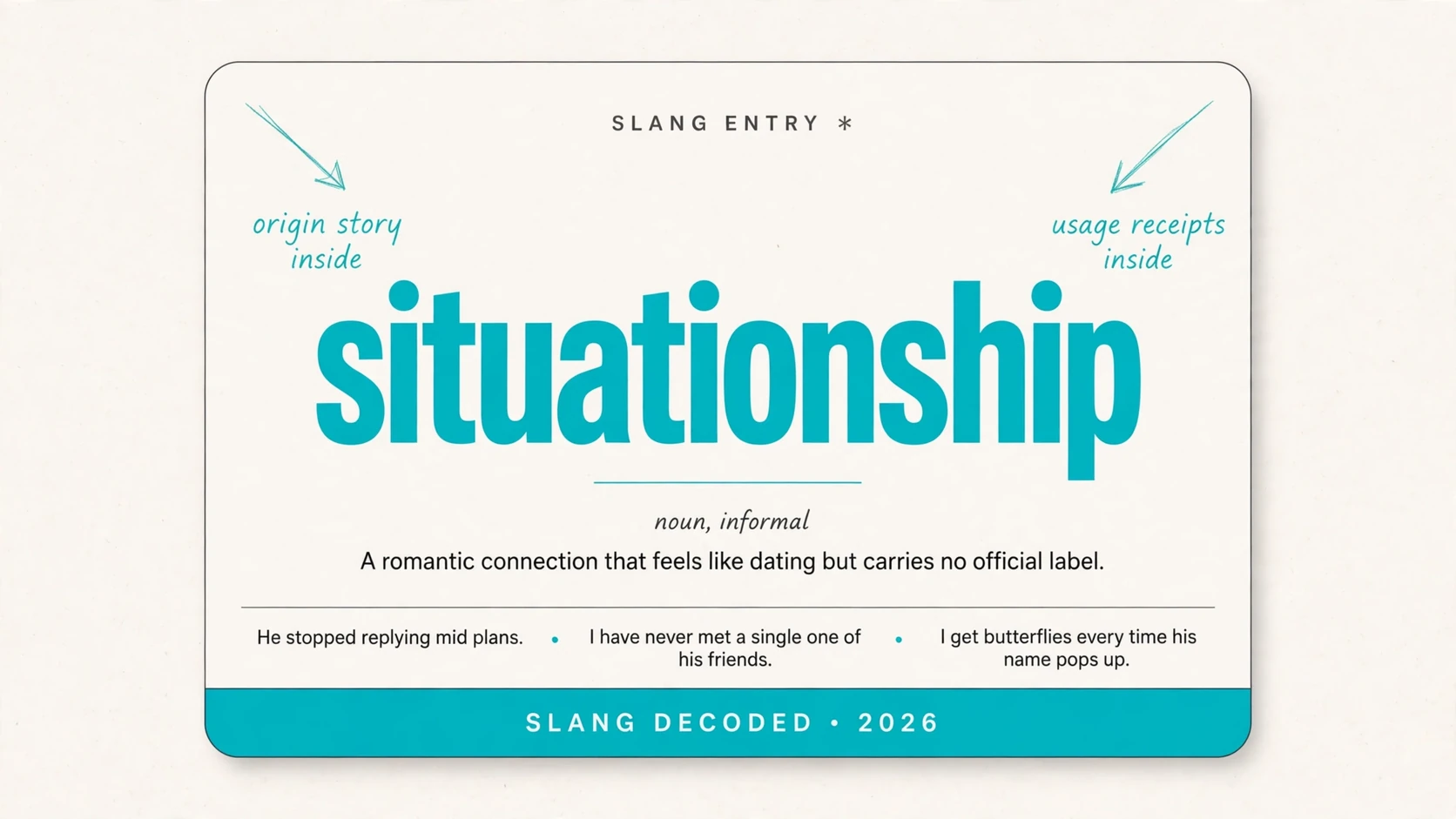
A situationship is a romantic connection that feels like dating but carries no official label, and gen z relationship terms like situationship give that middle stage a name you can say out loud. You text every day and make plans, yet neither of you has asked the question that would turn it into something defined.
That gap between feeling close and being official is where this vocabulary lives. These words help you describe what is happening without forcing a label neither person is ready to claim, and they help you spot when a connection drifts somewhere you did not choose.
From First Text to Defined, the Stages These Words Actually Map
| Stage | What it usually looks like |
|---|---|
| Crushing | You notice someone and rehearse unsent texts. |
| Talking stage | Daily texts while you learn each other’s routines. |
| Soft launch | Hint photos and songs, no name attached. |
| Situationship | Couple behavior in private, no label in public. |
| Roster phase | Several casual options kept open and unranked. |
| Sneaky link | Quiet meetups you agree not to publicize. |
| Friends with benefits | Friendship first, closeness with clear limits. |
| Cuffing season | Cold month coziness that may fade by spring. |
| Going official | An agreed label you both tell friends. |
How Gen Z Relationship Terms Like Situationship Sort Labels by Commitment
| Label | How much commitment it signals |
|---|---|
| Talking stage | Low, you are still learning about each other. |
| Situationship | Medium and murky, couple behavior, no label. |
| Sneaky link | Low and private, secrecy built in. |
| Roster spot | Low, you are one option among several. |
| Friends with benefits | Medium trust, low romance, friendship leads. |
| Cuffing pairing | Seasonal and cozy, commitment may fade fast. |
| Exclusive but undefined | High loyalty, low labels, confusion starts here. |
| Soft official | High in practice, friends know, no announcement. |
| Official partner | Full, you both chose and use the label. |
Talking Stage, Situationship, or Something More, Spot the Difference
| Signal | What it usually points to |
|---|---|
| Daily good morning texts | Steady interest, not proof of exclusivity. |
| Meeting their friends | A step toward a shared social world. |
| Plans made weeks ahead | Real investment, casual flings rarely book ahead. |
| Only late night meetups | Limited access, the connection stays in one lane. |
| No photos together | Privacy or secrecy, and the difference matters. |
| A boundaries talk | Maturity, limits named early prevent misunderstandings. |
| Jealousy with no label | Feelings outpacing the agreement, classic tension. |
| Shared playlists and inside jokes | Closeness that feels official before any label. |
| Dodging the define talk | Avoidance, repeated dodging answers the question itself. |
Where These Words Live Online and What Tone They Carry
| Place it shows up | How people use it there |
|---|---|
| TikTok captions | Short, funny, confessional storytimes about confusing weeks. |
| Instagram stories | Vague and visual, polls and lyrics do the talking. |
| Group chats | Blunt and detailed, friends vote on what texts meant. |
| Dating app bios | Playful and filtering, warning off fast label seekers. |
| Snapchat streaks | Low stakes and daily, keeping the streak feels like effort. |
| Comment sections | Joking and relatable, strangers bond over identical experiences. |
| Voice notes | Softer and more honest, tone carries what text flattens. |
| Text threads | Direct and replayable, screenshots become the evidence. |
| Reddit threads | Long and analytical, strangers untangle mixed signals. |
The Exit Words, When a Connection Cools, Fades, or Gets Shelved
- , “He stopped replying mid plans.” It appeared in a group chat comparing screenshots. The context is a sudden cutoff, colder than a slow fade.Ghosting, “He stopped replying mid plans.” It appeared in a group chat comparing screenshots. The context is a sudden cutoff, colder than a slow fade.
- Orbiting, “She never texts back but watches every story.” It appeared in a comment thread under a breakup storytime. The context is staying visible online after going silent in private.
- Benching, “He only texts when his main plans fall through.” It appeared in a voice note recap shared between close friends. The context is being kept warm as a backup option.
- Breadcrumbing, “He sends one flirty meme a week, then vanishes.” It appeared in a caption about mixed signals. The context is tiny interest that never builds into plans.
- Slow fade, “Our replies went from paragraphs to one word answers.” It appeared in a text thread that friends read together. The context is a gradual pullback that avoids a direct ending.
- Zombieing, “He ghosted me in spring and liked my photo in winter.” It appeared in a bio joke about exes returning. The context is a casual reappearance after long silence.
- Caspering, “She sent a kind goodbye text, then went quiet.” It appeared in a group chat praising a gentler ending. The context is a friendly ghosting with a short farewell attached.
- Cushioning, “He kept flirting with his backup while we talked.” It appeared in a comment section about roster habits. The context is lining up a next option before the current one ends.
- Stashing, “I have never met a single one of his friends.” It appeared in a voice note about a six month situationship. The context is being hidden from someone’s social world.
The Feelings Words, Icks, Butterflies, and Gut Checks
- The ick, “He clapped when the plane landed and I felt it instantly.” It appeared in a caption that went viral for its honesty. The context is a sudden turnoff over a small habit.
- Down bad, “I am down bad, I checked if he was online three times.” It appeared in a group chat confession. The context is liking someone far more than you want to show.
- Butterflies, “I get butterflies every time his name pops up.” It appeared in a bio about a new crush. The context is nervous excitement before anything is defined.
- Catching feelings, “I was supposed to keep it casual, but feelings arrived.” It appeared in a voice note to a best friend. The context is when a casual setup turns emotional.
- Delulu, “I am a little delulu about us, but let me dream.” It appeared in a comment thread full of jokes. The context is playful hope beyond what the facts support.
- In your feels, “That song put me straight in my feels about him.” It appeared in a story caption late at night. The context is emotion triggered by music or a memory.
- Cuffed, “Sorry, I am cuffed now, no more late night texts.” It appeared in a group chat announcement. The context is being happily tied to one person.
- Simping, “I am simping hard, I brought coffee to his study session.” It appeared in a comment section teasing a friend. The context is going out of your way for a crush.
- Left on delivered, “I have been left on delivered for two days.” It appeared in a text thread screenshot. The context is anxiety over a read receipt with no reply.
Green Flags and Red Flags Hidden Inside the Vocabulary
| Word or phrase | What it tells you |
|---|---|
| Consistent replies | Green flag, steady effort beats vanishing grand gestures. |
| Clear boundaries | Green flag, limits named early show respect. |
| Introduces you to friends | Green flag, the connection enters a shared world. |
| Respects a no | Green flag, the most basic test any connection passes. |
| Plans in daylight | Green flag, real dates happen outside late hours too. |
| Only texts after midnight | Red flag, you may fit a narrow slot, not a full life. |
| Vague about other people | Red flag, simple questions get jokes, not answers. |
| Apologizes without excuses | Green flag, accountability stops small hurts turning bitter. |
| Remembers small details | Green flag, attention shows listening, not just attraction. |
What to Say When You Want a Label, Space, or a Clean Break
| What you want | A line that says it plainly |
|---|---|
| Define it | I like where this is going, can we talk about what we call this. |
| Slow down | I like you, but let us take the next weeks at a calmer pace. |
| More space | I need room this week, about my schedule, not a punishment. |
| Keep it casual | I am not looking for a label right now, I want that clear. |
| End it kindly | I enjoyed this, but I do not see it becoming what we need. |
| Meet friends first | I would love you to meet my friends before anything bigger. |
| Stop late night only meetups | I want real daytime dates if we keep seeing each other. |
| Take a break | Let us pause two weeks, then check in honestly. |
| Go public | I would like us to stop hiding this, if you are comfortable too. |
Why Labels Feel Both Helpful and Heavy Right Now
, and slay, where one word carries a whole social read and a whole set of expectations.no cap, and slay, where one word carries a whole social read and a whole set of expectations.
The weight arrives when the label starts doing the deciding for you, because a word can freeze a connection in place instead of describing it. You might stay in a situationship for months simply because naming it felt easier than asking for more, or you might rush to define something that was still happily forming. The healthiest move is treating the word as a starting point for a conversation, not as a verdict on what you two are allowed to become.
How to Read the Room Before You Name It
Watch what actually happens across a normal week before you pick a label, because patterns tell the truth faster than promises do. Notice who plans, who follows through, who makes room in daylight hours, and who only appears when it is convenient. If the effort flows both ways and the hard talks feel safe, you have room to ask for clarity without fearing that one question will end everything.
Also pay attention to how the word lands with the other person, since the same term can sound fun to one person and dismissive to another. Some people hear situationship and feel seen, while others hear it and feel reduced to a placeholder they never agreed to be. A quick check like asking how they describe what you share can reveal more than any glossary ever will, and it keeps the conversation human.
Keeping It Kind When the Label Does Not Fit
Kindness starts with honesty about what you want, even when that honesty risks an awkward silence or a changed dynamic. If you want commitment and they want casual, saying so early is kinder than hoping they will change their mind through patience alone. If you want casual and they want more, saying so early protects them from investing months in a future you never planned to offer.
Endings deserve the same care as beginnings, so a short clear message beats a slow fade almost every time. You do not owe a stranger a long essay, and you do not need to debate someone who has already heard you, but a few honest lines give both people a clean place to move on from. That habit, more than any trendy term, is what keeps dating culture decent.
Questions People Ask About Gen Z Relationship Terms Like Situationship
What is a situationship in simple words?
A situationship is a close romantic connection without an agreed label, so it feels like dating but stays undefined.
How is a talking stage different from a situationship?
The talking stage is the early getting to know you phase, while a situationship is deeper and more couple like yet still unlabeled.
Is a situationship always a bad thing?
Not always, since it can suit two people who want closeness without commitment, but it turns sour when one person wants more and stays quiet about it.
Why do people use so many labels for dating now?
Labels help people name unclear stages fast, compare notes with friends, and ask for what they want without a long speech.
How do you ask to define a situationship?
Pick a calm moment, name what you enjoy, and ask directly what label, if any, fits how you both want to move forward.