
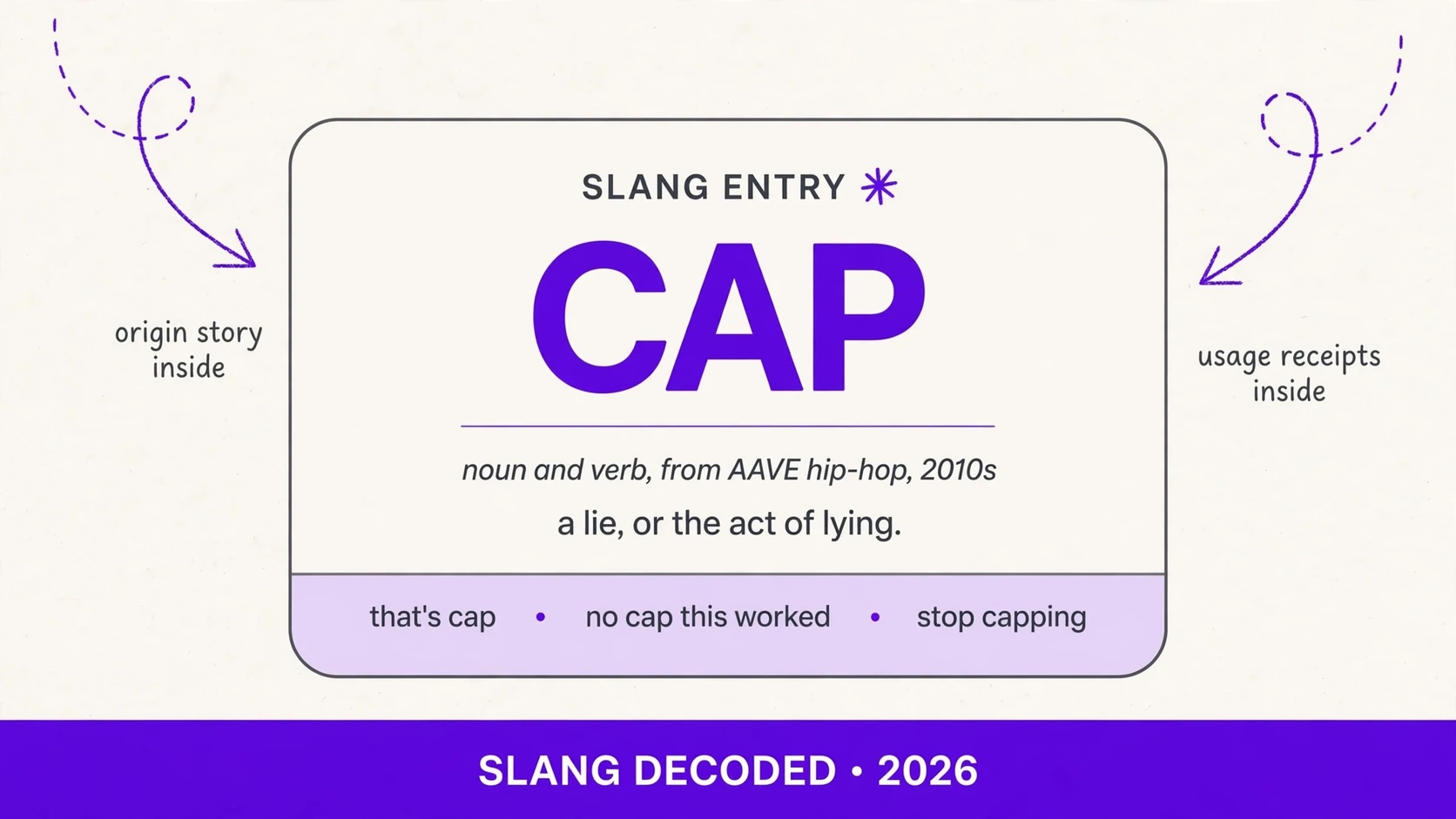
Cap means a lie. As a noun it is a lie, as a verb it means lying, and “no cap” means no lie, all serious. What Does Cap Mean In Slang has one simple core but a social one. You hear it in callouts, rap hooks, and group chats, working as accusation, defense, and punchline.
Once you know the code you will spot cap everywhere. It lives in tweet replies, TikTok captions, Twitch chat, and group chats, traveling from Black Twitter and Southern hip-hop into everyday speech. This guide breaks down where it came from and how to use it.
Every Flavor of Cap You Will Actually Hear
| Meaning | Context |
|---|---|
| A flat out lie | Someone invents a story about their life and you call it out |
| A stretch of the truth | A detail is real but the bragging around it is inflated |
| Lying as an action | Saying someone is “capping” means they are faking right now |
| Exaggeration for jokes | Friends tease each other with cap for funny effect |
| Fake confidence | Big talk with nothing to back it up, like claiming a car you do not own |
| Performative honesty | “No cap” used to promise that what follows is genuine |
| A style of posting | Overly staged photos and captions get labeled cap |
| Denial of a claim | A short reply that says “I do not believe you” without a long argument |
| Self aware bragging | Saying “I am not capping” before telling a wild but true story |
Cap in the Wild: Lines You Have Already Scrolled Past
“no cap I studied for six hours” posted as a TikTok caption over a desk setup video, the creator trying to prove the grind was real before anyone questioned it.
“That’s cap and you know it” dropped in a comment thread, a viewer shutting down a storytime about a celebrity run-in that kept changing details.
“stop capping, your rent is due” texted in a group chat, friends roasting one of their own after he claimed to be flying out a date he clearly could not afford.
“high cap” shouted in a Twitch chat, the streamer’s audience reacting to a lobby of players bragging about rank before a single round was played.
“no cap this might be the best track on the album” written under a lyrics video, a fan making sure the compliment reads as sincere instead of hype.
“that’s capping” said in a voice note, a friend calling out another friend’s story about finishing a marathon they never trained for.
“cap or nah” posted as a poll caption on a selfie dump, the poster inviting followers to vote on whether the vibe was authentic.
“lowkey no cap, I miss high school” written in a bio-adjacent caption, a poster pairing softness with slang to prove the feeling is honest.
“bro is capping” left under a workout clip, gym friends teasing a lifter whose listed personal record looked physically impossible.
What Does Cap Mean in Slang Across Its Timeline
| Year | What Happened |
|---|---|
| Early 2010s | Southern hip-hop, especially Atlanta rap, pushes cap as slang for lying |
| 2014 | “No cap” starts circulating in rap lyrics and mixtape culture |
| 2016 | Black Twitter picks up cap as a callout tool in reply threads |
| 2017 | “High cap” becomes a recurring phrase in rap and meme captions |
| 2018 | Streaming culture spreads it through gaming chats and reaction videos |
| 2019 | TikTok captions turn “no cap” into a mainstream sincerity stamp |
| 2020 | Instagram story stickers and polls make “cap or nah” a template |
| 2021 | Everyday group chats adopt it, far from its original music scene |
| 2022 onward | It settles into general internet slang with both playful and serious uses |
Cap Platform by Platform
| Platform | How Cap Is Used There | Vibe |
|---|---|---|
| Quick callouts in reply threads when a take smells fake | Skeptical and fast | |
| TikTok | Captions that promise honesty, like “no cap this worked” | Casual and sincere |
| Story polls asking followers “cap or nah” | Playful and interactive | |
| Twitch | Chat spam when a streamer or guest brags mid broadcast | Loud and collective |
| YouTube | Comment sections fact checking storytime videos | Detective like and blunt |
| Group chats | Friends roasting each other over wild claims | Warm but ruthless |
| Rap lyrics | Hooks and verses about not lying and not faking | Confident and raw |
| Threads debating whether a viral story is cap | Analytical and dry |
Receipts: No Cap Moments That Actually Landed
“no cap the finale broke me” posted under a show review, a fan insisting the emotional reaction was not performative fandom.
“he’s capping about the price” texted during a car shopping group chat, a sibling warning the family about a seller’s inflated number.
“that’s the biggest cap I’ve heard all week” written as a reply to a viral job posting promising remote work and a six figure salary with no experience.
“no cap, thanks for checking in” sent as a late night message, someone dropping the slang to signal real gratitude.
“she said she never eats fast food, that’s cap” overheard at a table, friends laughing because the accused had a drive thru bag in hand.
“all cap” posted as the entire caption on a gym progress photo that was clearly edited, the commenter letting two words do the work.
“not capping when I say this is the best pizza here” written in a food review comment, the reviewer borrowing rap language to sound certain.
“cap alert” dropped in a live chat, viewers warning each other that a guest on the stream was exaggerating their resume.
“bro no cap that song saved my playlist” written under a song link, a listener turning a casual share into a real endorsement.
When Calling Cap Wins and When It Backfires
| Situation | Tone | Safe or Risky |
|---|---|---|
| A friend’s funny exaggeration | Playful teasing | Safe, it keeps the joke moving |
| A viral story with holes | Skeptical but fair | Safe if the facts really do not line up |
| A stranger’s brag in a reply | Blunt | Risky, it can read as picking a fight |
| A job interview claim | Too casual | Risky, slang undermines the moment |
| A heavy serious topic | Dismissive | Risky, it can sound like you are minimizing pain |
| Your own story that sounds wild | Self aware | Safe, “no cap” heads off doubt |
| A seller’s pitch in a DM | Direct | Safe, it sets a boundary fast |
| A teacher or parent talking | Disrespectful | Risky, the slang itself becomes the problem |
Cap’s Inner Circle of Cousin Terms
| Cousin Term | How It Connects | Overlap |
|---|---|---|
| No cap | The positive twin, meaning no lie | Direct partner |
| Fax | Agreement that something is true, the opposite energy of cap | High |
| Fr | Short for for real, backing up a true statement | High |
| Sus | Doubt about a person or situation, like cap but broader | Medium |
| On God | A swear that you are telling the truth, stronger than no cap | Medium |
| Bet | Agreement or a challenge, often paired with no cap | Medium |
| Clout | Fame chasing, which cap often accuses people of | Low |
| Touch grass | A dismissal, shares cap’s callout spirit | Low |
Ready Made Phrases Built on Cap
“that’s cap” used as a full reply, the classic short callout when a claim feels fake.
“no cap” posted before or after a sentence, the sincerity stamp that says the words are honest.
“stop capping” said to a friend, the friendly command to drop the act and tell the truth.
“high cap” used in rap lyrics and captions, the intensified version meaning a big lie.
“cap or nah” asked as a question, inviting the other person to defend their story.
“that’s capping” said while the lie is happening, the present tense form for live situations.
“all cap” dropped as emphasis, the total dismissal of everything just said.
“not capping” used before a wild claim, the speaker swearing honesty in advance.
“bro is capping” said about a third person, the group chat version of pointing and laughing.
Why Cap Became the Internet’s Built in Lie Detector
Cap won because it is faster than arguing. Instead of typing a paragraph about why someone’s story does not make sense, you drop two words and the whole comment section understands the verdict. It fits the speed of replies and live chats, and it carries a little swagger that “that is untrue” never could. The term also traveled well, moving from Atlanta studios and Black Twitter into dorm group chats and office Slack channels without losing its bite.
whenever a story sounds too good to be true, yet it also pairs with “no cap” to build trust instead of breaking it. That double life, accusation and oath in one tiny word, keeps it useful in almost every corner of the internet. You can doubt and you can promise, all with the same three letters.Stan whenever a story sounds too good to be true, yet it also pairs with “no cap” to build trust instead of breaking it. That double life, accusation and oath in one tiny word, keeps it useful in almost every corner of the internet. You can doubt and you can promise, all with the same three letters.
How Cap Sounds When Real People Say It
The grammar is simple and that is the point. Cap works as a noun, so a lie itself is “a cap” or just “cap,” and it works as a verb, so someone is “capping” or “capped” when they fake it. You will hear “no cap” at the start of a sentence for emphasis or at the end like a stamp, and you will see “that’s cap” standing alone as a complete thought in comment sections. Nobody overthinks it, and overthinking it is usually what gives away a non native user.
Context does the heavy lifting. Said with a laugh among friends, cap is basically a roast with a smile. Said flat in a debate thread, it is a challenge to prove yourself or back down. The word rarely needs backup, but the tone around it decides whether it lands as funny, harsh, or just honest. Listen for that tone before you borrow the word yourself.
The Flip: Cap as a Compliment and a Flex
“No cap” flipped the whole meaning on its head in the best way. Where cap accuses, no cap vouches, and saying it turns a normal sentence into a promise. Musicians use it to swear their lyrics are lived experience, posters use it to prove a review is not sponsored, and friends use it to show they actually mean the compliment. The phrase became a seal of authenticity in a timeline full of staged content.
This positive side is why brands and captions grabbed it so fast. Slapping “no cap” on a post signals that you are in on the joke and being real at the same time, which is exactly the tone social media rewards. But there is a catch worth knowing. The more often you swear “no cap,” the less people trust any single instance, so the word works best when you spend it like money instead of printing it.
How to Use Cap without Sounding Lost
Start small and stay in casual spaces. “That’s cap” works in replies, captions, and group chats where everyone already talks this way, and “no cap” fits when you want to stress that you mean something. Read the room first, because the same word that gets laughs in a friend thread can sound cold in a serious conversation. If the topic is heavy or the audience is formal, plain honesty beats slang every time.
Watch how often you use it, too. Cap is punchy because it is short, and short words lose their punch when they show up in every sentence. One well placed “that’s cap” in a thread of fifty comments lands harder than twenty in a row. Treat it like hot sauce, a little on the right moment, and your timing will look natural instead of forced.
Your Cap Questions, Answered
Is cap a noun or a verb?
It is both. As a noun it means a lie, and as a verb it means lying or faking, like “he is capping.”
What does “no cap” mean exactly?
It means no lie or all facts, a promise that what you just said or are about to say is genuine.
Where did cap slang come from?
It grew out of AAVE and Southern hip-hop, especially Atlanta rap in the early 2010s, then spread through Black Twitter, TikTok, and streaming culture.
Is calling something cap rude?
It can be. Among friends it is playful teasing, but aimed at strangers or in serious moments it can sound dismissive or confrontational.
What is “high cap”?
It is an intensified version meaning a big or obvious lie, popularized in rap lyrics and meme captions.