
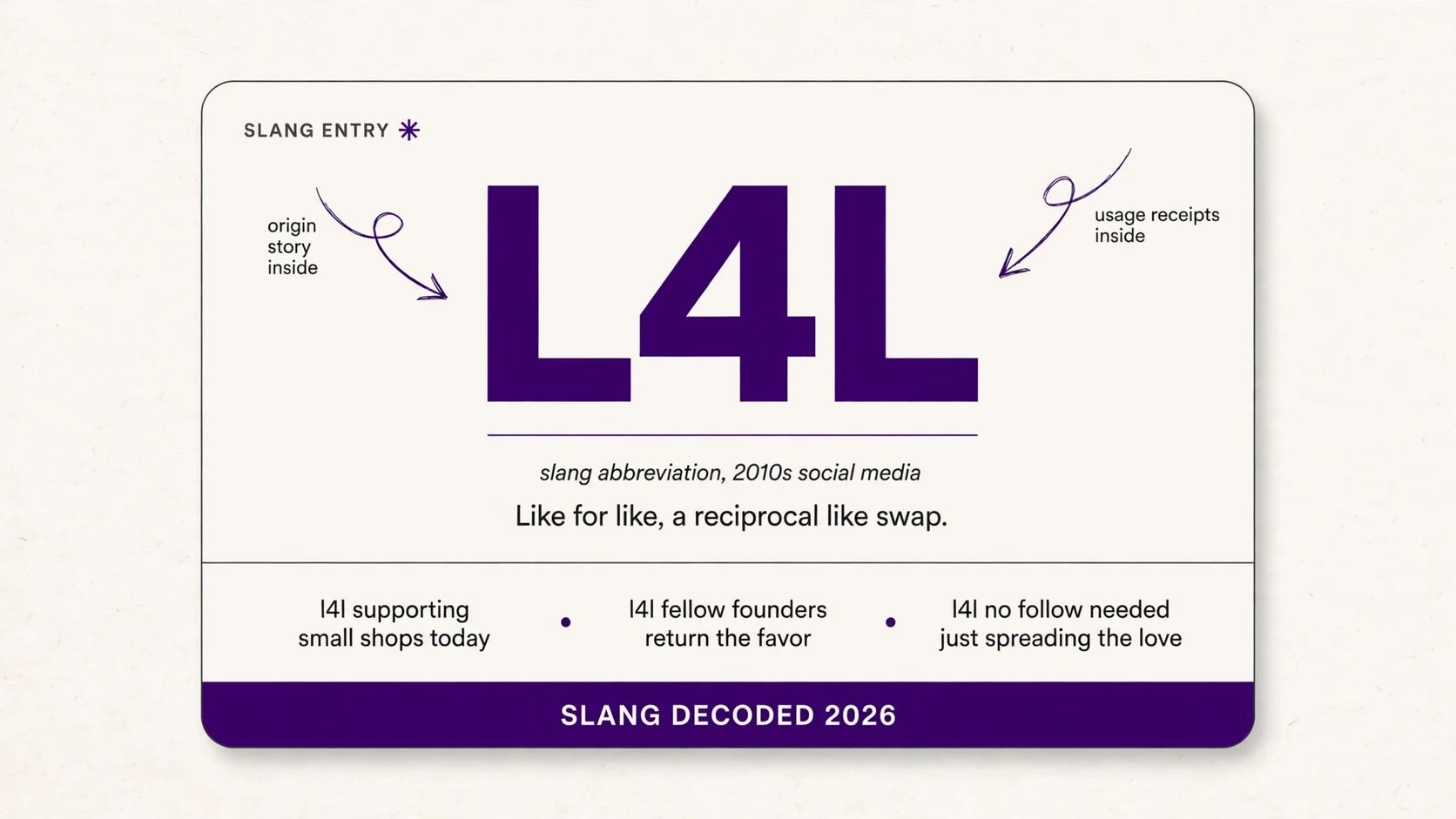
When you ask what does l4l mean in business, the short answer is like for like, a swap where one account likes a post and expects a like back. No separate business or finance definition hides behind the letters.
In business the same shorthand is worn by a brand, a creator, or a small shop trying to look busy online. This is not boardroom jargon. It is Instagram and TikTok language in a work context. Read the tag as a trade offer first, and a business tactic second, and you will rarely misread it.
The Like Swap Decoded for a Brand Feed
| Reading | How it shows up for a business |
|---|---|
| Like for like | A brand likes a creator post, awaiting a like back |
| Reciprocal engagement | Two accounts trade likes to lift a new post |
| Growth shortcut | A new shop uses swaps to make a quiet page look active |
| Social proof play | A higher count aims to make strangers trust a page |
| Community signal | A like trade between local shops reads as mutual support |
| Hashtag invite | #L4L invites strangers to trade likes, no message needed |
| Comment offer | A swap comment turns a visit into a two way deal |
| No finance meaning | No business, banking, or investing definition was found |
How the Hashtag Era Turned a Swap into a System
| Period | What happened |
|---|---|
| Early hashtag era | Swap tags spread on Twitter, where hashtags made trades findable |
| Instagram growth years | Use rose with Instagram, and the like was the easiest trade |
| Creator economy rise | Small creators and shops chased early visibility with swap tags |
| Pod culture | Group chats formalized swaps, with members liking on schedule |
| Algorithm pushback | Platforms favored real interaction, weakening empty swaps |
| Brand caution | Marketers separated real audience signals from traded likes |
| Twitch split | On Twitch the letters mean lurk for lurk, a different reading |
| 2026 reality | The tag circulates, but savvy brands treat it as weak |
Where Brands Actually Drop L4L Right Now
| Platform | Business use | Vibe |
|---|---|---|
| Hashtag on photos, Reels, and swaps with peer shops | Casual and hustling | |
| TikTok | Swaps under launch videos and small business videos | Fast and peer driven |
| Page likes traded in small business groups | Community minded | |
| X | Swap replies under promo posts, often with a follow offer | Blunt and transactional |
| Snapchat | Swaps in stories and private circles, rarely public | Private and fleeting |
| Twitch | Lurk for lurk in streamer circles, not for brands | Insider and risky |
| Almost never used, and it reads off brand there | Awkward and out of place | |
| DMs and group chats | Direct deals between creators, shops, and partners | Quiet and practical |
When the Swap Helps and When It Starts to Hurt
| Situation | Tone | Risk level |
|---|---|---|
| Two local shops liking each other launch posts | Warm and supportive | Low |
| A new page trading likes with peers | Eager and scrappy | Low to medium |
| A brand spamming L4L under unrelated posts | Desperate and spammy | High |
| A luxury or finance brand using swap tags | Off brand and cheapening | High |
| A creator trading likes inside a trusted pod | Friendly and routine | Medium |
| A brand buying likes through an exchange service | Hollow and misleading | High |
| A customer spotting swaps in comments | Curious, then skeptical | Medium |
| A launch post with swaps plus real comments | Balanced and human | Low |
Receipts from the Feed, Likes Traded in Plain Sight
l4l, supporting all the small shops today, drop your link below
Seen in an Instagram comment under a new candle shop launch post. It reads as peer support.
just posted our fall drop, l4l if you run a small biz too
Seen in an Instagram caption for a boutique clothing post. It targets owners, not shoppers.
l4l, will return every like before close of business
Seen in a Facebook small business group thread. It sounds like service language, but is only about likes.
new menu just dropped, l4l and tell me what you would order
Seen in a TikTok comment from a cafe account under its launch video. The food question adds a real hook.
l4l, no follow needed, just spreading the love today
Seen in a comment on a handmade jewelry Reel. Dropping the follow ask lightens the trade.
l4l from one local bakery to another, your croissants look unreal
Seen in a comment between two neighborhood food accounts. The compliment makes the swap feel genuine.
posting our restock at noon, l4l with fellow makers
Seen in a story caption reshared as a post by a stationery shop. Likes come from peers, not future buyers.
l4l, happy to support, your packaging is so clean
Seen in an Instagram comment on a skincare brand post. Praise plus swap softens a cold request.
The Cousins That Travel with Every Swap Tag
| Term | Relationship to L4L |
|---|---|
| F4F | Follow for follow, a bigger ask than one like |
| S4S | Shoutout for shoutout, a promo trade, not one like |
| SFS | Shoutout for shoutout in shorter form, same promo swap idea |
| Engagement pod | A group liking on schedule, a more organized swap |
| Like back | Plain English for the same offer, often written LB |
| Follow back | A reply promise after a follow, close to F4F but looser |
| Tag for likes | An older tag family inviting likes, no return promised |
| Reciprocity | The habit behind it, you return a favor given |
| Social proof | Why brands care, busy pages feel safer |
Who Drops It and What They Want from the Trade
| Group | How they use it |
|---|---|
| New small shops | To make a fresh page look active |
| Solo creators | To trade support with peers and stay visible between posts |
| Local businesses | To back neighboring shops and build a visible local network |
| Side hustle sellers | To push a drop or restock past quiet hours |
| Social media managers | Rarely public, sometimes quietly in peer groups |
| Customers | Almost never, and when they do they usually run a page too |
| Bigger brands | Almost never public, it can cheapen a polished image |
| Scammy growth pages | Aggressively, with mass comments and no conversation |
More Receipts, This Time from Brand and Creator Corners
l4l, fellow founders, I liked your launch post, return the favor when you can
Seen in a comment thread under a startup founder Reel. Founder language makes it sound like networking.
our team will l4l every comment on this post today, go go go
Seen in a brand post caption during a flash sale. The swap becomes an event that drives comments.
l4l, honest review in return if you want real feedback too
Seen in a DM screenshot shared in a creator group chat. Feedback lifts the trade above a bare like.
l4l, supporting black owned brands all week, tag one below
Seen in an Instagram comment under a roundup post. The community frame gives the swap purpose.
l4l, just a small candle brand trying to survive the algorithm
Seen in a TikTok bio line for a home goods shop. A bio swap tells visitors the page is small.
l4l, will like your last three if you like mine
Seen in a comment on a thrift shop post. Raising the count shows how trades escalate.
l4l, no weird stuff, just local shops helping local shops
Seen in a Facebook group post from a plant shop owner. The reassurance shows the owner knows swaps can look spammy.
l4l, our new scent is live and we need eyes on it fast
Seen in a caption for a fragrance launch Reel. Speed is the point, the swap is a flare, not a plan.
Why a Like Swap Reads Differently on a Brand Account
The same three letters land differently from a teen and from a shop owner. A teen reads as playful, while a brand reads as a business asking for a public favor. Customers judge what the letters say about confidence in your product.
Context does the heavy lifting here. A swap between local shops can feel neighborly, while a swap under a stranger viral post can feel like a flyer shoved into a hand. Keep trades inside real relationships, and the move stops looking like a shortcut.
What Customers Think When They Read What Does L4l Mean in Business on Your Page
A shopper tapping your comments wants proof real people liked what they saw. A wall of swap comments tells another story, and a good product can look like it needed help. Counts rise, but trust can fall when every comment sounds like a trade.
You need not hide support for other small accounts. Let it sound human, with a real comment about the product or photo. A specific compliment travels further than a bare swap tag.
The Reach Tradeoff You Feel Before You See It
Traded likes give a new post a quick pulse, but rarely show whether the right people saw it. Trading accounts are often sellers chasing the same lift, not repeat shoppers. Dashboards look busier while sales and real comments stay flat.
The same swap logic shows up in f4f, s4s and sfs, and each trades a quick number for a weaker signal about who cares. Read results with clear eyes. If likes climb and nothing else moves, you bought motion, not momentum.
Smarter Moves When You Need Eyes without the Swap Tag
Ask a question your ideal customer can answer in five seconds, and let replies do the work a swap tag was meant to do. Post a before and after, a packing clip, or a mistake you fixed. Real buyer comments teach the feed more than a traded tap.
Team up with one peer brand for a joint post, a giveaway with clear rules, or a story swap explaining why you like each other shop. That trade helps both pages and gives viewers something useful. You keep support, lose the spammy aftertaste.
Frequently Asked Questions About L4L in Business
Should a business use L4L on its main brand account?
Only sparingly in peer spaces, since public swap tags can make a polished brand look desperate.
Is L4L a real finance or business term with a separate meaning?
No separate business or finance meaning was found, since this is the like for like swap applied by brands.
How is L4L different from F4F for a small shop?
L4L trades a single like while F4F trades a follow, so F4F asks for a longer commitment.
Can L4L hurt reach or credibility for a brand?
Yes, traded likes can inflate counts without real interest and make comments look shallow to shoppers.
What is a safer alternative to L4L for a new business page?
Ask a real question, share useful behind the scenes content, and run one clear peer collaboration.