
In a data center, MW means megawatt, which is a unit of electric power equal to one million watts. When you see a data center listed at 20 MW or 100 MW, you are looking at how much power that facility can handle, not how much storage it holds or how fast its internet connection runs. That detail changes how you read headlines about new builds, expansions, and AI-ready campuses. If you picture MW as the size of the power supply coming into the building, you can compare sites, spot hype, and ask smarter questions.
What Mw Stands for in a Data Center
MW is short for megawatt. Mega means million, watt measures power, so one MW is one million watts. In data center talk, that is capacity, or how much power a building, a hall, or a campus can support at once. People rarely spell it out, they just write 40 MW and move on, but if you are new, that shorthand can feel like code. Learn that MW means power size, and the rest of the jargon gets easier fast.
- MW stands for megawatt in data center specs
- One MW equals one million watts
- MW means power capacity, not storage
- MW means power capacity, not internet speed
- Larger MW usually means a larger power supply
- MW covers buildings, halls, phases, and campuses
- Check if a figure is total or IT load
- MW is power at a moment, not over a day
How Big Is One Megawatt Really
One megawatt feels abstract until you compare it with smaller units. A phone charger uses a few watts, a laptop uses tens of watts, and a microwave uses around one thousand watts. One megawatt is one thousand times that microwave level, which is why data centers need it and your living room does not. Homes vary too much for one fixed home count, so think in pure math: servers, cooling, and backup systems all draw power together, and that adds up fast.
| Unit | Watts |
|---|---|
| 1 watt | 1 |
| 10 watts | 10 |
| 100 watts | 100 |
| 1 kilowatt | 1,000 |
| 10 kilowatts | 10,000 |
| 100 kilowatts | 100,000 |
| 1 megawatt | 1,000,000 |
| 10 megawatts | 10,000,000 |
Mw Versus Kw and Gw in Data Center Specs
Specs jump between kW, MW, and GW because each unit fits a different scale. Kilowatt works for a rack or small room, megawatt works for a building or campus, and gigawatt works for a very large campus, where one gigawatt equals one thousand megawatts. Remember the ladder: one thousand watts make one kilowatt, one thousand kilowatts make one megawatt, and one thousand megawatts make one gigawatt. That lets you compare a hall post with a campus headline without mixing up scale.
| Size | Plain reading |
|---|---|
| 1 MW (1,000 kW) | Small hall |
| 5 MW (5,000 kW) | Modest building |
| 10 MW (10,000 kW) | Mid size facility |
| 20 MW (20,000 kW) | Common new build |
| 50 MW (50,000 kW) | Large building |
| 100 MW (100,000 kW) | Big campus |
| 200 MW (200,000 kW) | Very large campus |
| 500 MW (500,000 kW) | Huge campus plan |
Where You See Mw on Data Center Listings
You will run into MW in property listings, press releases, construction updates, and social posts from people tracking new builds. Sometimes it sits right in the headline, like a 60 MW facility coming to a new city. Other times it sits in a specs box next to floor space and cooling type. The words around the number matter, because total capacity, IT load, phase one, and campus total each point to a slightly different slice of power.
| Listing phrase | What to check |
|---|---|
| Total capacity | Backup power included |
| IT load | Cooling share included |
| Phase 1 capacity | Later phases planned |
| Campus total | Buildings built yet |
| Operational MW | Power live today |
| Under construction MW | Opening time frame |
| Planned MW | Permits and power deals final |
| Available MW | Speed to use it |
Mw, It Load, and Facility Power Explained
This is where most confusion starts, so take your time with it. A data center uses power for more than servers. It also uses power for cooling, fans, pumps, lighting, security, and losses in power equipment. IT load is the slice that powers computers themselves. Facility power, often called total power, is the bigger number that covers IT load plus all supporting gear, so two sites at 20 MW can still differ in practice.
| Power bucket | What it covers |
|---|---|
| IT load | Servers and network gear |
| Cooling load | Chillers, fans, and pumps |
| Power losses | UPS and transformers |
| Lighting load | Halls and offices |
| Security load | Cameras and monitoring |
| Office load | Desks and staff areas |
| Backup systems | Generators and batteries |
| Total facility load | IT plus supporting systems |
Common Mw Phrases You Will Run Into
Once you know the core meaning, phrases around MW get easier to decode. A 20 MW facility is a site built around 20 megawatts of capacity. A 100 MW campus is a group of buildings adding up to 100 megawatts. MW of IT load narrows the focus to server power, while MW under construction means power being built, not live yet. An expansion adds MW, a phase breaks a big campus into buildable chunks, and hyperscale is a casual word for very large sites, with no single official MW cutoff everyone agrees on.
| Phrase | Plain meaning |
|---|---|
| 20 MW facility | Site at 20 megawatts |
| 100 MW campus | Buildings total 100 megawatts |
| MW of IT load | Server power only |
| MW under construction | Being built, not live |
| MW operational | Live and usable now |
| MW expansion | Extra power added |
| Phase 1 at 30 MW | First stage only |
| MW available now | Open for new customers |
Mw in Conversation: Examples You Can Copy
You do not need to sound like an engineer to use MW correctly. Keep the number next to MW and add a little context, like the city or whether the site is live or still being built. That context stops your post from sounding like a random number floating in space. Read these examples out loud, then swap in your own city or number and the sentence still works.
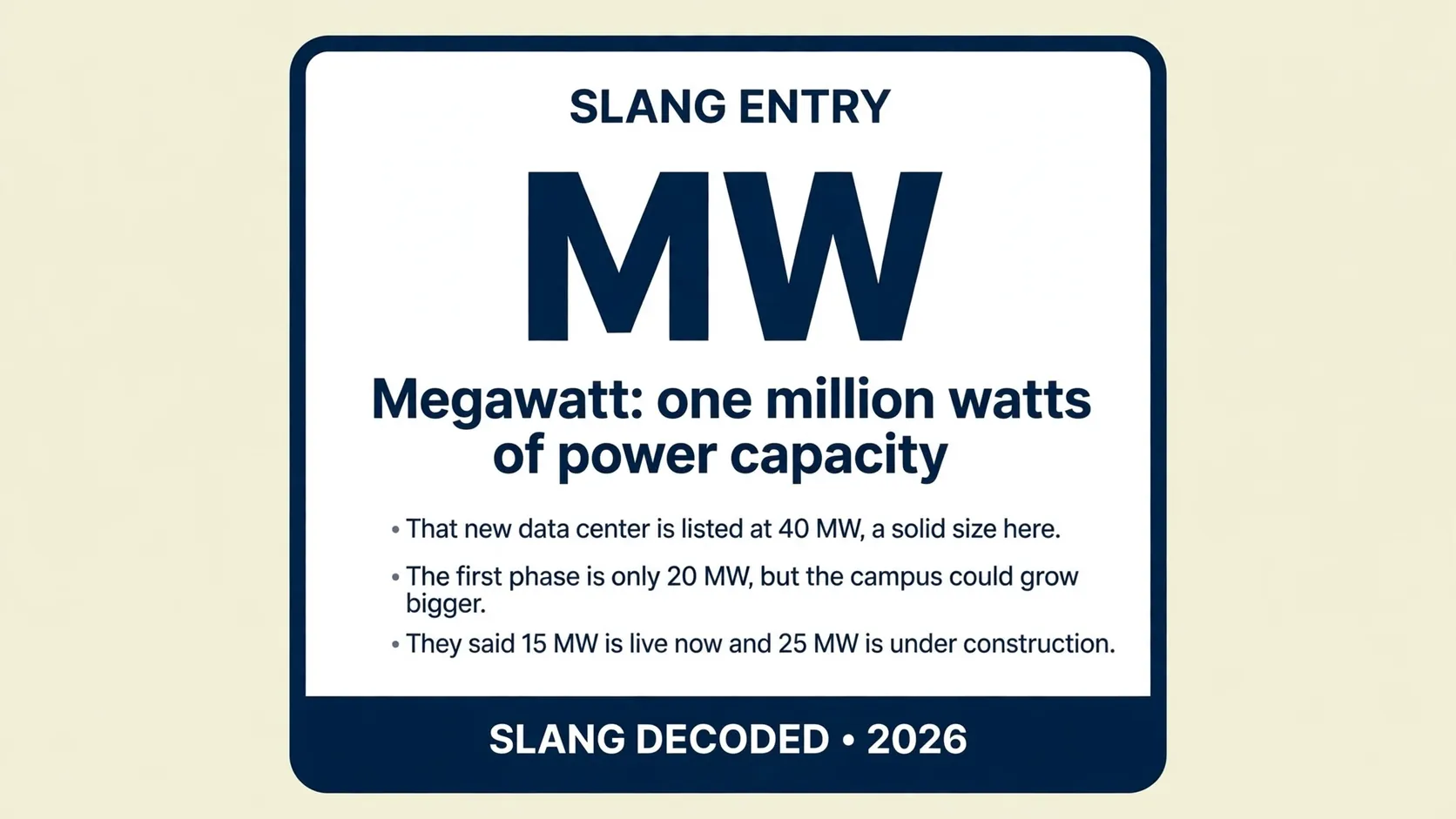
- That new data center is listed at 40 MW, a solid size here.
- Did you see the 100 MW campus plan at the edge of town?
- The first phase is only 20 MW, but the campus could grow bigger.
- They said 15 MW is live now and 25 MW is under construction.
- I thought MW was about storage, then I learned it is power.
- How much MW of IT load does that building offer customers?
- A 60 MW site sounds huge beside a 500 MW campus plan.
- The listing says 30 MW total, so check the IT load share.
- This expansion adds 10 MW, enough for a few more halls.
Mw Mistakes to Avoid When You Read a Spec Sheet
Even smart readers mix up MW details when they skim too fast. The most common mistake is treating MW like storage, speed, or floor space. MW is power only, so a bigger number does not mean more hard drives or faster downloads on its own. Another common mistake is comparing IT load on one site with total capacity on another site as if they were the same thing. Pause before you share, and check what kind of MW is quoted.
- Mixing up MW power with data storage size
- Mixing up MW power with internet speed
- Comparing IT load with total power directly
- Treating planned MW as already live
- Assuming one hall number covers a whole campus
- Reading MW as energy over a day
- Confusing MW with MWh, energy over time
- Sharing a headline number without checking context
Why Data Center Folks Talk in Mw Instead of Watts
People in data centers talk in MW because watts get messy at this scale. Writing 100,000,000 watts in every post is slow to read and easy to mistype, while writing 100 MW is clean and instantly clear to anyone who follows the industry. It is the same reason you say kilometers for a road trip instead of counting every single meter along the way.
MW also makes comparison fast. When you line up a 20 MW site, a 50 MW site, and a 200 MW campus, you can see the size gap in one glance. That speed matters in fast moving threads where people scan headlines, share updates, and debate new builds without stopping to do long math in the comments.
How to Use Mw Correctly in Your Own Posts
If you want to use MW in your own posts, keep it simple and specific. Put the number right before MW, add the place or project name, and say whether the power is live, under construction, or planned. A post like “the new site in Austin is planned at 80 MW” gives readers everything they need, while a post that just says “80 MW” leaves them guessing.
You should also avoid turning MW into a vague hype word. Saying a site is massive because it has a big MW number is fine, but pairing that number with context is better. Tell your readers if it is a single building or a campus, and if you know whether the figure is IT load or total power, share that detail too, because it shows you actually read the spec.
Mw Next to Other Slang You See Online
MW lives in a very different corner of the internet from chat slang, and that contrast is useful to remember. Data center MW is a technical unit with a fixed math meaning, while chat slang often shifts by app, friend group, and year. When you scroll past posts that mention mms, nfs, and clm in the same feed as a data center update, you can tell at a glance that those terms belong to messaging culture, while MW in that update belongs to power and infrastructure.
That mix is normal on a busy timeline. One minute you are reading about a new campus, the next minute you are decoding a text from a friend. Keeping the context straight helps you avoid funny mixups, like trying to read a power spec as if it were a texting shortcut. If the post is about buildings, servers, and power deals, MW almost always means megawatt.
The Bottom Line on Mw in Data Centers
The bottom line is refreshingly simple. In a data center, MW means megawatt, and megawatt means one million watts of power capacity. That number tells you how much power a hall, a building, or a campus can support, and it helps you compare sites without getting lost in long strings of zeros.
Next time you see MW in a headline, a listing, or a comment thread, slow down for one second and check the words around it. Look for IT load versus total power, live versus planned, and single building versus campus. With those three checks, you can read MW like a regular and join the conversation with confidence.
Frequently Asked Questions About Mw in Data Centers
What does MW mean in a data center?
MW means megawatt, which is one million watts of electric power capacity for a data center hall, building, or campus.
Is MW the same as MWh in a data center?
No, MW measures power at a moment in time, while MWh measures energy used over a period of time.
Does a higher MW number mean faster internet?
No, a higher MW number means more power capacity, not faster internet speed or more data storage.
What is the difference between IT load MW and total MW?
IT load MW covers power for servers and IT gear only, while total MW also covers cooling, losses, and other facility systems.
Can I use MW when I talk about a data center online?
Yes, just put the number before MW, name the site or city, and say whether the power is live, under construction, or planned.