
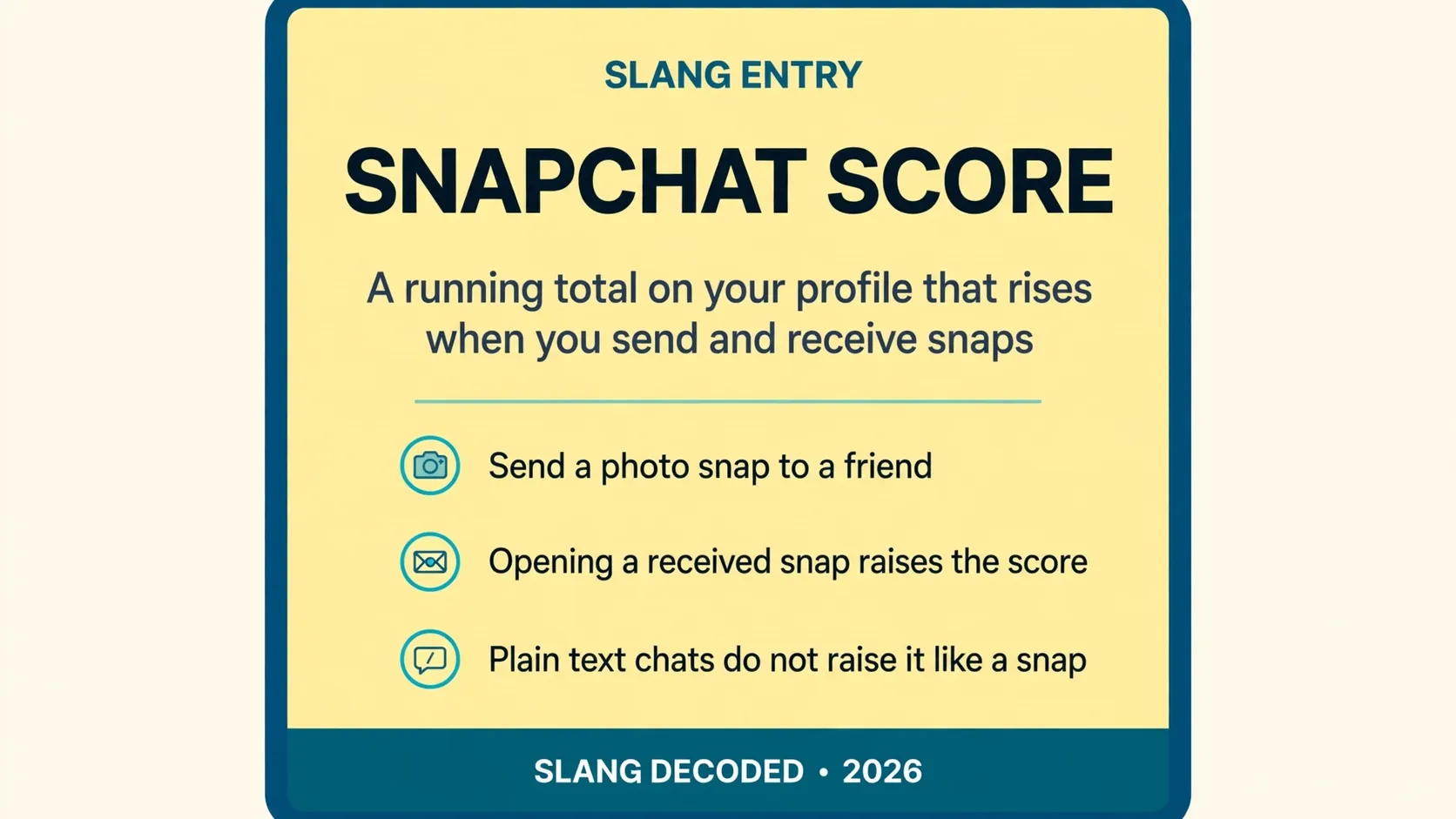
Your Snapchat score is a running total on your profile that rises when you send and receive snaps and take part in other activity inside the app. It is not a grade, it is not a follower count, and it does not measure how popular you are in real life. Think of it as a counter that tracks how much you have used Snapchat over time. If you have ever opened a friend profile and spotted a number next to a ghost icon, that number is the score, and it tends to spark curiosity and questions in chats.
A Quick Snapshot of the Term
Snapchat score is the name people use for that profile total. It goes up gradually, it does not go down when you take a break, and it is visible to people who can see your profile in the app. The score is best read as a history marker. It shows that an account has been active, not that the person behind it is more fun or more loyal.
| Detail | What It Tells You |
|---|---|
| Location | It appears on a Snapchat profile near the username |
| Direction | It only moves upward over time |
| Main driver | Sending and receiving snaps |
| Extra activity | Other in app actions can also add to it |
| Visibility | Friends and profile viewers may see it |
| Speed | It grows slowly with regular use |
| Breaks | Taking time away does not lower it |
| Meaning | It is a usage total, not a rating |
| Best use | A light conversation starter, nothing more |
How Your Score Is Built
The score builds through the ordinary things you already do on Snapchat. When you send a snap to a friend, that action counts, and when a friend sends one back and you open it, that counts too. Posting to your story and staying active can also play a part, although Snapchat has not published a simple points chart that lists every action and its exact value. That lack of a public formula is why so much guessing happens online. Treat snaps as the main engine and everything else as a smaller bonus.
In everyday chat you might hear snap score as a short form of the full term, snap as the photo or video message itself, and mms as an older phone message format that people sometimes compare it with, even though a snap and an mms message work in very different ways. The score itself, though, belongs only to Snapchat. You cannot carry it to another app, and no other app can raise it for you.
- Send a photo snap to a friend
- Send a video snap to a friend
- Receive a snap and open it
- Keep a regular back and forth going
- Post to your story from time to time
- Try new features inside the app
- Stay active across different days
- Reply to snaps instead of only watching stories
- Use the app as part of a normal routine
Actions That Do Not Move the Number
Not everything on Snapchat feeds the score in the same way. Plain text chats are a normal part of talking to friends, but they are not snaps, so a chat message alone should not push the total upward in the same way. Watching a story without sending anything also does not work like sending a snap. The score rewards snap activity first.
| Action | Likely Effect on Your Score |
|---|---|
| Sending a photo snap | Raises the score |
| Sending a video snap | Raises the score |
| Opening a received snap | Raises the score |
| Sending a plain text chat | Does not raise it like a snap |
| Watching a story only | Does not raise it like a snap |
| Scrolling without sending | No clear snap effect |
| Deleting the app for a week | Does not lower the score |
| Making a new account | Starts a fresh total from zero |
| Viewing your own profile | Does not raise the score |
Where to Find It on Your Profile
Finding your score takes only a few taps. Open Snapchat, go to your profile screen, and look near your username and display name. The number sits beside a small ghost icon. Layouts change with updates, so the exact spot may shift slightly.
If you want to check a friend score, open that friend profile in the same way. You will see their total if their privacy settings allow it. If you cannot see it, settings, friendship status, and app version can affect what shows up, so a missing number is usually a privacy detail, not a fault.
Common Score Myths to Ignore
Myths travel fast because the score feels mysterious. One popular myth says a secret trick adds thousands of points overnight. There is no honest shortcut like that. Another myth says your score drops if you ignore the app. It does not, because totals do not shrink just because you took a weekend off. A third myth says a high score proves someone talks to a lot of people, but it might also mean one person sends many snaps to a small circle every day.
| Myth | Reality Check |
|---|---|
| A trick adds thousands overnight | No honest shortcut works that way |
| Your score falls when you rest | Totals do not drop from inactivity |
| A high score means many friends | It may mean many snaps to few friends |
| Chatting alone boosts it fast | Snaps matter more than plain chats |
| Stories alone build it quickly | Sending snaps is the stronger driver |
| A low score means a new person | It may mean a quiet or fresh account |
| Everyone can see every detail | Privacy settings affect what is visible |
| The score judges character | It only tracks app activity |
| You must chase it daily | You can ignore it and still enjoy the app |
Score Ranges and What They Usually Suggest
People love to compare ranges, so read them loosely rather than as strict levels. A score in the hundreds often belongs to a newer or occasional user, a score in the thousands to someone who snaps regularly, and a score in the hundreds of thousands usually reflects years of steady use.
| Approximate Range | What It Often Suggests |
|---|---|
| Under 500 | New or occasional use |
| 500 to 2,000 | Getting started with friends |
| 2,000 to 10,000 | Regular snapping habit |
| 10,000 to 50,000 | Frequent and steady use |
| 50,000 to 100,000 | Very active over a long time |
| 100,000 to 250,000 | Heavy daily snap routine |
| 250,000 to 500,000 | Years of consistent activity |
| Over 500,000 | Exceptionally long or intense use |
| Any range | Still just a usage total |
Score Etiquette in Everyday Chats
Score etiquette is simple. Do not use the number to pressure someone, and do not let someone use it to pressure you. If a friend asks about your score, you can share it, laugh it off, or say you do not track it. If your own score stays flat for a while, that usually means you have been busy elsewhere. Snapchat works best when the number stays in the background.
- Never demand a snap just to raise a score
- Do not compare scores to rank friends
- Let a friend keep their number private if they prefer
- Avoid teasing someone for a low total
- Avoid bragging about a high total
- Keep streaks and scores as fun, not obligations
- Take breaks without guilt when you need them
- Talk about the snap itself, not only the number
- Remember that real friendship is not a counter
Related Terms You Will See Nearby
Snapchat has its own small vocabulary. A streak tracks consecutive days of snapping back and forth with one friend, a story is a collection of snaps friends can view for a limited time, and a snap itself is the photo or video message at the center of the app. Keep each term in its own lane. Your score is the lifetime total, your streak is a daily habit with one person, and your story is what you share more widely.
| Term | Simple Meaning |
|---|---|
| Snap | A photo or video message |
| Story | Snaps shared for friends to view |
| Streak | Consecutive days snapping with one friend |
| Score | Lifetime activity total on a profile |
| Ghost icon | The small symbol near the score |
| Friend profile | Where you view another user details |
| Chat | Plain text messages inside the app |
| Filter | A fun effect added to a snap |
| Lens | An interactive effect for photos and video |
Why People Care About the Number
People care about the score because it is visible, easy to compare, and tied to something social. When you open a profile, the number is right there. That visibility turns a simple counter into a talking point, especially among friends who snap every day.
Caring a little is not the same as needing to chase the number. Treat it like a step counter. It is interesting to glance at, and it does not need to control how you spend your evening.
How to Talk About Scores without Pressure
Talking about scores works best when you keep the tone light. Ask a friend how long they have used the app, or joke about how slowly your own total climbs. Those conversations feel friendly because they focus on memories and habits, not on ranking.
You also have every right to set a boundary. If someone keeps asking for snaps only to raise a number, say you prefer to snap when you have something real to share. Good friends will understand it.
A Calmer Way to Use Snapchat
A calmer way to use Snapchat starts with sending snaps because you want to share a moment, not because a counter demands it. Send a photo of something funny or a quick video from your day to a close friend, and let the score rise on its own in the background.
Friends can tell when a snap is sent with care and when it is sent only to keep a number moving. If you focus on real moments first, your score will still grow, and your chats will feel better too.
Frequently Asked Questions
What does Snapchat score mean in simple terms?
It means a lifetime total of your snap activity that appears on your profile.
Does chatting raise your Snapchat score?
Plain text chats do not raise it the way sending and opening snaps do.
Can your Snapchat score go down?
No, taking a break does not lower a total that has already built up.
Why is my Snapchat score not changing?
You may be chatting or watching stories without sending or opening many snaps lately.
Is a high Snapchat score important?
No, it is a fun usage counter, not a measure of friendship or worth.