
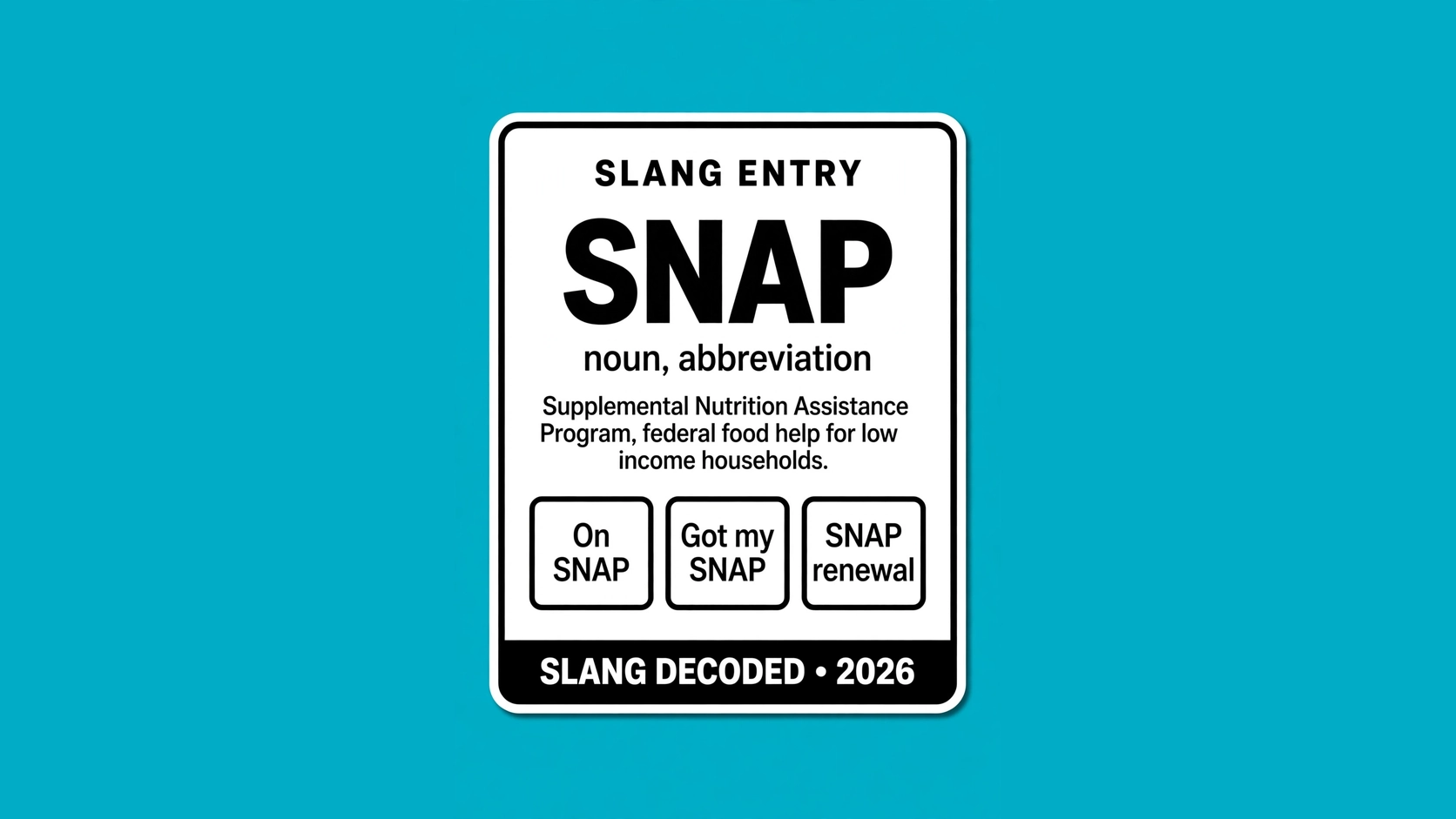
When you ask what does snap mean in government, the core answer is that SNAP stands for the Supplemental Nutrition Assistance Program, the United States federal food assistance program that helps people with low incomes buy groceries. You will meet it in news and official notices about food help, not as slang for a photo.
It is an official name turned into four letters, so read it as shorthand for a real benefit. Once you know the full name, who it helps and how it reaches a household fall into place.
What Does Snap Mean in Government When You See It in a Headline
When a headline uses SNAP, it usually means food assistance policy, funding, eligibility, or enrollment, not social media. Words nearby such as benefits, households, stores, and states confirm that the writer means the program.
| Where you meet the term | What it usually points to |
|---|---|
| News about food aid | The federal food program for low income households |
| A budget story | Federal nutrition spending for eligible households |
| A state agency notice | Local rules for applying and renewing a benefit |
| A grocery store sign | A store that accepts the benefit card for eligible food |
| A school or clinic flyer | Help for families who may qualify for food support |
| A disaster update | Extra food help after a declared emergency |
| A policy debate | Debates on benefit levels, work rules, and access |
| A research report | Data on hunger and household food spending |
| A benefits letter | Your case, balance, renewal date, or duty |
The Full Name in Plain Words
Each word tells you something useful. Supplemental means extra help on top of what a household can already spend, not a full grocery budget. Nutrition points to food and health, assistance to support rather than a loan, and program to rules run by government.
| Word in the full name | Plain sense for a reader |
|---|---|
| Supplemental | Extra help added to a household food budget |
| Nutrition | Food that supports health and daily energy |
| Assistance | Support given to people who meet the rules |
| Program | A planned benefit with set rules and limits |
| Federal | Funded by the national government of the United States |
| Food | Groceries for home preparation and eating |
| Purchasing | Buying eligible items at an approved store |
| Low income | Limited earnings and resources under set limits |
| Household | People who live together and share food costs |
From Food Stamps to a Card in Your Wallet
SNAP did not start with a plastic card. It grew out of an older food stamp system that used paper coupons, and the delivery method changed while the basic goal stayed the same. The old name still appears in everyday speech, which is why many people use both names for the same benefit.
| Period in the story | What changed for ordinary people |
|---|---|
| Early food stamp efforts | Paper coupons helped families buy food |
| The 1964 law | A national program took lasting shape |
| Later expansion years | More households could qualify as need changed |
| The 2008 renaming | Food Stamp Program became SNAP in full |
| The card era | Paper coupons gave way to an electronic benefit card |
| The EBT system | Benefits load monthly onto a debit style card |
| Recession years | Enrollment rose as jobs and incomes fell |
| Pandemic years | Temporary boosts reached more households |
| Recent years | Rules and amounts kept shifting with law and prices |
Who the Program Is Built to Help
SNAP is aimed at households that struggle to afford enough food, and the rules look at income, household size, and certain expenses. Many different households use the benefit for a period when money is tight.
- Working parents whose wages fall short for groceries
- Single adults with low earnings facing rent and food costs
- Older adults on a fixed income with little room for food
- People with disabilities facing extra costs and limited work
- Veterans needing short or longer term food help
- Students where work and household rules allow it
- Families with children needing meals during school breaks
- Households hit by job loss, illness, or income drop
- People in rural areas with scarce jobs and high food prices
What the Benefit Can and Cannot Buy
A SNAP benefit is for food, and that boundary matters at the checkout. You can use it for groceries you prepare at home, from fresh produce to pantry staples. You generally cannot use it for hot ready to eat food, alcohol, tobacco, vitamins, medicines, or nonfood items such as soap.
| Item type at the store | How SNAP usually treats it |
|---|---|
| Fresh fruits and vegetables | Eligible food for home preparation |
| Bread, rice, and pasta | Eligible pantry staples for meals |
| Meat, poultry, and fish | Eligible protein foods for the household |
| Milk, cheese, and eggs | Eligible dairy and breakfast foods |
| Snack foods and soft drinks | Often eligible even when they are less healthy |
| Hot deli meals ready to eat | Generally not eligible under normal rules |
| Alcohol and tobacco products | Not eligible under program rules |
| Vitamins and medicines | Not eligible as nonfood health products |
| Soap, paper goods, and pet food | Not eligible as nonfood household items |
How People Talk About Snap Day to Day
In everyday speech, people rarely say the full program name. They say SNAP, food stamps, EBT, or benefits, and the meaning usually comes from context. A caseworker may say SNAP in a letter, a friend may say food stamps in a chat, and a store sign may say EBT accepted.
- On SNAP means currently receiving the monthly benefit
- Got my SNAP means the monthly amount has loaded
- SNAP card means the electronic card for eligible food
- SNAP benefits means the amount available for food
- SNAP office means the local agency handling cases
- SNAP renewal means the regular check keeping a case open
- SNAP eligible means meeting income and household rules
- Lost SNAP means a closed case or missed renewal
- SNAP approved means an application met the rules
Words That Sit Close to Snap
SNAP does not stand alone in government language. It sits beside other food and income programs, and people often mix them up. Each one has its own rules, age groups, and payment method.
| Related term | What it means in plain language |
|---|---|
| EBT | Electronic Benefits Transfer, the card system for benefits |
| Food stamps | The older common name for the same food benefit |
| WIC | A separate program for women, infants, and young children |
| TANF | Cash help for families with children under state rules |
| Food bank | A charity that gives out free food in a local area |
| Food pantry | A local site where people collect donated food |
| School meals | Free or low cost meals served through schools |
| D-SNAP | Disaster SNAP for people hit by a declared disaster |
| FNS | The federal service that oversees nutrition programs |
Tone, Trust, and Common Mix Ups
The tone around SNAP in government writing is formal and practical. Officials use it in notices and press releases, while reporters use it as neutral shorthand. In personal conversation the tone can shift, because food help touches pride and family budgets, so some people speak quietly and others speak openly.
The biggest mix up comes from Snapchat, where snap means a photo or video message that disappears. That meaning has nothing to do with a government benefit, even though the spelling is the same. A second mix up comes from snap decision, a fast choice, and snap election, an election called early. Benefits, households, or food aid in context point you back to the program.
Watch also for snap used as a verb in a policy story. A headline might say funding could snap back, but that is ordinary verb use, not the program name. SNAP in capitals almost always signals the program, while lower case snap often signals sound, speed, or a photo.
Snap in News, Budgets, and Everyday Chat
News writers love short forms, and SNAP fits a headline far better than the full program name. That is why you will see it in stories about spending, hunger, and state policy even when the article explains little. Slow down and check whether the story is about funding, a new rule, or a personal story.
In everyday chat, the term travels faster than the details. A neighbor may mention a SNAP balance, a clerk may ask about EBT, and a family member may ask how to renew. Each use points back to whether a household can buy enough food this month.
Why the Short Form Sticks
Short forms stick when they save time and still carry a clear meaning, and SNAP does both. Four letters are easier to print, say, and search than a five word program name. Over time it becomes recognized even by people who have never applied.
It also travels across forms, cards, signs, and apps without changing. A person can see SNAP on a letter, hear it on a call, and read it on a store door, and the meaning stays steady. That steadiness builds trust.
What Does Snap Mean in Government for a Reader in 2026
For a reader in 2026, the answer stays grounded in the program itself, even as rules, amounts, and state systems keep changing. Treat any dollar amount or income limit as a snapshot for a given year and state, not a permanent national fact. Check a current state agency guide rather than an old article or social post.
If you search nearby phrases such as what does snap mean in england, what does snap mean in football, and what does snap mean on doordash, you will find different worlds, because each one points to a different snap story. That contrast shows why context matters more than spelling. In government writing, SNAP means food assistance, while in those other searches it can mean a card game, a play on the field, or a delivery app feature.
A Clear Way to Use the Term Yourself
When you use the term yourself, spell it in capitals on first use and add the full name beside it if your reader may be new to it. That small step removes doubt where some readers think first of Snapchat and others think first of food aid. After that, SNAP alone is enough.
Pair the term with a plain verb to keep it human and clear. Say a household receives SNAP, uses SNAP at the store, or renews SNAP each year, rather than hiding the action behind jargon. Clear verbs help your reader picture the benefit in real life.
Questions People Ask About Snap in Government
What does SNAP stand for in government?
SNAP stands for the Supplemental Nutrition Assistance Program, the federal food assistance program in the United States.
Is SNAP the same as food stamps?
Yes, food stamps is the older common name for the same benefit, now delivered through an electronic card.
Is SNAP connected to Snapchat?
No, Snapchat is a separate photo messaging app, while SNAP in government means the food assistance program.
Who can receive SNAP benefits?
Households with low incomes that meet size, income, expense, and state rules may qualify for monthly food benefits.
Can SNAP be used for hot meals and household goods?
No, SNAP is generally for eligible groceries for home preparation, not hot ready to eat meals or nonfood items.