
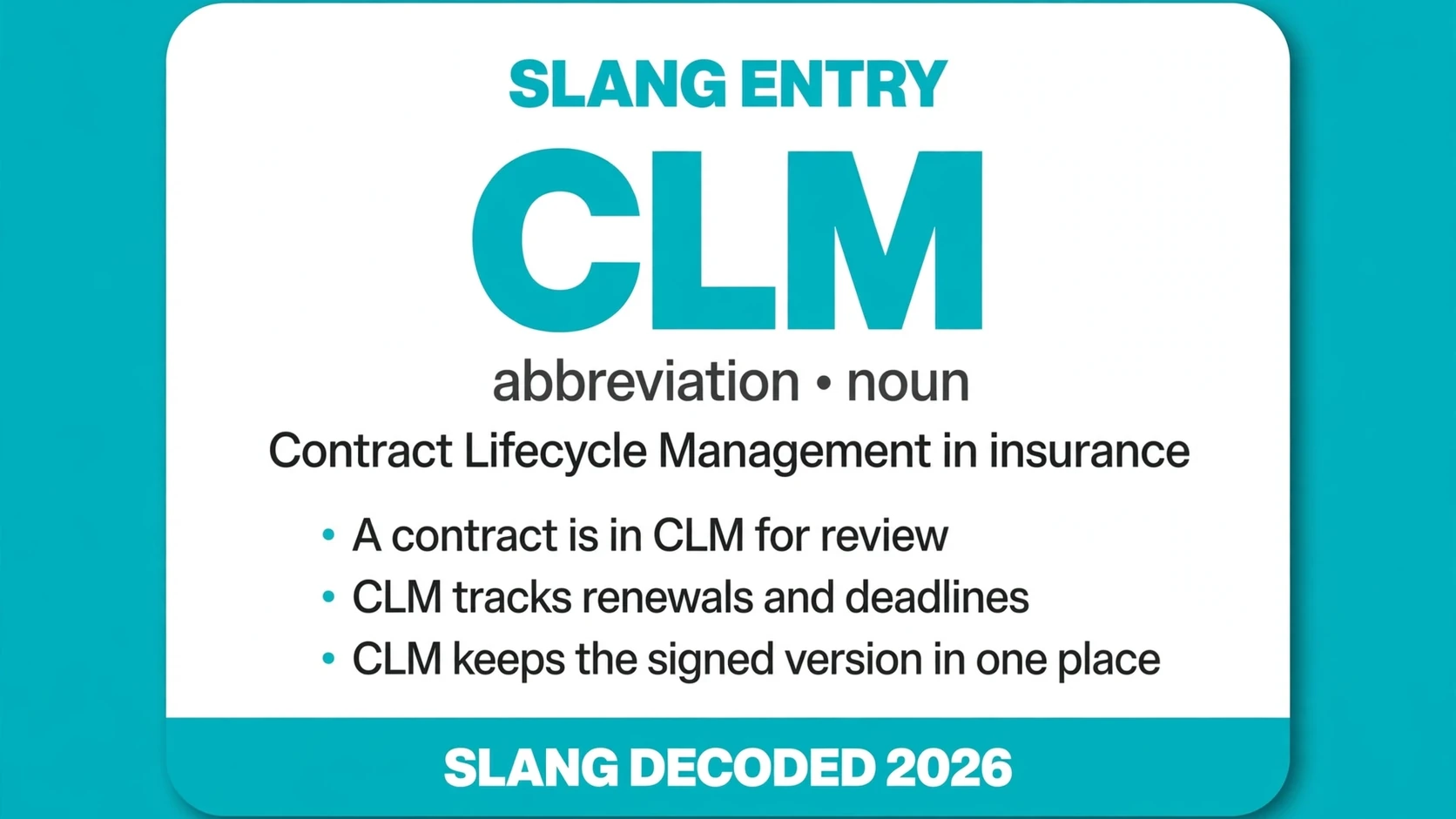
CLM in insurance most often means Contract Lifecycle Management, the end to end process for creating, approving, signing, storing, tracking, renewing, and closing contracts. If you are asking what does clm mean in insurance, you are usually asking about that business process, not about a piece of street slang or a casual text shortcut.
You will see the term in job posts, vendor pages, legal team emails, and software descriptions, and in those settings it points to organized contract work. It helps insurers keep policy wording, partner agreements, and renewal dates in one controlled system instead of scattered files.
What Does Clm Mean in Insurance When You See It at Work
In an insurance office, CLM is shorthand for a workflow and a set of tools for keeping track of promises made in writing. A policy is a contract, a reinsurance treaty is a contract, and a broker or vendor agreement is also a contract, so one system often handles many document types at once. The term is neutral and professional, used by adults at work rather than by teens trading jokes online.
| Setting | What CLM usually means there |
|---|---|
| Carrier office | Policies, endorsements, and partner contracts |
| Broker office | Carrier appointments, commissions, and distribution deals |
| Reinsurance team | Treaties, certificates, and settlement terms |
| Legal team | Review, approval, and version control for wording |
| Compliance team | Audit trails and rule checks for contracts |
| Underwriting team | Drafting and approval for program wording |
| Claims vendor team | Service terms, rates, and performance duties |
| Vendor team | Renewals, duties, and termination tracking |
| Operations team | The stored record of what a policy promised |
The Full Journey of an Insurance Contract from First Draft to Final Close
A contract lifecycle has clear stops, and CLM manages every stop in order. It starts when a team asks for a new agreement or a change to an old one, continues through drafting, review, and negotiation, and keeps going after signing, because duties, dates, and renewals still need attention until the contract ends. Good CLM work makes each stop visible, so no one must guess who approved a clause or where the signed copy lives.
| Stage | What happens at this stage |
|---|---|
| Request | A team asks for a new or changed contract |
| Drafting | Approved templates shape the first version |
| Review | Legal, underwriting, and compliance check wording |
| Negotiation | Parties discuss terms, limits, and timelines |
| Approval | Named approvers confirm the final wording |
| Signing | Authorized people sign in a compliant way |
| Storage | The signed version is filed with its history |
| Monitoring | Teams track duties, deadlines, and renewals |
| Renewal or close | The contract renews, changes, or ends |
The Insurance Contracts That Usually Live Inside a Clm System
An insurer does not manage only one kind of contract, and that variety is why CLM matters. Personal and commercial policies sit next to agreements that support the business behind those policies, and each type has different owners, dates, and risks. A CLM system brings those documents together, lets each team see what it needs, and helps leaders find affected contracts fast when a renewal or rule change arrives.
- Policy agreements for coverage, limits, premiums, and duties
- Endorsements that change a policy during its term
- Reinsurance treaties that share risk between insurers
- Broker agreements for appointment, authority, and commissions
- Agent contracts for selling authority and payment terms
- Third party administrator agreements for claims handling
- Vendor contracts for technology, data, and services
- Non disclosure agreements for confidential talks
- Regulatory documents for compliance and audit readiness
How Clm Shows up in Everyday Insurance Jobs and Teams
CLM is not only a legal team tool, even though lawyers often lead contract work. Underwriters use it to move program wording forward, operations teams use it to find the signed version fast, and finance teams use it to check payment and commission terms. In daily work it often looks ordinary. A user opens a template, sends a draft for review, approves the final version, and signs it without printing a stack of paper.
| Team | How CLM helps that team |
|---|---|
| Legal | Controls wording, versions, and approvals |
| Underwriting | Speeds wording and endorsement handling |
| Compliance | Flags rule issues and keeps audit trails |
| Claims operations | Clarifies vendor duties and agreement dates |
| Broker relations | Shortens onboarding and renewal cycles |
| Finance | Makes commission and settlement terms verifiable |
| Procurement | Tracks supplier duties and renewals |
| Technology | Connects contract data to other systems |
| Leadership | Shows contract risk and bottlenecks clearly |
Clm Next to Other Insurance Abbreviations You Might Mix It up With
Insurance work is full of three letter terms, so it is easy to mix CLM up with a neighbor that sounds similar. The key test asks what the system mainly manages. If the main object is a contract and its full life from draft to close, CLM is the right label. If the main object is a customer, a claim file, a document, or a payment, another term probably fits better.
| Abbreviation | How it differs from CLM |
|---|---|
| CRM | Manages customer relationships, not contracts |
| ERP | Manages finance and operations across a firm |
| CMS | Manages content or claims, not contracts alone |
| DMS | Stores documents without full lifecycle tracking |
| BPM | Improves business processes in general |
| TPA | Names an administrator firm, not a process |
| SLA | Sets service levels inside an agreement |
| KPI | Measures performance, but manages no contract |
| API | Connects software systems, including CLM tools |
Reading a Clm Mention Like a Pro without Guessing
You do not need to memorize every expansion of CLM, because context usually gives you the answer in seconds. Start with who sent the message and what document or project sits nearby. A legal update about treaty wording, a vendor page about renewal alerts, or a job post for a contract analyst all point to Contract Lifecycle Management. Then look for clue words such as draft, approval, renewal, clause, signature, or audit trail.
- Check who sent the message and their work area
- Look at the document type, such as a policy or treaty
- Scan nearby words for draft, approval, or renewal
- Note the goal, such as faster signing or safer wording
- Ask if a tool, a process, or both is discussed
- Watch for dates, renewals, and deadlines
- Compare the tone, since work CLM sounds formal
- Do not assume a casual text meaning at work
- When doubt remains, ask for the spelled out term
Why Insurers Moved from Folders and Email to Clm Tools
For years, many insurers managed contracts with shared folders, email threads, and printed copies, and that method worked until volume, speed, and regulation outgrew it. A search for the right version could take hours, a missed renewal date could cost money or trust, and a rule change could leave inconsistent wording across regions. CLM tools add templates, approval routing, signing, clause search, alerts, and audit trails in one place.
| Old way | What CLM changes |
|---|---|
| Email negotiation | Keeps redlines and approvals in one record |
| Shared folders | Stores one final version with clear history |
| Manual renewal tracking | Sends alerts for renewals and expirations |
| Paper signatures | Uses compliant electronic signing |
| File name search | Searches clauses, terms, and dates |
| No duty owner | Assigns duties, owners, and deadlines |
| Inconsistent templates | Uses approved templates for steady wording |
| Weak audit evidence | Builds a clear trail of who did what |
| Slow broker onboarding | Speeds appointment deals with guided workflows |
The Casual Meanings of Clm That Can Confuse an Insurance Search
Outside insurance, CLM has several casual and unrelated meanings, and search results can mix them together. In texts, some people use clm as a short form of calm, while other texting guides list call me as a casual reading. In workplace slang, some sources list career limiting move, a very different idea that has nothing to do with contract software. Those readings are real in their own corners of language, but they are not the professional insurance meaning.
| Casual or other use | Why it does not fit insurance work |
|---|---|
| Calm in a text | A tone word for relaxing, not a process |
| Call me in a text | A request for a phone call, not a system |
| Career limiting move | Slang for a risky choice, not contract work |
| Called and left message | A phone note status, not a lifecycle |
| Customer lifecycle management | Tracks a customer journey, not contract duties |
| Content lifecycle management | Manages published content, not insurance agreements |
| Claims and litigation group | Names an industry alliance, not a process |
| Commercial lines manual | A coverage reference, not lifecycle software |
| Common law marriage | A legal status term, unrelated to contract tools |
How to Use Clm Correctly in a Work Message
Use CLM after you have spelled it out once, so your reader knows you mean Contract Lifecycle Management and not a casual text reading. A clean first use names the full term and then adds the short form in the same sentence, and later uses can rely on the short form alone. That habit keeps messages short without losing clarity.
Keep the tone direct and task focused when you write about CLM at work. Name the contract, the stage, and the next step, such as review, approval, or signing, so the reader can act without asking for basic facts. Short and clear beats clever here, because contract work rewards precision over style.
What Clm Does Not Mean in an Insurance Office
CLM does not mean a mood, a joke, or a request for a phone call when you are inside an insurance workflow, even if you have seen those readings in texting guides. It also does not mean claims management on its own, although claims vendor agreements can live inside a CLM system. The core idea stays tied to contracts, their wording, their approvals, and their duties over time.
If you are browsing slang guides, you may also run into what does clm mean on snap, what does ftm mean in gender, and what does purple snapchat mean, but those guides answer different questions than an insurance workflow does. That contrast is useful, because it reminds you to check the setting before you carry a casual meaning into a professional message. In insurance, the setting is the clue, and the clue points to contracts.
When to Ask for the Full Wording Instead of Assuming
Ask for the spelled out term when the message lacks contract clues, when the sender is outside insurance, or when the stakes are high. A renewal, a signature, a payment term, or a regulatory filing is no place for a guess, and a quick question can prevent a costly mix up. Most professionals will respect that question, because abbreviations travel across industries with different meanings.
You can ask in a simple and polite way that keeps work moving. Say you want to confirm whether the writer means Contract Lifecycle Management, and name the document or project you are discussing. That single check protects the timeline, the wording, and the relationship, and it shows you take contract details seriously.
Questions People Ask About Clm in Insurance
What does CLM stand for in insurance?
In insurance, CLM most often stands for Contract Lifecycle Management, the managed process for contracts from drafting through renewal or close.
Is CLM the same as claims management?
No, CLM is broader contract work, although claims vendor agreements and related duties can be tracked inside a CLM system.
Who uses CLM in insurance?
Legal, underwriting, compliance, claims operations, broker relations, finance, procurement, and technology teams all use CLM in different ways.
Does CLM only mean Contract Lifecycle Management?
No, CLM has other meanings in texts and other fields, but Contract Lifecycle Management is the main reading in insurance work.
Should you use CLM in a message to a customer?
Use the full term first for a customer, and use the short form only after that, so the customer is not left guessing about the meaning.