
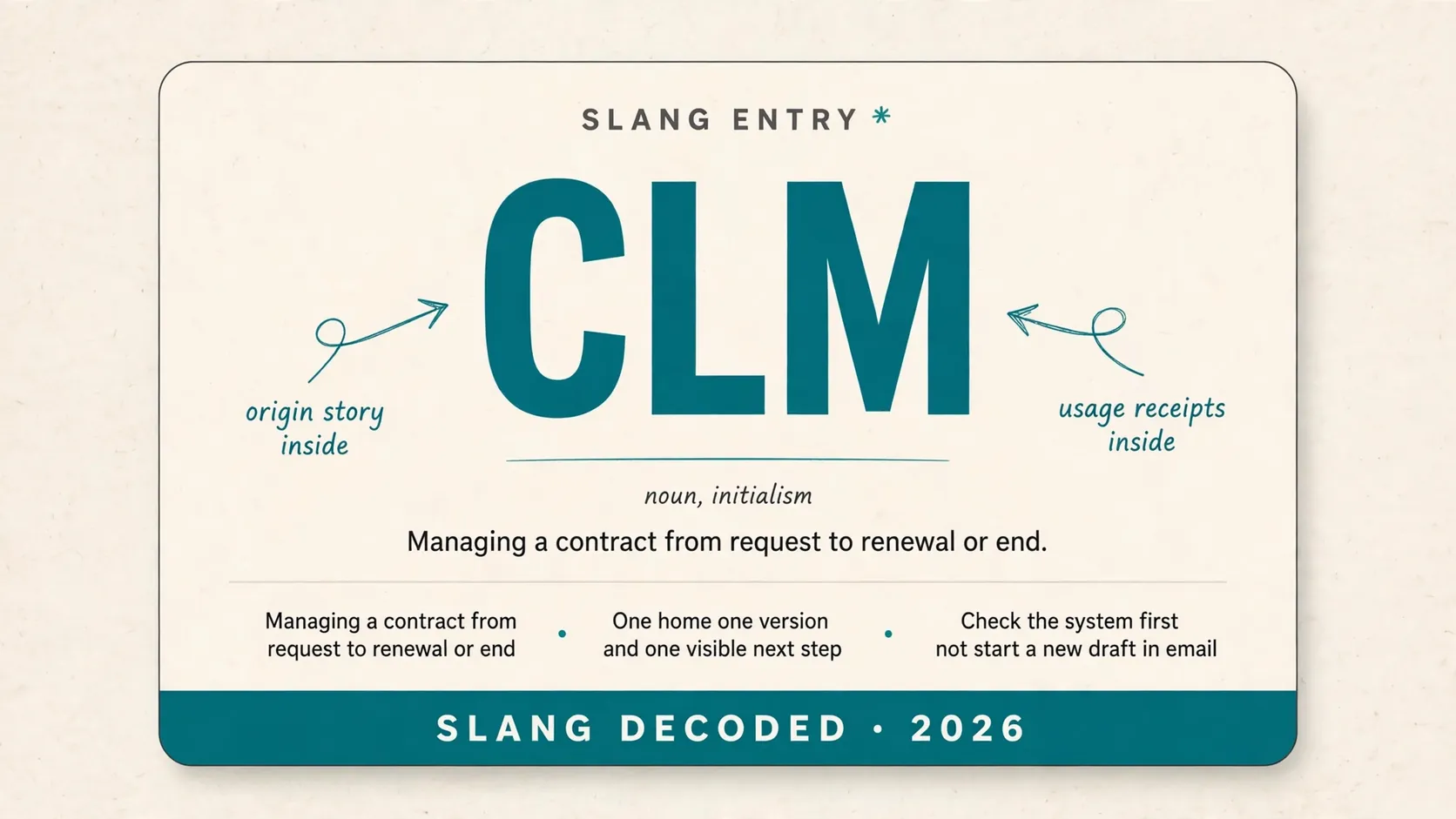
If you ask what does clm mean in business, the direct answer is Contract Lifecycle Management, the way you manage a contract from request to renewal or termination. You will see those three letters in legal threads, sales deals, procurement chats, and software pitches, and in almost every business case they point to contracts.
That distinction matters because a missed renewal, a lost version, or a stalled approval can cost you time, money, and momentum at work. This guide walks you through each stage, each team, and each lookalike term in plain language you can use right away.
What Does Clm Mean in Business for a Small Team That Has No Legal Department
| Business angle | Plain translation for your workday |
|---|---|
| Full form | Contract Lifecycle Management, the full name behind the letters |
| Core job | Managing a contract from request to renewal or end |
| Not just storage | Active tracking of dates, duties, and versions |
| Main users | Legal, procurement, sales, finance, and operations on one deal |
| Pre signature work | Drafting, redlining, negotiation, and approval before signing |
| Post signature work | Obligation tracking, compliance, renewals, and amendments after signing |
| Software meaning | A central platform automating routing, reminders, and templates |
| Process meaning | The workflow itself, even with spreadsheets and shared drives |
| Second office meaning | Career Limiting Move, a joke warning about career harm |
Clm Lines You Will Actually Hear at Work
“We need CLM before this renewal slips again.”
Heard in sales operations near a renewal date. Note shows deadline urgency and early flagging.
“Put it through CLM so legal can see the redlines.”
Heard in a deal chat after a customer edits terms. Note shows a handoff to shared review.
“Is this in CLM yet or still sitting in email?”
Heard in procurement when a vendor deal feels lost. Note shows frustration with scattered files.
“CLM caught the auto renewal clause this time.”
Heard in finance after a near miss renewal. Note shows relief and post signature tracking.
“We cannot sign until CLM routes it for approval.”
Heard in operations when a discount needs sign off. Note shows a control step for deals.
“That template came straight from our CLM library.”
Heard in legal onboarding for a new hire. Note shows consistency from approved language.
“Our CLM dashboard shows forty open contracts this week.”
Heard in a pipeline meeting seeking status clarity. Note shows visibility across scattered deals.
“Do not call that a CLM, it was just a filing cabinet.”
Heard in a software demo overstating storage. Note shows skepticism about lifecycle claims.
“He pulled a real CLM at the client dinner.”
Heard in office gossip after a risky client remark. Note shows the slang second meaning.
The Contract Journey from First Ask to Final Close
| Lifecycle stage | What you actually do at this stage |
|---|---|
| Request | Someone asks for a contract with scope and dates |
| Authoring | You draft from an approved template and clause library |
| Negotiation | Both sides edit terms and settle price, scope, and risk |
| Approval | Managers and legal reviewers sign off in set order |
| Execution | Both parties sign and the deal becomes binding |
| Storage | The final version lives in one searchable repository |
| Obligation tracking | You watch deliverables, payments, and key dates |
| Renewal | You decide early to renew, renegotiate, or end |
| Amendment or end | You record changes, close duties, or terminate cleanly |
Who Leans on Clm and Why It Matters to Each Team
| Team at work | Why CLM changes their day |
|---|---|
| Legal | They review language once, then templates carry routine deals |
| Procurement | They track supplier terms and renewals without email hunts |
| Sales | They close faster because approvals move automatically |
| Finance | They see payment and renewal costs before revenue surprises |
| Operations | They know what was promised, by whom, and by when |
| Human resources | They manage offer letters with consistent and secure versions |
| Information technology | They connect contract tools to finance systems safely |
| Leadership | They get a portfolio view of risk and decisions |
| Small business owner | They start with templates, one repository, and key dates |
Clm in Different Rooms and What the Tone Tells You
“Legal wants CLM on every enterprise deal now.”
Heard in leadership when contract risk rises. Note shows a formal and protective tone.
“Sales just wants CLM to stop slowing the close.”
Heard in revenue meetings when review feels slow. Note shows impatience and a speed focus.
“Procurement lives in CLM all day during renewal season.”
Heard in supplier reviews when many deals come due. Note shows heavy daily renewal use.
“Finance found the missing rebate inside CLM.”
Heard in quarter end reviews explaining a payment gap. Note shows a positive money payoff.
“We are still doing CLM by spreadsheet, honestly.”
Heard in a small team with no platform budget yet. Note shows an honest and practical tone.
“That CLM rollout was painful but worth it.”
Heard in a retrospective after cleanup and training. Note shows mixed feelings and long term clarity.
“Do not email me another version, use CLM.”
Heard in negotiation when version chaos creates risk. Note shows a firm boundary for drafts.
“The client asked if we even have CLM.”
Heard in a vendor review checking your maturity. Note shows external pressure for control.
“Careful, that email could be a CLM.”
Heard in private chat before criticizing a boss. Note shows slang warning with humor.
Clm Beside Its Closest Lookalikes so You Do Not Mix Them Up
| Term you might confuse it with | How it differs from CLM in plain terms |
|---|---|
| CRM | CRM tracks people and deals, CLM tracks the contract itself |
| Document storage | Storage holds files, CLM also manages drafting and duties |
| E signature tool | Signing is one step, CLM covers before and after signing |
| ERP system | ERP tracks money and inventory, CLM focuses on agreement terms |
| Procurement platform | Buying tools handle orders, CLM governs the agreement |
| CLM process | The process is the workflow, even without special software |
| CLM software | The software automates that workflow with templates and alerts |
| Career Limiting Move | Office slang for a risky action, not a system at all |
| Customer lifecycle idea | A customer journey concept, not the contract lifecycle |
Positive, Neutral, and Risky Ways Clm Shows Up
| Use you will see | Tone and what it signals |
|---|---|
| Faster deal cycles | Positive, automated approvals help revenue move |
| Fewer missed renewals | Positive, alerts give time to renegotiate early |
| Cleaner audit trail | Positive, every edit and approval is recorded centrally |
| Better compliance | Positive, approved clauses reduce risky language |
| Heavy rollout effort | Mixed, cleanup and training can feel slow at first |
| Overbuying software | Negative, a huge platform can overwhelm a small team |
| Version chaos without CLM | Negative, scattered drafts create disputes |
| Slang warning use | Negative and humorous, it flags trust risk |
| Vendor hype | Skeptical, some tools only store PDFs |
Terms That Travel with Clm in Every Deal Thread
“Check the clause library before you rewrite that section.”
Heard in legal review when fresh risk language tempts. Note shows discipline and consistent wording.
“Redlines are still open on pricing and liability.”
Heard in negotiation when key terms remain unsettled. Note shows work in progress on key areas.
“The renewal window opens ninety days before expiry.”
Heard in procurement planning for calm renegotiation. Note shows planning and a decision window.
“Obligation tracking flagged a missed service credit.”
Heard in operations when a vendor misses a promise. Note shows accountability and a real remedy.
“Send it for e signature once approval is complete.”
Heard in a sales close checklist before final signing. Note shows sequence and prevents early signing.
“The approval workflow routed it to finance first.”
Heard in a deal update on discount checks. Note shows order across review queues.
“Everything lives in the repository now, no more hunting.”
You hear this after old contract folders were consolidated. Note shows relief and one searchable home.
“Compliance wants a report on data terms this quarter.”
Heard in a risk review seeking proof of controls. Note shows oversight using contract data.
“That vendor agreement is our template for new suppliers.”
Heard in procurement onboarding for future deals. Note shows reuse without lowering standards.
Why Your Deals Stall without a Contract System
You know the feeling when a deal is ready but nobody can find the latest version. That scattered setup forces you to chase email threads and guess about approvals. A clear CLM flow fixes that mess with one home, one version, and one visible next step.
You also gain speed when templates and routing do routine work for you. Legal still reviews risky clauses and finance still checks money, but nobody starts from a blank page. That shared rhythm is why teams that once feared process end up defending it.
When Clm Means Something Risky in Office Chat
You need context before you react, because the same letters can switch from a system to a warning in one sentence. In a contract thread, CLM means the platform that keeps deals moving, while in gossip it can mean a Career Limiting Move, like badmouthing a manager nearby. The setting and surrounding words will usually tell you which meaning fits.
You can treat the slang use as a friendly alarm rather than a formal label. Friends use it to say slow down and protect your reputation before a small moment grows bigger. It is humorous on the surface, but clients remember tone and judgment long after meetings end.
How to Read Clm in a Job Post, a Pitch, and a Slack Thread
You will spot CLM in job posts when a company wants someone who can own templates, approvals, and renewals. In a pitch, a vendor may promise faster closes, so ask what stages the tool actually covers. In chat, a short CLM mention often means check the system first, not start a new draft in email.
You will also see clm listed beside snap and mms in batch glossaries that group short tech and slang headwords together, but only clm points to contracts in a normal business thread. That contrast helps you avoid forcing a social meaning onto a deal conversation. When in doubt, read nearby sentences, then match your answer to contracts, careers, or software.
A Quick Gut Check Before You Say You Use Clm
You can claim a real CLM setup when you can answer four questions without hunting inboxes. You should know where the signed version lives, who approved it, and when renewal comes due. If you answer fast, you have a working process, even without a fancy platform.
You should be honest when your setup is still partial, because buyers will test it quickly. A shared drive plus a renewal calendar is a start, not a full system, and naming that gap builds trust. Start with templates and one repository, then add automation where delays keep showing up.
FAQ
What does clm mean in business in simple terms?
It means Contract Lifecycle Management, the process and software for managing a contract from request to renewal or end.
Is CLM only software or also a process?
It is both, since CLM started as a workflow and now often refers to the platform that automates that workflow.
What does CLM mean as office slang?
It can mean Career Limiting Move, a humorous warning about an action that could hurt your career or reputation.
How is CLM different from CRM?
CRM tracks customers and deals, while CLM tracks the contract terms, approvals, obligations, and renewal dates behind those deals.
Do small businesses need CLM?
Yes, in a simple form, because templates, one repository, and renewal alerts prevent missed dates and version confusion.