
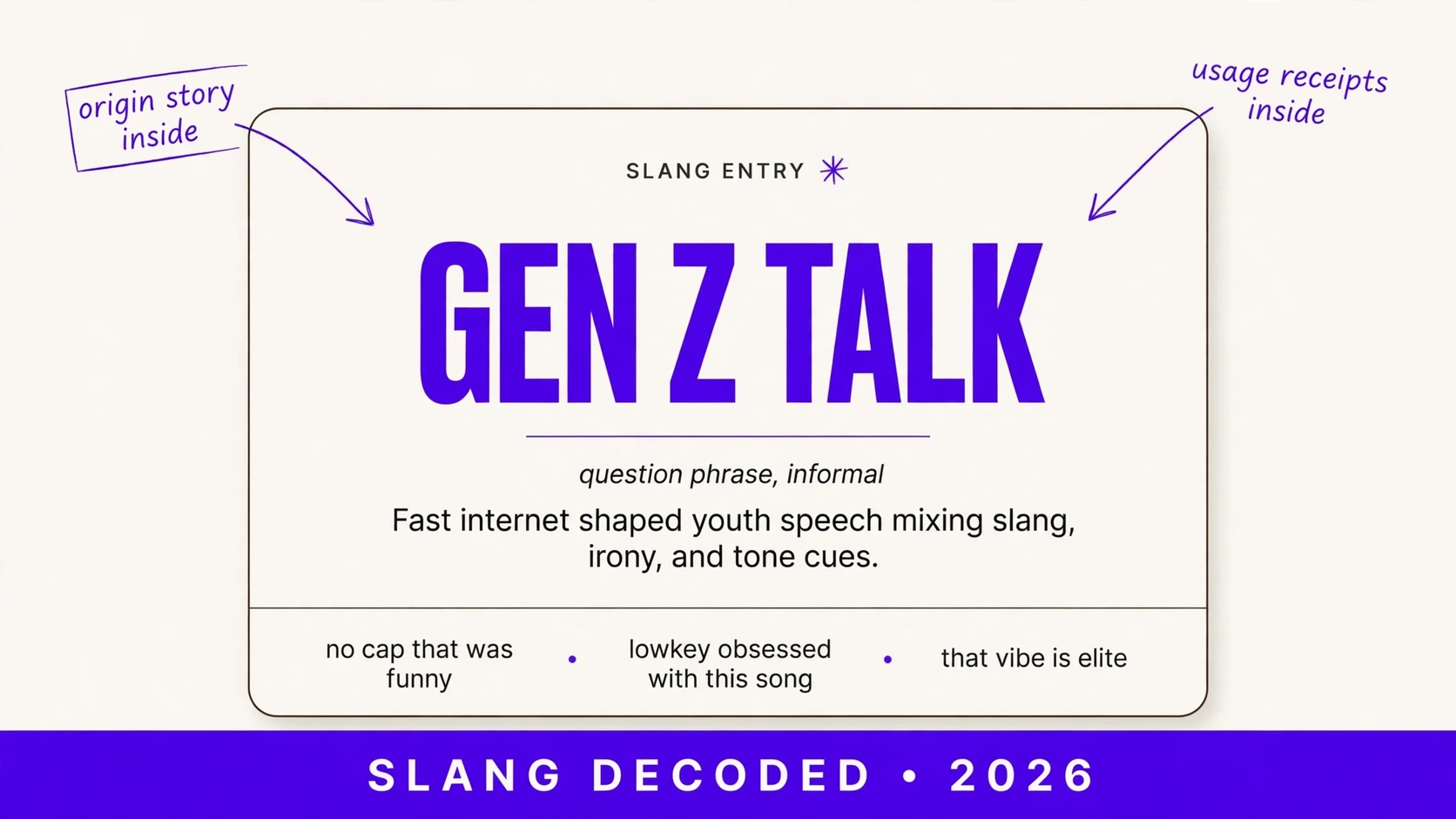
Gen Z talk is fast, playful, internet shaped speech that mixes slang, abbreviations, irony, and tone cues to signal closeness, humor, and shared references. When people ask how do gen z talk, they usually mean why younger speakers sound so different in texts, comments, videos, and everyday conversation.
It is not one accent, one dictionary, or one set of rules. It is a style shaped by group chats, short videos, memes, gaming, and social media, and it changes quickly as new words spread and older ones fade.
The Core Traits That Define the Style
The easiest way to recognize Gen Z speech is to listen for speed, compression, and tone. Words get shortened, feelings get packed into a few characters, and a joke often depends on delivery as much as on the words themselves. A sentence can sound flat on paper and hilarious out loud because the speaker is being ironic, deadpan, or deliberately dramatic.
| Trait | What it sounds like in real use |
|---|---|
| Compression | Long ideas shrink into short phrases, initials, or one vivid word |
| Layered tone | The same words can be sincere, joking, or sarcastic depending on context |
| Reference heavy | Memes, shows, games, and viral moments supply ready made shorthand |
| Emotional shorthand | Reactions arrive fast through slang, emojis, and reaction phrases |
| Playful exaggeration | Feelings get stretched for comic effect, then pulled back with a laugh |
These traits do not appear in every sentence. A Gen Z speaker can switch into formal, polite, or professional language in seconds when the situation calls for it. The casual style is a choice, not a limit.
Everyday Words You Will Hear Again and Again
Gen Z vocabulary is large, but a small core does most of the work. Some words describe approval, some describe embarrassment, and some describe a mood that is hard to name in one formal word. Their meanings often shift with tone, so context matters more than a fixed definition.
| Word or phrase | Everyday meaning |
|---|---|
| No cap | No lie, seriously, for real |
| Slay | To do something extremely well or look amazing doing it |
| Vibe | A feeling, atmosphere, or general energy |
| Lowkey | Quietly, secretly, or to a small degree |
| Bet | Yes, agreed, or a confident challenge |
| Ate | Did something perfectly, especially a performance or outfit |
| Rizz | Charm, flirting skill, or smooth confidence |
| Ick | A sudden turn off or feeling of disgust |
Many of these words started in specific communities, including Black American English, LGBTQ communities, gaming circles, and regional youth culture, before spreading widely online. That history matters because the words often carry cultural flavor that a simple dictionary definition misses.
Short Forms That Keep Messages Moving
Abbreviations are not laziness. They are a speed tool for typing on a phone, replying in a busy chat, or keeping a joke moving before the moment passes. They also work as social signals, since knowing them shows that you spend time in the same online spaces.
- LOL still means laughing, but it often marks light tone rather than real laughter
- LMAO signals stronger laughter or disbelief
- NGL means not gonna lie and usually introduces an honest opinion
- TBH means to be honest and softens a direct statement
- IMO means in my opinion and frames a take as personal
- IRL means in real life and separates online talk from offline life
- FOMO means fear of missing out
- POV means point of view and frames a video or joke from one angle
Tone, Punctuation, and the Hidden Message
Punctuation does a lot of emotional work in Gen Z writing. A period can feel cold, all caps can feel excited or sarcastic, and a line break can change the whole mood. This is one of the biggest sources of confusion between generations, because older style guides treat punctuation as grammar while younger writers often treat it as tone.
| Writing choice | How it often reads |
|---|---|
| No period at the end | Casual, friendly, and open ended |
| A sudden period | Blunt, annoyed, or final |
| All lowercase | Relaxed, soft, or intentionally unbothered |
| ALL CAPS | Excited, emphatic, or jokingly dramatic |
| Repeated letters | Stretched feeling, like soooo or noooo |
| One word reply | Could be agreement, boredom, or a joke, depending on the chat |
| Emoji after a joke | A signal that the message is playful, not serious |
How the Style Changes from Platform to Platform
Gen Z speakers do not talk the same way everywhere. They adjust length, slang density, and humor to fit the platform, the audience, and the format. A video caption, a private chat, and a comment under a friend’s photo can sound like three different people even when the writer is the same.
| Platform or setting | Typical style |
|---|---|
| Private group chat | Fast, messy, full of inside jokes and short replies |
| Short video comments | Punchy, referential, and built for quick reactions |
| Photo captions | Short, confident, funny, or deliberately vague |
| Gaming voice chat | Quick callouts, teasing, and exaggerated reactions |
| School or work messages | Clearer and more polite, with slang dialed down |
This code switching is a skill, not an accident. Many Gen Z speakers are fluent in several online registers and choose the one that fits the room. When they sound formal in an interview and casual with friends, they are doing what every generation does, only with more platforms to juggle.
Grammar Habits That Sound New but Make Sense
Gen Z grammar often breaks school rules on purpose. Sentences get cut short, verbs get reused in new ways, and old words get new jobs. The result can sound broken to an outsider, but it usually follows its own logic and rhythm.
- Because phrases can stand alone for comic timing, like because reasons
- Like works as a filler, a comparison, and a way to quote speech
- Literally gets used for emphasis even when the statement is not literal
- Adjectives become praise words, so a meal, a song, or an outfit can be elite
- Verbs get shortened, so a situation can be vibing, slaying, or giving
- Questions get flipped into statements for jokes, like who asked
New words get built from old ones, so a feeling can become a whole aesthetic
These habits also show up in memes and captions, where a short phrase does the work of a full paragraph. The humor often comes from the gap between the small number of words and the large feeling behind them.
Gen Z Talk Next to Older Generations
Comparing generations helps explain why Gen Z speech feels so distinct. Older generations also had slang, but they did not grow up with group chats, algorithmic feeds, and video comments shaping language every day. The speed of spread is new, even when the desire to sound cool and current is very old.
| Feature | Gen Z tendency | Older tendency |
|---|---|---|
| Where slang spreads | Short videos, memes, and chats in hours or days | Music, television, and school over months or years |
| Tone in writing | Punctuation and spacing carry feeling | Grammar and full sentences carry formality |
| Humor style | Ironic, self aware, and layered | More direct, story based, or observational |
| Reaction speed | Instant replies, reactions, and short jokes | Longer replies and more complete thoughts |
| Word lifespan | Some words fade in months | Many words lasted for years |
What People Often Get Wrong About It
The most common mistake is assuming that Gen Z talk is careless, rude, or empty. In practice, it is often careful in a different way, with attention paid to tone, audience, and timing. A short reply can be warm in one chat and cold in another, and choosing the right version takes social awareness.
| Misunderstanding | What is usually happening instead |
|---|---|
| They cannot speak properly | They are code switching between casual and formal styles |
| Slang means they are not serious | Slang can carry real feelings, praise, or support |
| Short messages mean low effort | Short messages can be fast, warm, and well timed |
| Irony means they do not care | Irony often protects feelings while still saying something real |
| New words appear from nowhere | Most words travel from music, gaming, or specific communities |
Understanding this helps older listeners avoid correcting a style that is not broken. It also helps younger speakers see why their messages sometimes land badly with people who read punctuation and brevity in a more formal way.
Why It Sounds so Fast to Older Listeners
Speed is the first thing many older listeners notice, and it is not only about talking quickly. Gen Z conversation often skips setup because the group already shares the reference. A meme, a lyric, or a viral clip can replace a whole explanation, so the talk jumps straight to the reaction.
That shared background is what makes the style feel exclusive from the outside. If you missed the reference, the joke can feel random. If you know it, the same line feels precise and funny. This is also why Gen Z humor travels so well inside a friend group and so poorly in a formal summary.
How Irony Changes the Meaning
Irony is the engine of much Gen Z humor, and it is also the part most likely to be misread. A speaker might praise something in an exaggerated way, pretend to be unbothered, or describe an ordinary day as if it were a major event. The joke depends on the listener knowing that the speaker does not fully mean the surface words.
This does not mean Gen Z speakers never speak sincerely. They do, often and openly, especially about friendship, mental health, creativity, and identity. Irony and sincerity sit side by side, and friends learn to tell them apart through tone, timing, and history. A deadpan joke from a close friend reads very differently from the same words sent by a stranger.
How to Keep up without Forcing It
The best way to understand Gen Z talk is to listen more than you imitate. Pay attention to how words are used in real chats and videos rather than memorizing a list and dropping slang into every sentence. Forced slang usually sounds louder than natural slang, and friends can tell the difference instantly.
Finally, remember that language keeps moving. A word that feels fresh today may feel dated next year, and that is normal. If you are curious about related slang, you might enjoy reading about rizz, slay, and no cap, since those three show how praise, confidence, and honesty get packed into very short Gen Z words. The goal is not to sound twenty years younger. The goal is to hear what is actually being said.
Frequently Asked Questions
Do all Gen Z speakers talk the same way?
No, region, culture, friend group, platform, and personality all shape the style, so Gen Z talk is a family of styles rather than one fixed voice.
Is Gen Z slang mostly invented online?
Some words start online, but many travel from music, gaming, Black American English, LGBTQ communities, and regional youth culture before going viral.
Why does punctuation feel so emotional in Gen Z messages?
Because in fast texting, punctuation, capitalization, and spacing often signal tone, warmth, distance, or humor more than strict grammar does.
Can older people use Gen Z slang without sounding forced?
Yes, when they use a few words naturally and in the right context, but copying every new term at once usually sounds like an imitation rather than a conversation.
Will Gen Z slang disappear as this generation gets older?
Some words will fade, some will enter everyday English, and new words will replace them, which is how youth slang has always worked across generations.