
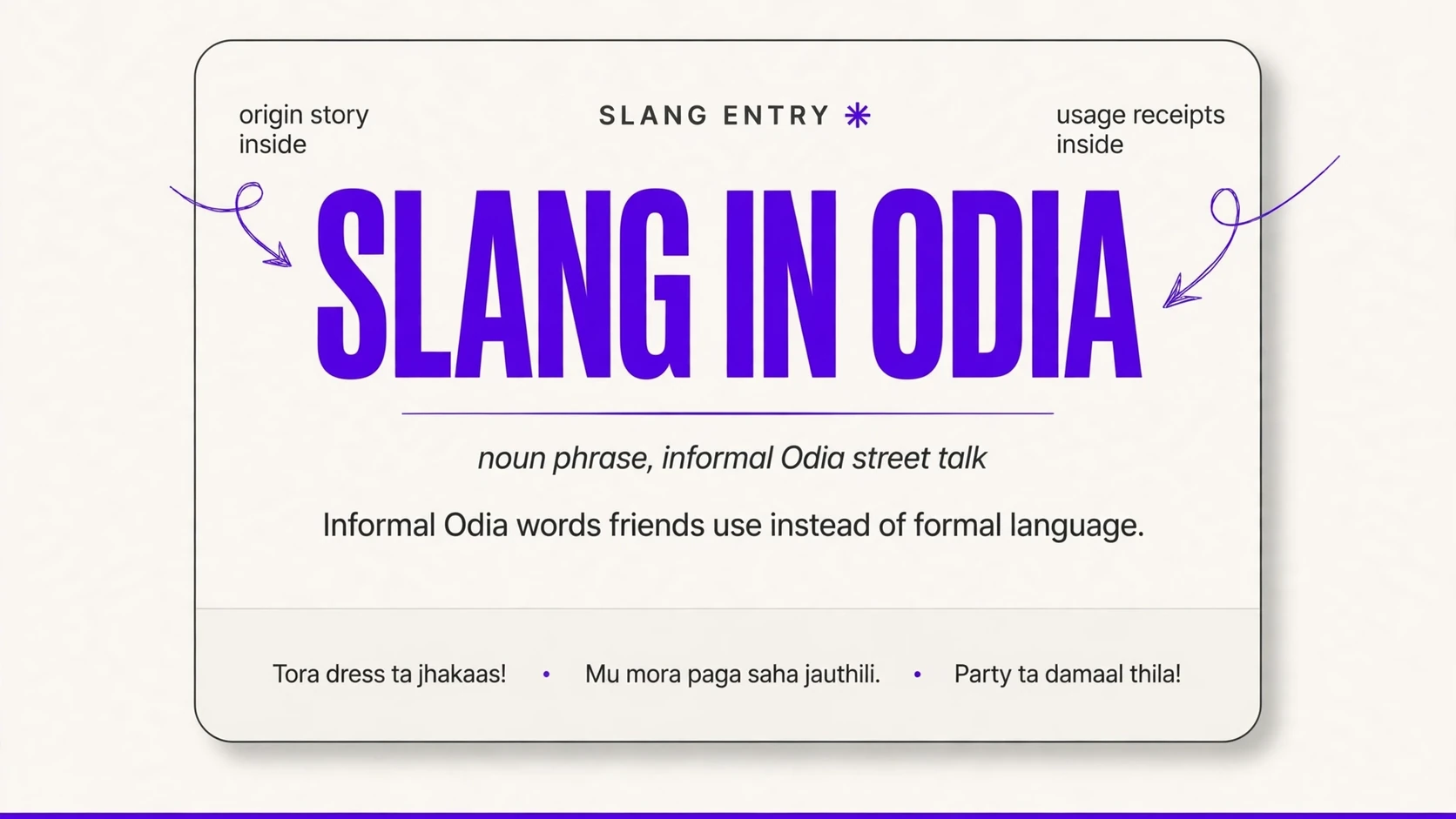
Slang language meaning in odia is the informal, everyday way Odia speakers talk when they drop formal textbook language and use playful, street level words instead. It covers nicknames for friends, punchy praise, teasing comebacks and short exclamations that make a chat feel warm and local rather than stiff and distant.
Odia is the language of Odisha in India, and it is also called Oriya in older usage. You will hear this slang in college canteens, family group chats, markets in Bhubaneswar and Cuttack, and short videos online, where tone and friendship matter more than perfect grammar.
What Slang Language Meaning in Odia Looks Like in Real Conversations
Odia slang is not a separate language, nor bad Odia. It is a relaxed register beside formal Odia, used to sound close, funny or current.
| Odia slang form | Everyday sense |
|---|---|
| Jhakaas | Awesome, cool or seriously impressive |
| Bindass | Carefree, chill and unbothered by stress |
| Fatafati | Fantastic, brilliant or full of energy |
| Paga | A close friend or trusted buddy |
| Babu | Buddy, dude or an affectionate way to address someone |
| Chalu | Clever, street smart or quick on your feet |
| Ghanta | Nonsense, disbelief or a flat whatever |
| Timepass | Passing time, not serious or just messing around |
| Damaal | Wild fun, crazy energy or a great party mood |
From Formal Odia to Street Talk without Sounding Rude
Formal Odia keeps respect front and center, while street talk shortens everything and leans on tone. Know your listener, because one joke can feel friendly with a friend and rude with an elder.
| Setting | Street shift you will notice |
|---|---|
| Greeting a close friend | A short hi or babu replaces a formal greeting |
| Asking how someone is | A quick casual version replaces the long polite form |
| Praising an outfit | Jhakaas or fatafati replaces a plain word for good |
| Praising a performance | Fodu or damaal signals top level excitement |
| Calling a friend over | Paga or babu signals closeness at once |
| Teasing a show off | Chhota don is playful among friends |
| Rejecting a tall story | Ghanta signals disbelief fast |
| Ending a lazy chat | Timepass sums up a session with no real plan |
Campus Lines You Will Hear in Bhubaneswar and Cuttack
College towns set the pace, and students remix Hindi, English and local Odia into fast lines. Listen for the punch word first, because it carries the whole feeling.
“Tora dress ta jhakaas!”
Heard in a college corridor in Bhubaneswar. The context here is pure praise for a friend.
“Se bindass lok.”
Heard in a hostel chat in Cuttack. The context here is admiration for a calm person.
“Party ta damaal thila!”
Heard after a college fest in Bhubaneswar. The context here is wild fun after a good night.
“Mu mora paga saha jauthili.”
Heard in a canteen plan in Cuttack. The context here is warm friendship.
“Kaun babu, kouthi chalichha?”
Heard as a street greeting in Cuttack. The context here is a friendly buddy greeting.
“Se chalu loka, sabu bujhipare.”
Heard in a classroom joke in Bhubaneswar. The context here is praise for street smarts.
“Ghanta kahuchhu, seta heba nahi.”
Heard in a debate between friends in Cuttack. The context here is playful disbelief.
“Eta sabu timepass, serious nuhen.”
Heard in a group chat about a slow afternoon in Bhubaneswar. The context here is low stakes fun.
“Se patakha laguchhi ajikali.”
Heard as a compliment at a campus event in Cuttack. The context here is bold praise for close friends.
How Borrowed Words Became Local Odia Slang
Many Odia slang words did not start in Odia, and that is part of their charm. Hindi film talk, English college slang and local humor met in Odisha cities, and youth kept the fun, useful words.
| Borrowed word | How Odia speakers bend it |
|---|---|
| Jhakaas | Used for anything awesome, from food to fashion |
| Bindass | Used for a person, a mood or an attitude |
| Patakha | Used as bold praise for someone who looks stunning |
| Fodu | Used for a fantastic result or a top notch performance |
| Chhota don | Used playfully for a young show off |
| Timepass | Used for idle fun or a filler plan |
| Scene | Used for a situation, a drama or a plan that is unfolding |
| Setting | Used for a connection or an arranged plan |
| Full power | Used for maximum energy or excitement |
Group Chat Receipts That Show the Tone in Action
Group chats are where Odia slang proves itself, because short lines must carry humor and attitude. One slang word can flip a boring update into a joke friends repeat as an inside joke.
“Ajira match ta fatafati thila re!”
Spotted in a friends group chat after a cricket match. The context here is shared excitement after a match.
“Bindass raha, sabu thik heijiba.”
Spotted in a late night chat before an exam. The context here is reassurance for a stressed friend.
“Tume paga mane mora bhai bhali.”
Spotted in a birthday message between close friends. The context here is loyalty between close friends.
“Ghanta, tu kebe asila?”
Spotted in a chat when a friend arrived unexpectedly. The context here is surprised, playful disbelief.
“Scene ta pura change heigala.”
Spotted in a chat after a sudden plan change. The context here is drama after a sudden twist.
“Chalu achha, tume sabu manage karidela.”
Spotted in a chat praising a friend who fixed a problem. The context here is respect for quick thinking.
“Damaal night, au thare heba darkar.”
Spotted in a chat the morning after a party. The context here is a demand for a repeat night.
“Timepass kariba chal, class pare.”
Spotted in a chat planning a lazy break after class. The context here is low pressure fun.
“Jhakaas photo, insta re deide.”
Spotted under a photo shared in a friends chat. The context here is instant praise for a photo.
A Quick Decoder for Praise, Teasing and Disbelief
Sorting Odia slang by mood helps you use it safely and read a room fast. Praise lifts people up, teasing keeps friends laughing, and disbelief calls out a story without a fight.
| Mood | Odia slang move |
|---|---|
| Big praise | Jhakaas or fatafati for something awesome |
| Chill praise | Bindass for someone calm and easy going |
| Wild fun | Damaal for a party or a crazy good time |
| Close friendship | Paga for a buddy you trust completely |
| Affectionate address | Babu for a friend you greet warmly |
| Playful teasing | Chhota don for a friend acting big |
| Street smarts | Chalu for someone clever and quick |
| Bold looks | Patakha for someone who looks stunning |
| Flat disbelief | Ghanta for a story that sounds false |
Where Age, Place and Respect Change the Word You Pick
One word can feel perfect in one place and wrong in another, so Odia slang is about reading people. City youth push it further, while family and work settings expect a calmer tone.
| Situation | Safer pick |
|---|---|
| Talking to close friends | Go bold with jhakaas and damaal |
| Talking to older relatives | Keep it warm and skip bold teasing |
| Talking to a teacher | Stay polite and save slang for after class |
| Chatting online with strangers | Start neutral and mirror their tone |
| Praising someone in public | Pick kind praise, not looks words |
| Joking in a group chat | Use inside jokes everyone gets |
| Meeting someone new | Use a friendly greeting and light humor first |
| Working in a formal office | Keep slang out until coworkers go casual |
Mistakes Learners Make When They Try Odia Slang Too Fast
New learners often grab the loudest slang word and drop it everywhere, and that is where things go sideways. Slang works through timing and friendship, not magic, so copying a line without context can sound forced or rude.
“Ghanta, mu janini.”
Spotted in a learner chat where a joke fell flat. The context here is a warning about sounding dismissive.
“Se patakha, mu kahili sabunka samnare.”
Spotted in a public comment that embarrassed a friend. The context here is a warning about privacy and consent.
“Mu chhota don, sabu mora.”
Spotted in a classroom joke that annoyed a teacher. The context here is a warning about formal rooms.
“Bindass, exam chhada.”
Spotted in a study group chat before a test. The context here is a warning about stressed friends.
“Timepass loka, tume kichhi karuna.”
Spotted in a chat where teasing turned into an insult. The context here is a warning about teasing that stings.
“Jhakaas, au kichhi kahiba nahi.”
Spotted in a reply that shut down a conversation. The context here is a warning about ending talk.
“Paga, paisa de.”
Spotted in a message to a new acquaintance. The context here is a warning about false closeness.
“Chalu, tume mo joke bujhiparila nahi.”
Spotted in a chat after a failed joke. The context here is a warning about humor turning sour.
Why Odia Slang Feels Warmer than Textbook Odia
Textbook Odia is clear, but it can sound distant with friends. Slang shortens that distance, because paga or babu signals closeness at once.
That warmth is why slang spreads through music and short videos so fast. A catchy line can travel across Odisha in days and feel like a shared secret.
How Social Media Is Remixing Odia Street Talk in 2026
Short videos are now the main slang factory for young Odia speakers. Creators mix Odia with English and Hindi, add a punchy slang word, and watch comments repeat it with new twists.
and gyat meaning, because they show how internet slang travels across languages in the same way. That crossover is the point, because Odia slang in 2026 feels local yet global at once.sigma meaning and gyat meaning, because they show how internet slang travels across languages in the same way. That crossover is the point, because Odia slang in 2026 feels local yet global at once.
When to Keep Slang Out of the Conversation
Slang is a bad fit when respect or clarity matter more than humor. Job interviews, condolence notes, formal letters and talks with elders call for calmer Odia.
Keeping slang out then is not a loss of personality. It shows you can read a room, and that makes your slang smarter later.
How to Learn Odia Slang without Sounding Forced
Start by listening more than you speak, and copy tone before words. Watch who friends praise with jhakaas or challenge with ghanta, and wait for that same comfort level.
Then try one word at a time in low stakes chats, and let friends correct you with a laugh. That slow build makes slang sound natural as timing and friendship grow together.
Frequently Asked Questions About Odia Slang
What does slang language mean in odia in simple words?
It means the informal, playful words Odia speakers use with friends instead of formal Odia.
Is Odia slang the same as formal Odia?
No, formal Odia is polite and structured while slang is relaxed, short and full of tone.
Do Odia speakers use Hindi and English slang words too?
Yes, many popular Odia slang words are borrowed from Hindi and English and then reshaped by local use.
Can learners use Odia slang with elders?
It is safer to stay polite with elders and save bold slang for close friends who enjoy that humor.
What is the safest Odia slang word for a beginner?
Jhakaas is a safe start for praise, because it is positive, widely understood and hard to misuse with friends.