
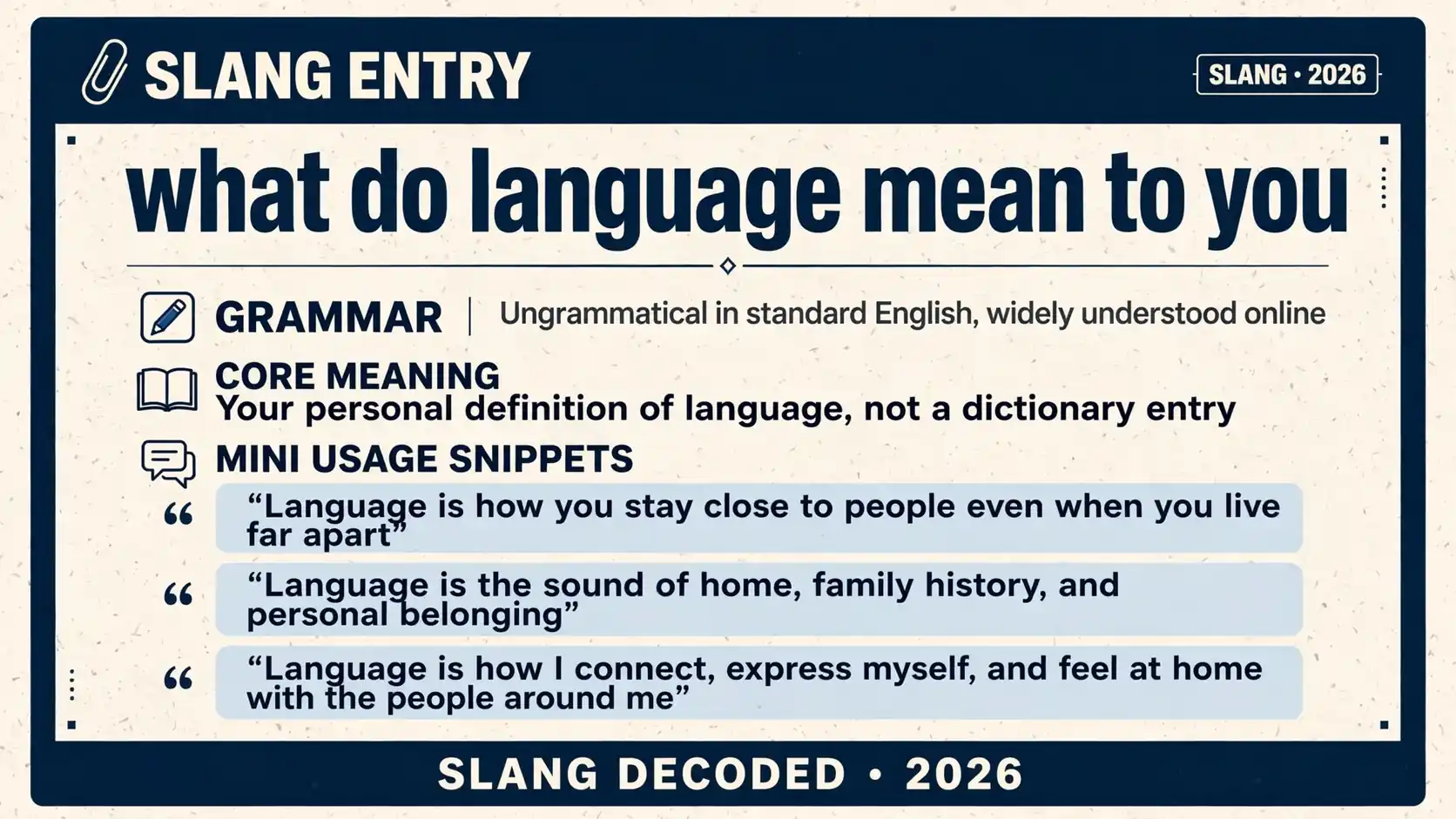
When someone asks what do language mean to you, they want your personal definition of language, not a dictionary entry. You are being asked to say what language does in your life, how it shapes the way you think, and why it matters to you in plain words.
That open style is why the question travels so well online and in class, and why a short answer can feel just as right as a long story. Your answer can be simple, honest, and still spark a real conversation.
What Do Language Mean to You at a Glance
Use this quick guide before you post or answer out loud, since it sums up the form and intent in one place.
| Point | Simple Take |
|---|---|
| Type | A personal prompt phrased as a direct question to one listener or reader |
| Core ask | Your own meaning for language, told through daily life and feeling |
| Grammar note | The wording is ungrammatical in standard English, yet widely understood online |
| Usual setting | Social posts, video captions, classroom warmups, and casual interviews |
| Typical answer length | One short sentence for a comment, or a few sentences for a longer post |
| Tone | Warm, curious, and open, with room for humor or serious reflection |
| Who asks it | Teachers, creators, interviewers, friends, and language learners |
| Who answers it | Anyone who uses language daily, which means almost every reader |
| Best reply style | Start with your own lived example, then name the bigger idea behind it |
How People Answer What Do Language Mean to You Online
Online answers tend to be short and personal, often rooted in family talk, music, texting, or learning a new tongue.
| Answer Type | What It Sounds Like |
|---|---|
| Connection answer | Language is how you stay close to people even when you live far apart |
| Identity answer | Language is the sound of home, family history, and personal belonging |
| Freedom answer | Language is a tool that lets you say what you think without holding back |
| Learning answer | Language is a skill you build slowly through mistakes and small wins |
| Emotion answer | Language is how you name feelings that would stay silent without words |
| Culture answer | Language carries jokes, stories, food talk, and shared memories forward |
| Work answer | Language is how you explain ideas, ask for help, and get things done |
| Play answer | Language is wordplay, slang, memes, and jokes shared with your circle |
| Hope answer | Language is a bridge that helps strangers understand each other better |
Where You Will See What Do Language Mean to You
You will meet this question where people trade short personal takes, since it needs no background knowledge at all.
- Short video captions that invite viewers to stitch, duet, or comment with a personal answer
- Classroom warmup slides that ask learners to reflect before a lesson on communication starts
- Language learning forums where beginners describe why they started studying a new tongue
- Interview clips where a host asks passersby for a quick, heartfelt take on words
- Social story prompts that turn a simple question into a chain of replies from friends
- Essay prompts that ask students to link language to identity, memory, or daily life
- Community posts where members share how a first tongue or second tongue shaped them
- Comment threads under videos about translation, accents, or cross cultural friendship
- Icebreaker games where each player gives a one line answer before the main activity begins
Grammar Notes for What Do Language Mean to You
Grammar is part of the story here, since readers still get the point right away despite the wording gap.
| Grammar Point | Plain Explanation |
|---|---|
| Subject and verb | Standard English would use does with language, not do, in this question form |
| Word order | The question puts do before language, which mirrors casual spoken question patterns |
| Missing article | A standard version might add the before language for a more formal sound |
| Singular subject | Language is singular here, so a formal verb form would match that singular subject |
| Learner pattern | The form matches a common pattern used by English learners worldwide |
| Informal acceptability | Online readers accept it because the meaning is clear despite the grammar gap |
| Formal rewriting | A formal rewrite would ask what language means to you in standard form |
| Keeping the original | Keep the original wording when you quote the prompt or tag the trend |
| Teaching value | Teachers can use the gap to spark a friendly talk about grammar and meaning |
What Do Language Mean to You in Classrooms and Language Learning
Teachers like this question because it lowers the pressure to be perfect, and any home dialect counts as valid ground.
| Classroom Use | Why Teachers Like It |
|---|---|
| Warmup prompt | It wakes up prior knowledge and gets every learner talking from minute one |
| Journal starter | It gives writers a personal hook before they tackle harder academic tasks |
| Pair discussion | It lets partners compare lives and notice how language differs by home |
| Vocabulary bridge | It links new words like communication and expression to lived experience |
| Speaking practice | It rewards fluency and ideas over perfect grammar in early speaking tasks |
| Reflection task | It asks learners to track how their view of language changes over time |
| Culture lesson | It opens a door to talk about accents, home speech, and respect |
| Assessment prompt | It can reveal understanding in a low stress way before formal testing |
| Homework question | It travels home well because family members can join the conversation too |
Similar Questions People Ask Instead
If you want the same energy with smoother grammar, these versions keep the personal focus while sounding more polished.
- What does language mean to you in your everyday life and in your closest relationships
- How would you describe language in your own words without using a dictionary definition
- What role does language play when you try to connect with people from other places
- When did you first notice that words could change how you felt about a moment
- How has learning a new tongue changed the way you see yourself and other people
- What is one memory where language helped you feel understood for the first time
- Why do you think humans rely on words even when gestures and images can help too
- How do you explain the power of language to someone who is just starting to learn it
- What would life feel like if you could not use words to share your thoughts
Tone and Intent Behind What Do Language Mean to You
Tone matters as much as wording, since the same question can feel playful online and serious in a classroom.
| Tone | What It Signals |
|---|---|
| Curious | The asker truly wants your view and is not testing you for a right answer |
| Playful | The asker invites jokes, slang, and light takes alongside deeper replies |
| Reflective | The asker wants a slower answer tied to memory, family, or personal growth |
| Supportive | The asker creates a safe space for learners and new speakers to share |
| Interview style | The asker wants a short, quotable take that fits a video or post format |
| Academic | The asker links the personal answer to bigger ideas about communication |
| Emotional | The asker expects feelings, stories, and honest moments rather than facts |
| Community building | The asker hopes replies will help readers feel less alone in learning |
| Exploratory | The asker treats language as an open topic with many valid answers |
How to Reply to What Do Language Mean to You in a Comment
A strong reply is specific, short, and true to your life, with no need for fancy terms to make it land.
| Reply Move | How to Do It |
|---|---|
| Start with one image | Name a kitchen table talk, a song, a text thread, or a classroom moment |
| Name the feeling | Say whether language feels like comfort, power, freedom, or belonging to you |
| Keep it short | Aim for one or two sentences so readers can grasp your point fast |
| Add one detail | Mention a person, place, or language that makes your answer feel real |
| Skip the lecture | Avoid a long definition and let your example carry the main idea |
| Invite a reply | End with a gentle nudge for others to share their own take too |
| Stay honest | Use your real voice even if your answer is simple or still forming |
| Match the tone | Mirror a playful thread with humor and a serious thread with care |
| Close with warmth | Leave readers with a line that feels open, kind, and easy to answer |
Why What Do Language Mean to You Hits Different in 2026
In 2026 much of your social life runs through captions, voice notes, and translated chats, so words crossing borders in seconds still carry local flavor.
If you like digging into phrases like this, you will also run into smush cute, lavender relationship, and fold meaning slang while scrolling slang guides, which shows why your own definition still matters most.
What Your Answer Says without Trying Too Hard
Your answer often reveals what you value most right now, whether family roots, learning and growth, or joy with friends.
Readers pick up on those cues fast, so a two sentence answer can feel richer than a long essay.
How to Use What Do Language Mean to You in a Post or Prompt
You can post the question as a caption, a story prompt, or a video opener, keeping the wording intact and adding your own answer first.
You can also use it as a classroom prompt, a journal heading, or an interview opener, giving people time to draw on a real memory.
The Shift from Textbook Definitions to Personal Ones
Textbooks once treated language mainly as rules, sounds, and sentence patterns, a view that can feel distant beside a phrase from home that still makes you smile.
Personal definitions flip that order, starting with talk, listening, laughter, and misunderstanding, then building toward the bigger idea.
Faqs About What Do Language Mean to You
Is what do language mean to you correct grammar?
No, standard English would use does instead of do, but the meaning stays clear to most online readers.
What is the best short answer to what do language mean to you?
Language is how I connect, express myself, and feel at home with the people around me.
Where did what do language mean to you come from?
It comes from casual online prompts and learner phrasing, where a personal question matters more than perfect grammar.
Can I use what do language mean to you in school work?
Yes for a prompt or quote, but use the standard form what does language mean to you for formal writing.
Why do people post what do language mean to you on social media?
People post it because it invites short, personal stories and sparks easy replies from a wide audience.