
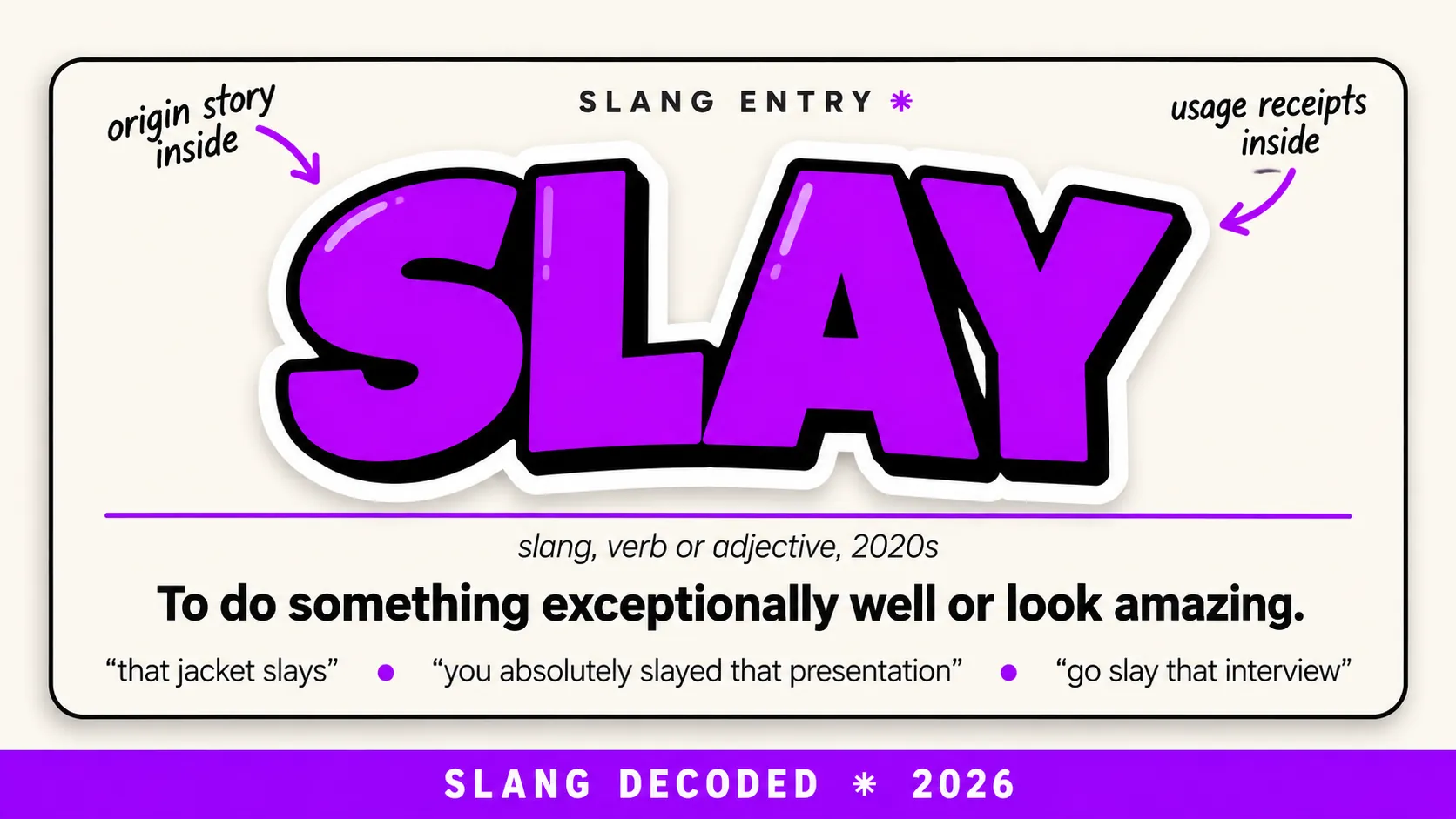
Slay means to do something exceptionally well, look incredible, or show so much confidence that people want to hype you up. If you’re wondering what does slay mean in slang, the fastest translation is usually killed it, nailed it, or looks amazing. On your feed, it can praise everything from an outfit to an exam result.
The word is much older than TikTok. Its modern praise-heavy meaning grew through Black and Latino queer ballroom culture, traveled through drag, music, stan culture, and social media, then became a flexible everyday reaction.
From Literal Killing to Ballroom-Level Excellence
| Period | What happened |
|---|---|
| Old English | The original verb referred to striking or killing someone or something. |
| 1800s | Figurative uses started appearing around overwhelming, impressing, or affecting someone strongly. |
| 1920s | You slay me could mean you make me laugh extremely hard. |
| 1970s | Black and Latino LGBTQ+ communities helped reshape the word around style, performance, and excellence. |
| 1980s | Ballroom culture strengthened the idea of slaying a look, category, attitude, or performance. |
| 1990 | Paris Is Burning exposed wider audiences to ballroom language and culture. |
| 2009 onward | RuPaul’s Drag Race carried drag and ballroom-influenced vocabulary to huge television audiences. |
| 2010s | Stan Twitter, pop fandoms, fashion spaces, and reaction culture pushed slay further online. |
| 2016 | Beyoncé’s Formation gave the term another major mainstream pop-culture boost. |
| 2020s | TikTok turned slay into an ultra-flexible reaction meaning excellent, yes, iconic, impressive, or keep going. |
The important part is that TikTok did not invent slay. Social media accelerated a meaning that already had decades of cultural history behind it.
What Does Slay Mean in Slang Across Real Conversations?
| Situation | What slay communicates | Mini example |
|---|---|---|
| Great outfit | You look amazing | that jacket slays |
| Strong performance | You crushed it | she slayed that set |
| Good makeup | The look came together perfectly | okay eyeliner slay |
| Big achievement | You did extremely well | slayyy you passed |
| Confident entrance | Your energy is landing | she walked in and slayed |
| Friend encouragement | Go succeed | go slay that interview |
| Agreement | I approve | slay honestly |
| Impressive photo | The whole image works | this pic absolutely slays |
| Funny exaggeration | Random enthusiastic approval | grocery shopping? slay |
| Ironic reaction | That’s funny or absurdly ordinary | answering one email today slay |
That last use matters in 2026. Slay does not always mean somebody accomplished something extraordinary. Sometimes the joke is that you’re giving dramatic praise to something aggressively normal.
Where Slay Lives on Your Feed
| Platform | How slay usually shows up | Vibe |
|---|---|---|
| TikTok | Comments under outfits, edits, transformations, performances, and jokes | Fast, exaggerated, playful |
| Compliments under photos, fashion posts, makeup, trips, and celebrity looks | Stylish and supportive | |
| X | Pop-culture reactions, stan posts, memes, ironic commentary | Dramatic or sarcastic |
| Group chats | Encouragement, celebration, quick approval | Casual and affectionate |
| Snapchat | Reaction to selfies, outfits, plans, and updates | Short and friendly |
| YouTube | Comments praising performances, transformations, or creators | Enthusiastic |
| Discord | Reaction word inside casual community chats | Meme-heavy |
| Gaming chats | Praise after a strong play or successful moment | Playful crossover usage |
| Workplace chats | Occasionally used jokingly among casual teams | Context-dependent |
| Spoken conversation | A punchy compliment or deliberately dramatic response | Depends heavily on delivery |
TikTok helped make the shortest version especially common. You can upload an outfit video and get nothing but slay, slayyyy, or SLAY in the comments. The lack of detail is part of the point.
A Slay Sighting Scrapbook
slayyy this outfit is everything
Where it appears: TikTok comment Context: Someone is praising a fashion or getting-ready video with deliberately stretched spelling for extra enthusiasm.
okay slay you got the job
Where it appears: group chat Context: A friend celebrates somebody’s good news without needing a long congratulatory message.
you absolutely slayed that presentation
Where it appears: work chat Context: The word shifts from fashion into performance and means you handled the presentation extremely well.
new hair is a slay
Where it appears: Instagram comment Context: Slay works almost like a noun here, meaning the result is a clear success.
go slay that exam
Where it appears: text message Context: The speaker is using it as encouragement before something happens rather than praise afterward.
she came onstage and SLAYED
Where it appears: fan post Context: Capital letters intensify praise for a singer, dancer, drag performer, or other entertainer.
making pasta tonight, slay
Where it appears: group chat Context: Nothing spectacular happened. The humor comes from giving a normal activity celebrity-level approval.
not the spreadsheet slaying harder than me
Where it appears: workplace meme Context: The speaker intentionally overuses the word for comic contrast.
wait this actually slays
Where it appears: comment section Context: The person expected something mediocre but ended up genuinely impressed.
The Tone Changes Faster than the Definition
| Situation | Likely tone | How it lands |
|---|---|---|
| Friend posts a great outfit | Sincere praise | Very natural |
| Singer nails a performance | Excited admiration | Natural |
| Friend announces good news | Celebration | Natural |
| Someone is nervous before an event | Encouragement | Supportive |
| Ordinary task gets called slay | Playful exaggeration | Usually humorous |
| Weak idea gets slay in response | Possible sarcasm | Depends on relationship |
| Boss says slay in formal email | Forced or comedic | Risky |
| Stranger uses slay after bad news | Tone mismatch | Awkward |
| Fashion critique says it doesn’t slay | Negative evaluation | Casual but blunt |
| Friend says slay with flat delivery | Ironic approval | Tone does most of the work |
The word usually carries positive energy, but delivery can flip it completely. A bright slayyy and a deadpan slay can communicate two different reactions even though the spelling barely changed.
Who Uses Slay Now and How
| Group | Typical usage |
|---|---|
| LGBTQ+ communities | Praise around style, performance, confidence, humor, and identity, with deeper historical familiarity in some spaces |
| Gen Z | General-purpose approval in texts, comments, jokes, and everyday speech |
| Younger millennials | Often connected to drag, stan culture, pop fandoms, and internet humor |
| Pop music fans | Used when a performer delivers a strong song, visual, tour look, or stage moment |
| Fashion communities | Praise for outfits, styling, makeup, hair, and presentation |
| Beauty creators | Reaction to transformations, makeup results, and tutorials |
| Meme communities | Intentionally excessive praise for mundane situations |
| Friends | Quick encouragement such as go slay or slay queen |
| Brands | Used in marketing to sound youthful, sometimes successfully and sometimes awkwardly |
| Older speakers online | Often adopted through younger relatives, TikTok, memes, or workplace internet culture |
Calling slay purely Gen Z slang misses some history. Gen Z helped make it massively visible online, but younger users inherited a word already circulating through Black queer and ballroom culture, drag, AAVE-influenced speech, pop fandoms, and earlier internet communities.
Slay, Ate, Served, and the Words Around It
| Term | How it differs from slay |
|---|---|
| ate | Usually says somebody performed extremely well and left little room for criticism |
| served | Often highlights what someone presented, especially a look, attitude, or performance |
| iconic | Praises something as memorable or culturally striking |
| fierce | Focuses more on bold style, confidence, or attitude |
| killed it | One of the closest mainstream equivalents to slayed |
| nailed it | More focused on executing a specific task correctly |
| snapped | Suggests somebody suddenly delivered an impressive performance or result |
| cooked | Depending on context, can mean performed well or created something impressive |
| mother | In stan and queer-influenced spaces, praises a woman or performer with commanding status or presence |
| werk | Encouraging praise closely associated with drag and queer culture |
Slay overlaps with all of these, but it is unusually flexible. You can slay an outfit, slay an interview, tell somebody to slay, call something a slay, or simply reply slay with no additional explanation.
When Slay Is Praise and When It Isn’t
| Usage | Actual message | Example |
|---|---|---|
| Direct compliment | You look excellent | you are slaying that dress |
| Performance praise | You did incredibly well | he slayed that solo |
| Encouragement | Go do your best | slay that interview |
| Celebration | Great news | you got accepted? slay |
| Agreement | I like that idea | movie tonight? slay |
| General approval | That’s good | honestly this slays |
| Hyperbole | I’m making this sound bigger for fun | cleaned my room, absolute slay |
| Sarcasm | That was not impressive | missing the bus again, slay |
| Critical negative | Something failed to impress | the second outfit doesn’t slay |
| Self-hype | I’m feeling confident | about to go slay |
The safest default interpretation is positive. If somebody comments slay under your picture, they are almost certainly complimenting you unless the surrounding conversation clearly signals sarcasm.
Another Round of Slay in the Wild
wait you made this yourself? slay
Where it appears: Instagram comment Context: Genuine admiration after learning that somebody created an outfit, artwork, meal, or project personally.
slay queen go get that degree
Where it appears: graduation caption comment Context: Celebration combines slay with queen, another praise-heavy form common in queer and internet language.
this transition absolutely slayed
Where it appears: TikTok edit comment Context: The viewer is specifically praising technical execution rather than someone’s appearance.
okayyyy slay
Where it appears: voice note Context: The stretched okay adds excitement before the compliment even arrives.
the makeup is slaying today
Where it appears: selfie caption Context: Someone uses slay to hype their own appearance without necessarily sounding arrogant because the phrase is deliberately playful.
you better slay tonight
Where it appears: friend text Context: It means go out there and impress everyone, not an actual warning or command.
why does this presentation kind of slay
Where it appears: group chat Context: Kind of creates comic understatement while slay provides the exaggerated praise.
she didn’t just perform, she slayed
Where it appears: fan discussion Context: Slayed upgrades a basic successful performance into something memorable.
another meeting at 8 a.m. slay
Where it appears: office chat Context: Clearly sarcastic. Nobody is genuinely celebrating the early meeting.
Ballroom Culture Gave Slay Its Modern Swagger
The literal verb has been around for centuries, and older figurative uses such as you slay me existed long before social media. But the modern style-heavy meaning did not suddenly appear when teenagers downloaded TikTok.
Black and Latino queer ballroom communities in New York used slaying around performance, presentation, confidence, fashion, and winning a room. In that environment, looking good was only part of it. Slaying carried the energy of delivering so completely that everyone watching understood the impact.
The 1990 documentary Paris Is Burning exposed wider audiences to ballroom culture. Later, drag culture and RuPaul’s Drag Race helped words associated with these spaces move into broader entertainment and online conversation.
That history matters because calling slay a random TikTok invention erases the communities that were already using and developing this kind of language decades before algorithmic feeds existed.
Beyoncé, Stan Twitter, and Tiktok Made Slay Massive
By the 2010s, slay was moving through pop fandom, fashion commentary, queer internet spaces, and stan Twitter. Fans could say an artist slayed a performance, a magazine shoot slayed, or a new look was about to slay before it even appeared.
Beyoncé’s 2016 Formation became a huge crossover moment. Her repeated use of slay placed an already established term inside one of the decade’s biggest pop-cultural releases, helping even more mainstream audiences recognize its praise-heavy meaning.
TikTok then accelerated the next shift. Instead of requiring an incredible outfit or performance, slay became usable as a tiny reaction to practically anything positive.
That’s why you now see someone respond slay to dinner plans, a haircut, a successful driver’s test, a new apartment, an absurd meme, or somebody announcing that they finally answered their emails.
Why Slay Can Sound Sincere or Completely Ironic
The funniest thing about modern slay is how little excellence it sometimes requires. You can tell a friend slay after they win an award, but you can also say slay because they remembered to buy toothpaste.
That exaggerated range is part of internet speech. A dramatic compliment applied to a tiny event creates humor. When somebody texts cleaned my kitchen, you might reply slay domestic legend without literally believing a historic achievement occurred.
Sarcasm works the same way. If your friend says their flight was delayed six hours and follows it with slay, they clearly mean the opposite. The positive word highlights how annoying the situation actually is.
So context beats the dictionary definition. Look at what happened, your relationship with the speaker, capitalization, stretched spellings like slayyyy, emojis, and whether the situation deserves celebration in the first place.
Slay Has Become a Reaction, Verb, Noun, and Pep Talk
Slay started as a verb, and grammatically it still behaves like one in sentences such as you slayed that performance. Internet culture has made it much more flexible.
You can call an outfit a slay, answer good news with just slay, describe somebody as slaying, or send a friend into an interview with go slay. The word can judge the result, cheer on the attempt, or simply signal your approval.
You’ll also see spellings such as slayyy and slaaay. Those extra letters usually increase excitement, friendliness, or deliberate theatricality. They do not create a separate meaning.
That flexibility explains its staying power. Plenty of viral slang depends on one meme or format. Slay survived multiple generations of internet culture because you can plug it into almost any situation where confidence, approval, performance, or playful enthusiasm is the vibe.
Faqs About Slay Slang
Does slay mean someone looks attractive?
Yes, it can mean someone looks amazing, stylish, confident, or especially well put together.
Is slay always a compliment?
Usually, but sarcastic delivery can make slay mean the exact opposite.
What does slay mean when someone texts only slay?
It usually means yes, nice, love that, good job, or keep doing what you’re doing.
Did slay come from TikTok?
No, its modern praise meaning has much older roots in Black and Latino queer ballroom culture before TikTok popularized it with wider audiences.
What is the difference between slay and ate?
Both praise strong execution, but ate usually emphasizes an especially impressive result, while slay can also work as encouragement, agreement, or a general reaction.